Denmark’s export of Aluminium scrap during 2018-20 displays gradual downfall
The economy of Denmark is a modern mixed economy with comfortable living standards, a high level of government services and transfers, and a high dependence on foreign trade. As a small open economy, Denmark generally advocates a liberal trade policy, and its exports, as well as imports, make up circa 50% of GDP. According to the updated IMF forecasts from 14th April 2020, due to the outbreak of the COVID-19, GDP growth is expected to fall to -6.5% in 2020 and pick up to 6% in 2021, subject to the post-pandemic global economic recovery.
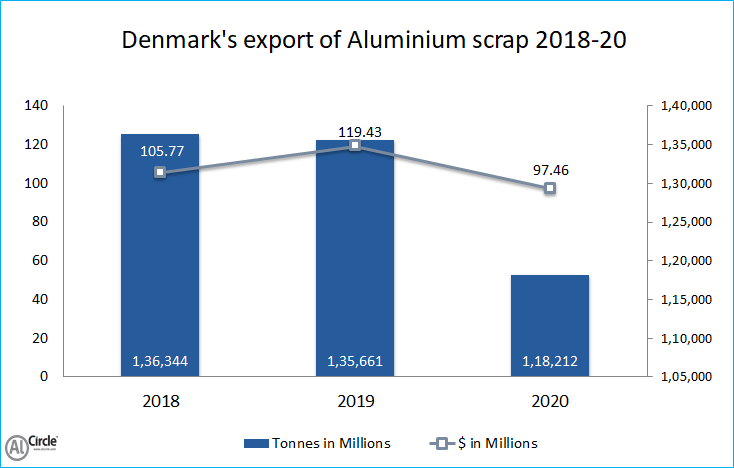
The Scandinavian nation’s aluminium scrap export during 2018-19 has been recorded at 272,005 tonnes and the revenue generated from the export remained at $225.20 million. The export for 2020 is expected to reach at 118,212 tonnes and earnings to stand at $97.46 million; when the export volume and earnings of the existing two years get added, it denotes 390,217 tonnes and $322.66 million respectively.
In 2018, Denmark’s export of aluminium scrap stood at 136,344 tonnes and foreign revenue earning remained at $105.77 tonnes, whereas in 2019 the export exhibited with the marginal downfall of 0.50%, as the export volume dropped to 135,661 tonnes, while earnings rose by 12.91% and stood at $119.43 million.
The export for 2020 has been analysed with de-growth by 12.86%, as the export volume is expected to dip and remain at 118,212 tonnes and earnings also to drop at $97.46 million.
Denmark’s major trading destination for exportation of aluminium scrap are Albania, Austria, Belgium, China, Czech Rep., France, Germany, Hong Kong, Hungary, India, Luxembourg, Italy, etc.
Panama’s export of Aluminium scrap reveals significant growth during 2017-20
Next articleDutch designer Richard Hutten melts down Amsterdam Schiphol airport’s old chairs for ‘sweeping’ new seating system, starts with aluminium frame recycling
Grow with
AL Circle