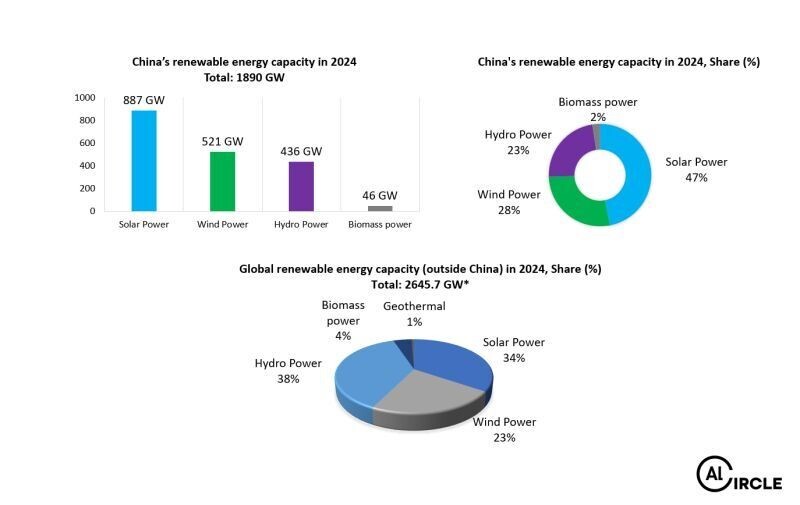
China continues to spearhead the global transition to renewable energy, achieving remarkable progress in 2024 with an addition of 277 GW of solar and 79 GW of wind capacity — outpacing many other nations.
These new additions elevated China's total renewable energy capacity (except hydro power) to 1,407 GW, signaling a steady shift towards renewables, with solar power alone contributing 886 GW and wind power accounting for nearly 521 GW. By the end of 2024, China's renewable energy capacity accounted for 15% of the world's total installed capacity for the year alone.
The rest of the world added 193 GW of solar photovoltaic capacity in 2024, with the United States contributing 163 GW and India 91 GW. Germany, Japan, Brazil, and Spain followed with additions of 91 GW, 77 GW, 51 GW, and 42 GW, respectively.
With this year’s growth, renewable energy now makes up over 56 per cent of China's total installed power capacity. However, thermal power generation remains heavily reliant on coal, with 82 per cent contribution, followed by natural gas accounting for 10 per cent and other thermal power (e.g. residual fuel) 8 per cent.
China vs Rest of the world
According to the International Energy Agency, China is expected to install 3,207 GW of new renewable energy capacity over 2024-2030, more than triple the growth recorded during 2017-2023. Since 2015, China’s share in global annual capacity additions has been increasing and is expected to reach to a contribution of 60 per cent by 2030. It is projected that China will have at least half of the world’s cumulative renewable energy capacity, aligned with its commitment to achieving net-zero emissions by 2060.
After China, the United States recorded the second-largest renewable energy capacity addition in 2024, driven by record installations of solar and battery storage, although wind energy growth plateaued. The addition of solar capacity was 39.6 GW, bringing the cumulative solar capacity to 220 GW, alongside 29 GW of battery storage — with a projected 45% growth in storage capacity for 2025.
But the projected data from the International Energy Agency suggests the European Union will surpass the United States in renewable energy growth between 2024 and 2030, with anticipated capacity additions of 551.8 GW compared to 497.9 GW in the US.
Why China falls short in low-carbon aluminium production?
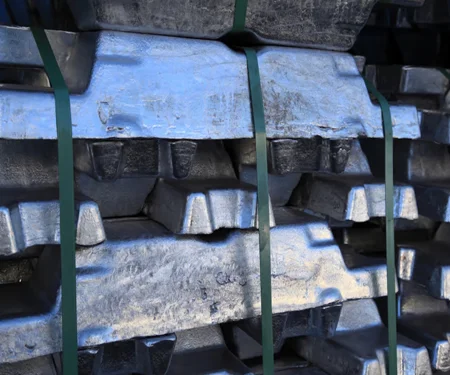
Now, the question arises that despite the consistent increase in China’s renewable energy capacity every year, why does the country’s low-carbon aluminium production remain lower than in many other regions? A key reason lies in the limited capacity of hydropower, the primary renewable energy source used for aluminium smelting. By the end of 2024, China's hydropower capacity stood at approximately 436 GW, significantly lower than the solar and wind capacity. Yunnan province is the one of the major regions in China where hydropower is abundantly available, thanks to sufficient rainfall, and where there is a presence of aluminium smelters. But the drawback is the region faces extreme weather patterns, with periods of excessive rainfall causing floods or drought conditions reducing water supply, leading to frequent fluctuations in hydropower output and thus affecting the metal production. For instance, in 2024, drought conditions in Yunnan resulted in an estimated reduction of 400,000 tonnes in aluminium smelting capacity. So to say, erratic rainfall is one of the primary challenges hindering green aluminium production.
Year ago, China Hongqiao Group and a few more coal-reliant smelters shifted their combined 6.56 million tonnes of aluminium capacity to Yunnan, lured by cheap hydropower availability. But alas! The move did not yield the expected benefits. Due to erratic rainfall patterns, only a little over half of the planned aluminium capacity shift could be realised, turning what seemed like a strategic opportunity into a costly gamble.
Information sources: S&P Global, International Energy Agency, Reuters