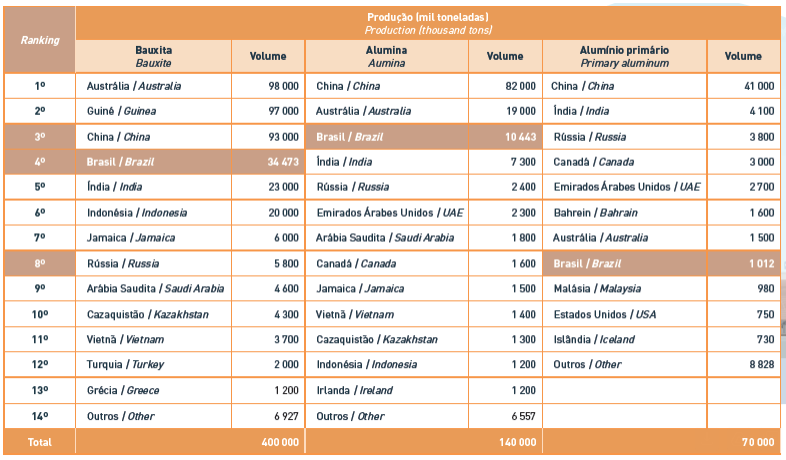
Brazil has reclaimed its position as a top ten player in the global aluminium industry, ramping up the production of primary aluminium and raw materials. Once, the country, which used to be the world's sixth largest aluminium producer, lost its momentum for an interim period and ranked 12th in 2022. However, in the subsequent year, Brazil's aluminium industry showed resurgence through advanced strategies and transformative initiatives in operations.
Overview and analysis of primary aluminium production
From the start of 2023, the Brazilian aluminium industry has been steadfast in raising domestic production with a strong focus on reducing reliance on imported products. The country successfully increased its primary aluminium production by 26 per cent to 1,021.7 thousand tonnes versus 810.9 thousand tonnes in 2022. With this production hike, Brazil may not have regained its sixth position among the top ten global producers, but it ranked up to 8th from 12th.
The increase in Brazil's primary aluminium production in 2023 was the sole result of the resumption of the Alumar smelter, jointly owned by Alcoa and Sounth32. After remaining idle for seven years, the smelter recommenced with renovated potlines having an annual installed capacity of 1.4 million tonnes.
Janaina Donas, executive president of ABAL (Brazilian Aluminum Association), explained: "2023 was a year of accommodations in the national and international scenario and it marks the end of a moderately weak cycle for the Brazilian aluminium industry. The escalation of geopolitical conflicts prolonged the negative effects of the deterioration of economic indicators initiated during the pandemic, resulting in an increase in global interest rates. Even in the face of a challenging scenario, Brazilian production of primary aluminium expanded 26% compared to 2022, reaching more than 1 million tons, which adds up to a volume of 850 thousand tons of recycled metal."
 Source: Brazilian Aluminum Association
The total investment made in the aluminium sector in Brazil in 2023 was US$1.1 billion, and the revenue earned was US$27 billion. This volume of investment reaffirms entrepreneurs' confidence in the direction of the Brazilian industry and economy, which also reflected in the increase of more than 10,500 jobs in 2023.
Brazil's primary aluminium production in 2023 ranked after China (41000 thousand tonnes), India (4100 thousand tonnes), Russia (3800 thousand tonnes), Canada (3000 thousand tonnes), United Arab Emirates (2700 thousand tonnes), Bahrain (1600 thousand tonnes), and Australia (1500 thousand tonnes).
Delving into raw material production
Brazilian bauxite production also increased last year by about 0.8 per cent to reach 34,472.6 thousand tonnes, compared to the previous year's output of 34,215.2 thousand tonnes. In contrast, domestic consumption of the mineral decreased by 3.4 per cent from 29,580.7 thousand tonnes in 2022 to 28,560.9 thousand tonnes in 2023. Of the total consumption, 26,536.9 thousand tonnes were destined for alumina production, down by 3 per cent Y-o-Y. On the other hand, exports increased by 12.4 per cent, standing at 4,731.9 thousand tonnes. The primary destinations were Canada, which accounted for 44.1 per cent of Brazil's bauxite exports; China, accounting for 32.3 per cent; Greece, 10.6 per cent; and Ireland, 10.4 per cent.
The lower consumption of bauxite by domestic alumina refineries was due to the dip in production by 3.9 per cent in 2023, reaching 10,443.4 thousand tonnes. Unlike bauxite, domestic consumption of alumina grew, thanks to increased primary metal production, by 6.2 per cent to 1.834.6 thousand tonnes. Exports, on the other hand, decreased by 9 per cent to 8,642.9 thousand tonnes. Canada (41.1 per cent), Norway (25.7 per cent, and the United States (15.6 per cent) were the main destinations.
Consumption pattern across the Brazilian aluminium industry
Going down to consumption details, the packaging sector was the largest consumer of processed aluminium products, absorbing 561 thousand tonnes, which was 38 per cent of the total. However, the volume of aluminium consumption in the packaging sector decreased by about 8.6 per cent Y-o-Y, in an environment of greater competition with other metals.
The transportation sector was the second-largest consumer, with the volume of 275 thousand tonnes, down by 2.4 per cent from the previous year due to sluggish export orders and difficulties faced by the light vehicle industry in recovering 2019 production levels.
The biggest decline in aluminium consumption was seen in the Machinery and Equipment industry, down by 14.1 per cent, totalling 35.8 thousand tonnes, as a result of the lack of investment in the specific industry. In contrast, the Civil Construction segment showed an increase of 6.6 per cent last year, reaching 159.8 thousand tonnes, driven by the sharp expansion of real estate.






















