您想继续阅读英文文章还
是切换到中文?
是切换到中文?

THINK ALUMINIUM THINK AL CIRCLE

The COVID-19 pandemic in Bolivia appeared amid an economic and political crisis as a result of the failed presidential elections of October 2019. Although timely measures were adopted to face the pandemic at the beginning of the outbreak and that, in effect, it did slow down the initial increase of the epidemiological curve, later it became impossible to stop the exponential growth of cases and finally, the health care system collapsed exposing its deficient structure. The lockdown paralyzed activities and many people lost their jobs; livelihoods were partially or destroyed which resulted in a loss of income for many. The economy faced a supply shock followed by a demand shock because the level of household consumption dropped. The government has now started to re-open the economy and has provided the financial system with funds for loans needed to boost the domestic demand.
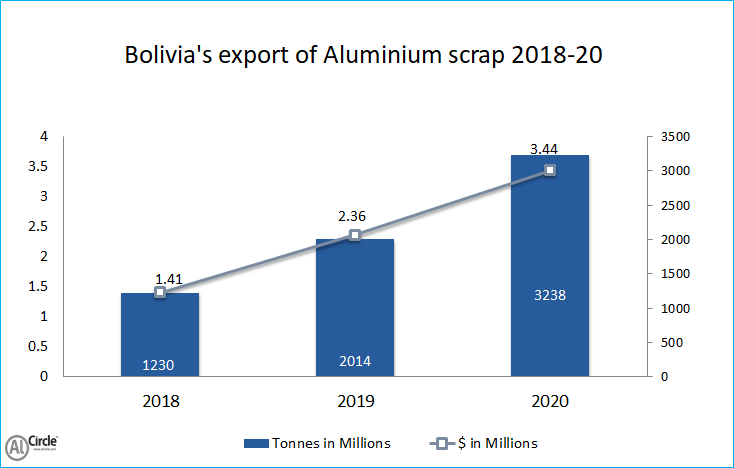
The Central South American nation’s export of aluminium scrap during 2018-19 records 3244 tonnes and the earnings gathered remained at $3.77 million. The export for 2020 is highlighted with 3238 tonnes, the highest in the three years and the earnings to stand at $3.44 million. However, when the export volume and expenditure for 2020 get footed with the previous two years, it unfolds 6482 tonnes and $7.21 million respectively.
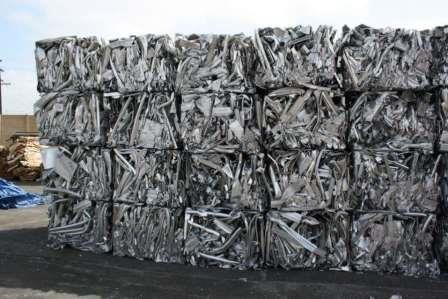
Bolivia’s export of aluminium scrap in 2018 stood at 1230 tonnes only and the earnings remained at $1.41 million, whereas, in 2019 the export saw growth by 63.73%, as the export volume rose to 2014 tonnes and the revenue earnings remained at $2.36 million.
The export for 2020 also marked growth by 60.77%, as the export volume grew to 3238 tonnes and earnings also climbed to $3.44 million.

The major trading destinations for Bolivia’s export of aluminium scrap are USA, Austria, Brazil, Mexico, South Korea, etc.
Responses