Belgium’s aluminium household articles import during 2018-20 exemplifies demand surge with marginal drop; 52% upturn estimated for 2021
The aspect of aluminium is the rationale it is used frequently in household articles. The metal aluminium is gradually replacing plastic and steel articles, as it is stronger and tougher than plastic and lighter than steel. Furthermore, aluminium allows heat to disperse quickly, keeping articles from overheating.
Belgium’s well developed free-market economy is founded on both industrial and service sectors, despite its small size it has consistently ranked among the top 20 economies of the world and stands strong.
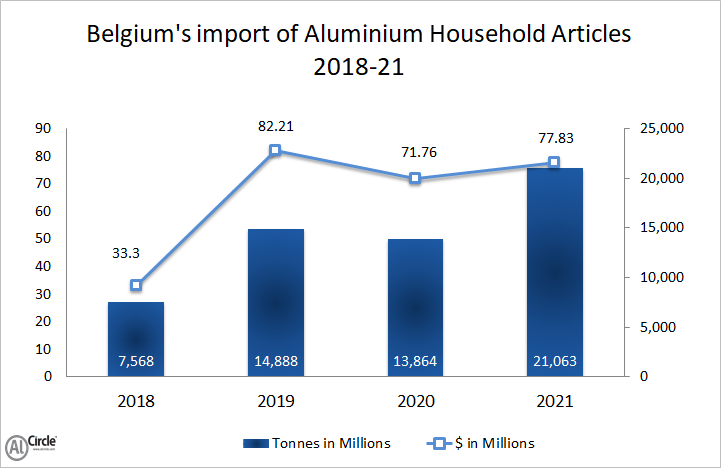
The country home to NATO headquarters, Belgium imported 36,320 tonnes of aluminium household articles during 2018-20, which drove revenue expenditure for import of around $187.27 million.
The Western European nation in 2018 imported 7568 tonnes of aluminium household articles with expenditure accounted to $33.30 million, whereas, in 2019, the import exemplified robust demand growth by 96.72%, as the import volume escalated to 14,888 tonnes and the expenditure climbed to $82.21 million.
In 2020, the import reflected a downfall by 6.87%, as the demand for the import of aluminium household articles dropped to 13,864 tonnes during the Covid-19 lockdown phase, keeping down the expenditure to $71.76 million.
Belgium’s import of aluminium household articles in 2021 is analysed with a hefty upturn of 51.92%, as the import volume is expected to reach 21,063 tonnes, again forcing the expenditure to stand at $77.83 million.

The major trading destination for the importation of the household articles is Albania, Algeria, Czech Rep., Denmark, China, France, Germany, Hungary, India, Italy, Netherlands, Poland, Spain, UK, etc.
MGI acquires 35-year-old aluminium fenestration firm ‘Barton Windows’
Next articleReynaers Aluminium excels with the glory of Al Khobar skyline project ‘Ajdan Rise’
Grow with
AL Circle