Ball Corporation exited fiscal 2025 as a structurally leaner aluminium packaging company, delivering double-digit revenue growth, region-wide volume expansion and record free cash flow, while headline earnings declined from an aerospace-inflated 2024 base. The year marked a reset in Ball’s earnings quality, balance-sheet profile and capital allocation framework.
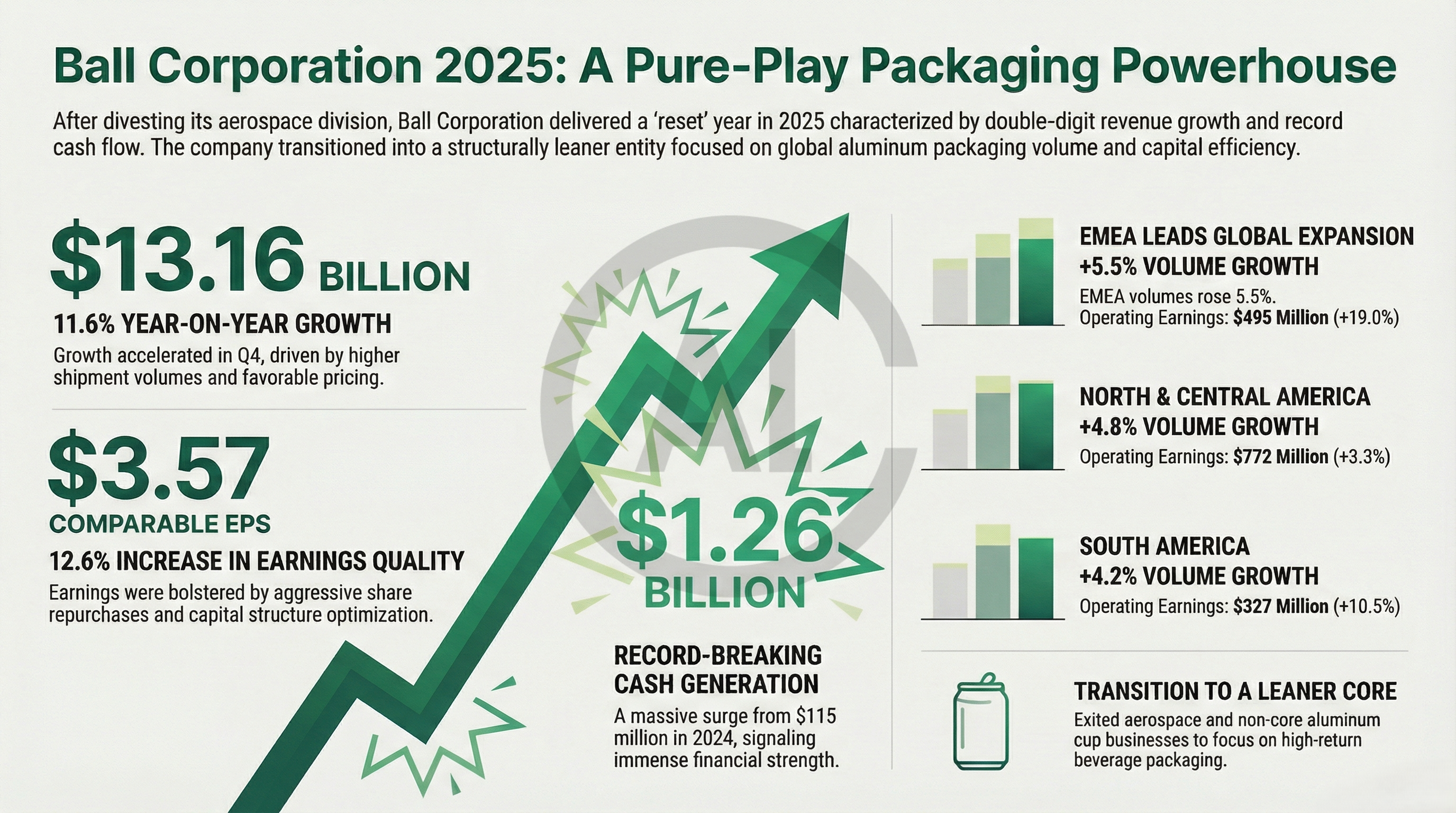
On a US GAAP basis, full-year 2025 net sales rose 11.6 per cent year-on-year to USD 13.16 billion, compared with USD 11.80 billion in 2024. Growth accelerated into the year’s close, with fourth-quarter revenue increasing 16.3 per cent Y-o-Y to USD 3.35 billion, reflecting higher shipment volumes and favourable price/mix across regions.
Earnings optics distort Y-o-Y comparison
Reported net earnings attributable to Ball Corporation fell sharply to USD 912 million, or USD 3.30 per diluted share, from USD 4.01 billion, or USD 13.00 per share, in 2024. The 77 per cent Y-o-Y contraction was almost entirely mechanical, driven by the absence of the USD 4.61 billion pre-tax gain recorded in 2024 following the divestiture of Ball’s aerospace business, which was classified as discontinued operations.
Quarterly performance highlighted the underlying stabilisation, wherein the global aluminium packaging business reported Q4 2025 net income of USD 200 million, versus a USD 32 million net loss in Q4 2024, when results were weighed down by impairment charges linked to the aluminium cups business. The swing back to profitability underscores the cleaner earnings base established post-portfolio rationalisation.
For the global aluminium value-chain 2026 outlook, book our exclusive report “Global ALuminium Industry Outlook 2026"
Comparable earnings show operating resilience
On a comparable, non-GAAP basis, Ball, the company known for its beverage can manufacturing, delivered full-year 2025 comparable net earnings of USD 985 million, up marginally from USD 977 million in 2024. More tellingly, comparable diluted EPS rose 12.6 per cent Y-o-Y to USD 3.57, supported by share repurchases that reduced the diluted share count to 276 million from 308 million a year earlier.
Fourth-quarter comparable net earnings edged lower to USD 243 million from USD 250 million, but comparable EPS increased to USD 0.91 from USD 0.84, reinforcing the earnings accretion achieved through capital structure optimisation rather than margin dilution.
Regional performance: EMEA drives margin expansion
In beverage packaging, North and Central America, full-year comparable operating earnings increased to USD 772 million on sales of USD 6.29 billion, compared with USD 747 million on USD 5.62 billion in 2024. The segment benefited from higher volumes and contractual aluminium cost pass-throughs to subsequent consumers, although margin expansion remained constrained by higher operating costs.
Fourth-quarter volumes rose at a high-single-digit rate, lifting full-year volume growth to 4.8 per cent.
Beverage packaging, EMEA’s comparable operating earnings rose 19 per cent Y-o-Y to USD 495 million, while sales increased to USD 3.98 billion from USD 3.47 billion. The earnings growth materially outpaced revenue growth, indicating positive operating leverage driven by volume recovery, favourable price/mix and currency translation. Full-year volumes expanded 5.5 per cent, and fourth-quarter operating earnings surged to USD 123 million from USD 90 million a year earlier .
The acquisition of an 80 per cent stake in Benepack for approximately EUR 184 million strengthens Ball’s European footprint and positions the region for continued margin accretion, particularly in premium beverage can formats.
In Beverage Packaging, South America, comparable operating earnings rose 10.5 per cent Y-o-Y to USD 327 million, supported by 4.2 per cent volume growth and favourable price/mix. Fourth-quarter earnings remained flat at USD 127 million, suggesting cost inflation limited incremental margin capture despite higher revenues.
Margins stabilise as operating leverage improves
At a consolidated level, comparable operating earnings increased to USD 1.55 billion in 2025 from USD 1.47 billion in 2024, while comparable EBITDA reached USD 2.04 billion. EBITDA margin stability, despite higher aluminium and operating costs, reflects Ball’s ability to pass through input costs contractually and extract scale efficiencies, particularly in EMEA.
Selling, general and administrative expenses declined to USD 566 million from USD 647 million, reinforcing Ball Corporation’s management’s focus on cost discipline following the aerospace exit.
Don't miss out- Buyers are looking for your products on our B2B platform
Cash flow and leverage define the year
Cash generation was the most decisive signal of financial strength. Operating cash flow surged to USD 1.26 billion from USD 115 million in 2024, a swing driven by the absence of aerospace disposal distortions and improved working capital control. Adjusted free cash flow reached a record USD 956 million, after accounting for aerospace-related tax payments.
Ball returned USD 1.54 billion to shareholders via dividends and share repurchases, exceeding adjusted free cash flow and signalling confidence in balance-sheet capacity. Capital expenditure was held at USD 474 million, below depreciation and amortisation of USD 622 million, enhancing cash conversion.
Net debt closed the year at USD 5.8 billion, with net debt to comparable EBITDA at 2.84x and interest coverage at 6.5x. These metrics place Ball firmly within investment-grade tolerance, providing headroom for selective capacity expansion or bolt-on acquisitions without compromising shareholder returns.
During 2025, Ball deconsolidated the aluminium cups business and reduced its stake in Ball United Arab Can Manufacturing Company to 10 per cent, receiving USD 74 million in cash. These moves lowered earnings volatility and capital intensity, aligning the portfolio more closely with high-return beverage packaging assets.