Ashapura rises as the dominant mineral platform in the midst of the global bauxite tussle
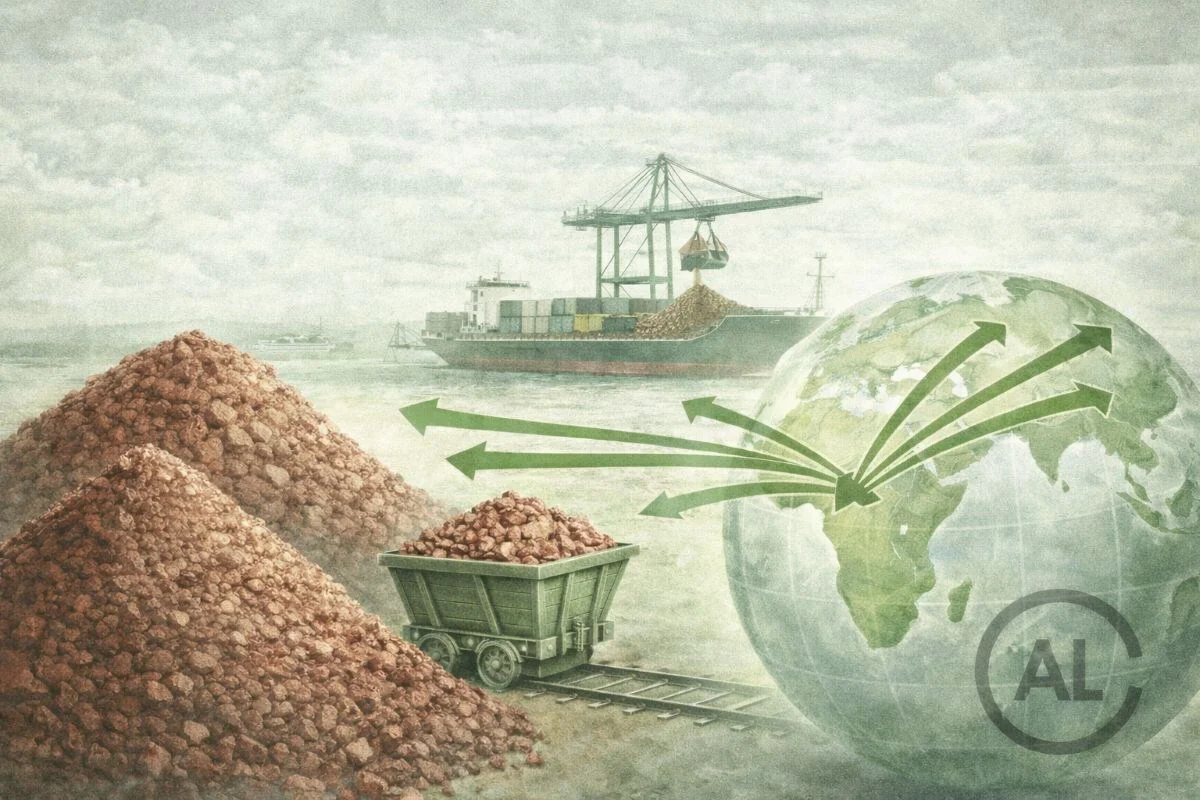
Ashapura Minechem of India is capitalising on a structural shift in global aluminium supply as bauxite is moving to the centre. With its operational base in Guinea, the company exported 3.38 million tonnes of bauxite in H1 FY26, almost meeting the full FY25 volume. With captive port capacity set to expand to 27 million tonnes by FY27, and plans to lift exports to 15 million tonnes by FY28, it is expected to dominate mining and market. H1 FY26 revenue rising by 75 and net profit up 136 per cent, Ashapura emerges as a profitable bauxite supplier amid global market constraints.
Explore- Most accurate data to drive business decisions with Outlook 2026 insights across the value chain
Ashapura evolves into a distinct mineral base
Founded in 1982, Ashapura started as a bentonite-focused company and later on evolved into a diversified, integrated industrial minerals platform spanning mining, manufacturing, and trading. Its product mix includes bleaching clay, kaolin, silica, iron ore and bauxite.
It balances both volume-driven and value-added applications, catering to a customer base spanning across sectors like paints, cement, fibreglass, oil and gas, and edible oil refining, and civil engineering.
Bauxite makes Guinea the centre of Ashapura’s strategic expansion
Although bauxite contributes a small 7 per cent share of revenue, it has become Ashapura’s primary volume and growth driver, anchored in Guinea. Bauxite, being the primary raw material for aluminium production, can be seen gaining an accelerating demand with global investments in electric vehicles (EVs), renewable energy, and infrastructure.
The vast reserves and mining-friendly policy environment of Guinea, estimated at 30 to 50 billion tonnes and 40 per cent of the GDP, have turned it into a key element of Ashapura’s expansion strategy. The company has built an end-to-end integrated functioning approach, involving captive mines, internal road networks, three ports viz., GSM, BOFFA, and Konta, and a handling capacity of 16 million tonnes. The company also manages an in-house road network exceeding 370 km, connecting mines to ports.
Strategic partnership agreements, including that with China Railway, have further reinforced mining, transport, and marine capacities.
Betonite upholds the strong Indian market
The backbone of Ashapura’s domestic operations in India, bentonite accounts for 45.2 per cent of the FY25 revenue. Commissioning of the new Kutch mines strengthened sourcing efficiency and supply reliability, with around 300,000 tonnes of expected annual dispatches. While producing bentonite, Ashapura also dominates in premium bleaching clay and benefits from strong demand for kaolin export, with several facilities operating near peak capacity.
Bleaching clay being the second-largest segment, contributes 28.3 per cent of turnover. Ashapura dominates the market with a 70 per cent share in India's premium bleaching clay segment. Kaolin accounts for approximately 9 per cent of turnover with strong expected demand.
Also read: Global bauxite production refused to blink in 2025, leading to an output exceeding 475 MT
China’s import demand and Ashapura’s export
China’s declining domestic bauxite reserves and tightening environmental standards have rendered it the largest bauxite importer globally. Currently, China is annually importing around 200 million tonnes of bauxite, with imports increasing by 10 to 15 per cent every year.
Since it mainly supplied bauxite to non-integrated Chinese aluminium smelters, Ashapura has capitalised on this shift. Surged export volumes with H1 FY26 shipments of 3.3 million tonnes, nearly matching full-year FY25 levels of 3 million tonnes, supported by CIF contracts that boost the reported revenue.
Expanding capacity and diversified portfolio
By FY28, Ashapura plans to upscale bauxite exports to 15 million tonnes to meet the rising demand. Expansion of port handling capacity from 16 million tonnes to 27 million tonnes by FY27 is being carried out, which is expected to enable higher captive and third-party cargo volumes. Management is pursuing a disciplined ramp-up to balance expansion and functional stability.
Additionally, apart from bauxite, Ashapura is exploring iron ore mining in Guinea, to be followed by commercial production. Although iron ore sales might generate lower topline owing to ex-mines pricing, lower logistics costs would likely support robust contribution margins, adding incremental profitability.
Positive financial performance and key risks
Financial results were supported by rising export volumes. Revenue in H1 FY26 grew 75 per cent Y-o-Y, EBITDA more than doubled, margins expanded, and the net profit increased 136 per cent. Domestic operations also improved, and management expects further acceleration in the second half.
Compared to its historical valuation, the stock is trading at a premium, signifying robust growth and strategic alignment. However, risks like volatile bauxite prices and the export market’s high dependence on Guinea persist. Nonetheless, Ashapura’s integrated structure and exposure to the clean energy transition make it a leading participant in the global bauxite platform transformation.
Must read: Key industry individuals share their thoughts on the trending topics

Cameroon bauxite project takes shape as Canyon locks in equipment, rail and leadership
Next articleErnst & Young appointed as the new auditor for Canyon Resources
Grow with
AL Circle