Aluminium Extrusions: A sustainable growth story or a margin trap in the present scenario?
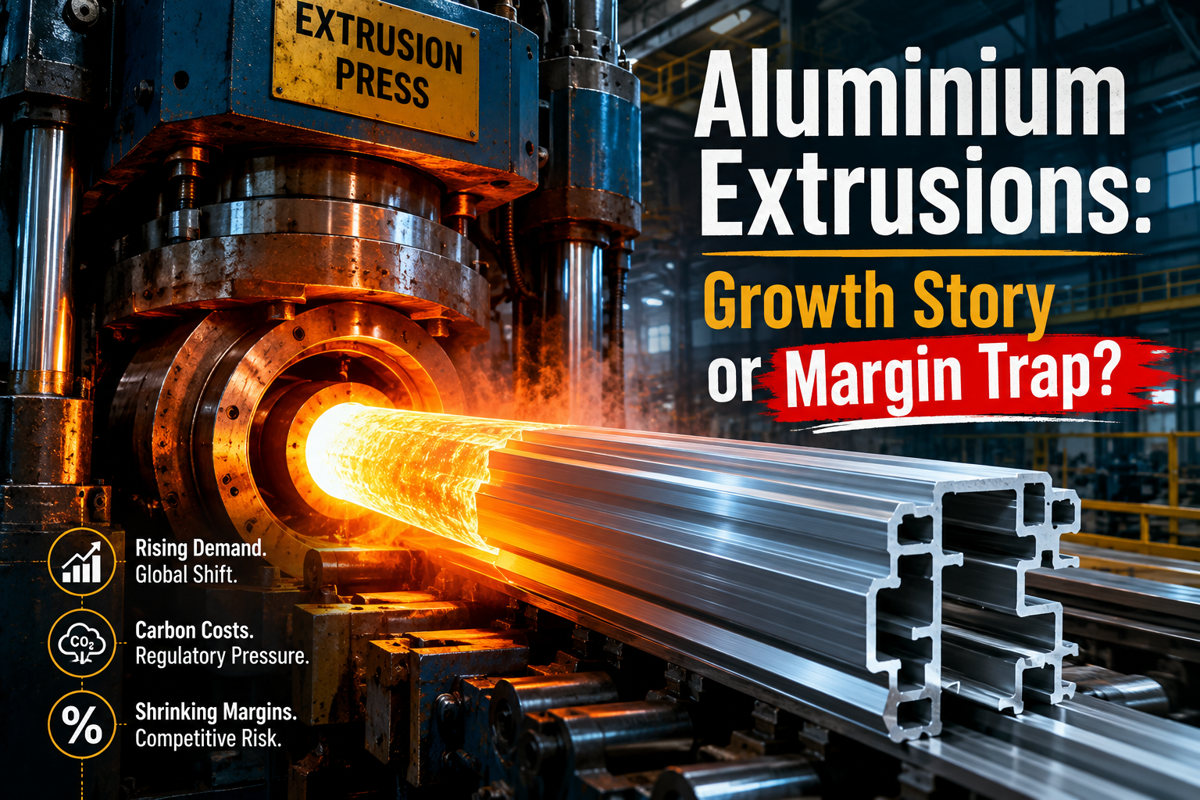
The image(s) used in this article is generated with an AI tool and does not depict any real-time moment
中文翻译附于新闻末尾,敬请继续阅读。
The global aluminium extrusion industry is currently navigating a severe structural dichotomy. If you look purely at the macroeconomic surface, the sector is riding an aggressive demand supercycle. The global push for electric vehicles, the rollout of green infrastructure, and strict regulatory mandates for lightweighting make the volume growth narrative look virtually unassailable.
However, dig a little deeper into the factory floor and a much darker picture emerges. Operating just beneath this surface-level optimism is a brutal margin compression dynamic. Escalating energy costs, aggressive international trade tariffs, war, rigid limits on primary raw material supplies, and the new reality of carbon pricing are threatening to trap traditional extruders in a low-margin, commoditised reality.
So, are we looking at a generational growth story, or are manufacturers walking blindly into a margin trap? To find the answer, we must examine the alignment between consumption outlooks, factory-level production challenges, and the incredible nanolevel research currently rewriting the rules of metallurgy.
The demand supercycle: Where the growth lives
The global aluminium extrusion market is experiencing robust, multi-sectoral expansion. This growth is entirely underpinned by aluminium's intrinsic material advantages, namely its superior strength-to-weight ratio, excellent thermal conductivity, and infinite recyclability.
Various predictive models project the market to expand from a baseline valuation of around USD 94.8 billion today to upwards of USD 230 billion by 2035, representing a compound annual growth rate of roughly 8.4 per cent.
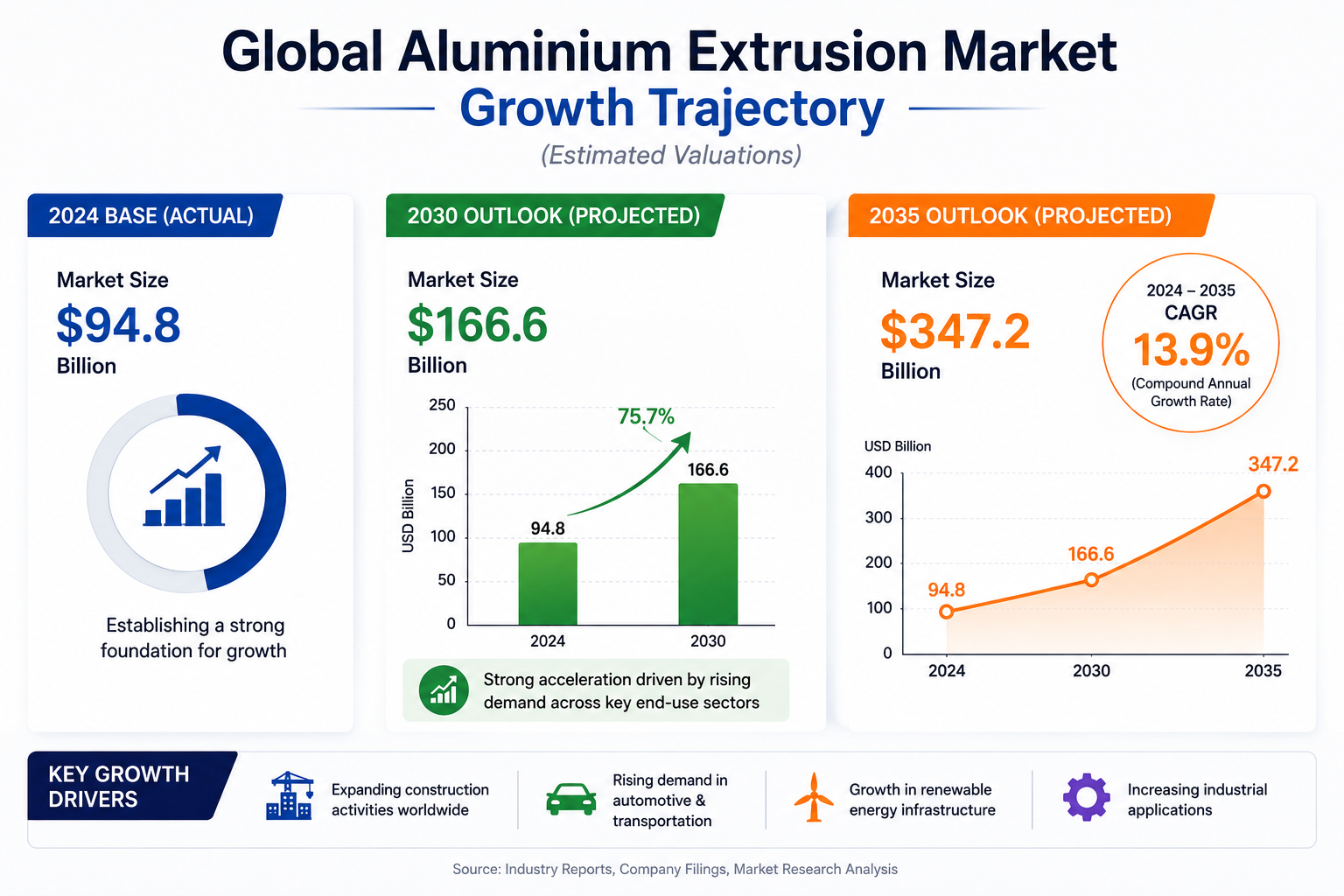
(Data compiled from aggregated OMR Global, MarketsandMarkets, and Precedence Research forecasts)
The Asia-Pacific market remains the dominant force, accounting for over 71 per cent of global revenue. Rapid urbanisation and massive infrastructure programmes in China and India are fuelling this. But if we look at specific end-user sectors, the growth drivers become much more nuanced.
The electric vehicle transition: The automotive sector represents the most technologically demanding growth vector. Because EV battery enclosures and thermal management systems require high-strength, multi-hollow profiles optimised for liquid cooling, extruded aluminium is the undisputed material of choice.
Crash management systems also rely heavily on extrusions for kinetic energy absorption. Advanced proprietary alloys allow automotive designers to optimise extrusion shapes and reduce wall thicknesses, yielding weight savings of 15 to 30 per cent compared to older alloys. Shedding this gross vehicle weight directly extends EV operational range.
Infrastructure and telecoms: While automotive gets the headlines, building and construction still represent over 60 per cent of global extrusion volume. The modern push toward sustainable, green building certifications has cemented aluminium's role in modern architecture.
To know more about the real-time aluminium extrusion market and its future roadmap, explore our report: The World of Aluminium Extrusions – Industry Forecast to 2032
Interestingly, the rollout of 5G telecommunications is also creating a highly specialised niche. Telecom giants are heavily incorporating composite thermal management extrusions in base station amplifiers. These profiles facilitate rapid heat dissipation, effectively reducing cooling system power consumption by up to 18 per cent across global networks. Furthermore, recent material flow analysis reveals that while construction and transport dominate direct use, the service and communication sectors are driving massive indirect aluminium demand, further tightening global supply requirements.
The margin trap - production vulnerabilities: Despite a fiercely upbeat demand profile, the production side of the industry is fraught with systemic challenges. These hurdles exert intense downward pressure on profit margins, threatening to turn high volume into an economic trap.
Energy intensity and supply inelasticity Aluminium extrusion is exceptionally energy-intensive. The conventional cycle of preheating billets, pressing the metal, and rapid quenching requires up to 1,500 kWh of energy per tonne. Reheating and pressing alone account for 80 per cent of total plant energy consumption. Regions dependent on volatile external energy markets have suffered severely, with high power prices recently forcing several European facilities to curtail or completely halt operations.
The financial toll on the industry's largest players is already highly visible. Industry giants like Norsk Hydro have reported severe margin erosion and escalating fiscal losses within their European extrusion divisions. In direct response to the prolonged market weakness and crippling regional energy costs, Hydro was forced to announce the closure of seven extrusion plants across Europe to restructure its operations and stem the financial bleeding.
Compounding this energy crisis is a permanent shift in global supply elasticity. Historically, any surge in global demand was met by rapid capacity expansions in China. That era has definitively ended. China has enforced a strict administrative production ceiling of 45 million tonnes per annum to meet its own environmental compliance targets. This cap prevents primary producers from expanding capacity even during periods of elevated pricing, permanently embedding higher baseline raw material costs into the global supply chain.
Billet premiums, interest rates, and weak construction cycles: Further squeezing these margins is the macroeconomic environment. Extruders do not trade solely on the London Metal Exchange cash price; their true cost of goods sold is heavily dictated by regional physical delivery premiums. Recently, the market has witnessed a massive price surge in extrusion billet premiums. Driven by supply chain bottlenecks, logistical fractures, and geopolitical shocks, these localised premiums have skyrocketed, causing extreme margin compression.
Prolonged periods of high interest rates have also initiated a weak cyclical phase in traditional residential and commercial construction, a sector that traditionally absorbs 60 per cent of global extrusion volume. When downstream architectural demand softens precisely as baseline billet costs and physical delivery premiums surge, independent extruders discover themselves caught in a devastating financial pincer movement, forcing them to either absorb the staggering costs or permanently lose market share.
Trade disruptions and carbon tariffs: The international trade landscape has fractured. The United States has finalised aggressive anti-dumping and countervailing duties against 14 countries, with tariffs ranging from 3.44 per cent to a staggering 365 per cent. These punitive measures artificially raise input costs while completely insulating domestic margins from international price competition.
Simultaneously, the European Union Carbon Border Adjustment Mechanism (CBAM) represents a fundamental evolution in trade policy. By pricing the environmental externality of carbon-intensive foreign smelters, CBAM penalises jurisdictions lacking green energy infrastructure. Carbon is no longer an abstract environmental metric; it is a fixed operating cost on the balance sheet.
Factory floor optimisation - The scrap reality: To survive these macroeconomic pressures, extruders must look inward. Recent empirical studies on sustainable production in aluminium extrusion, specifically those utilising multiple linear regression models on real industrial data, reveal that operational survival dictates a flawless control of scrap rates.
Data shows that while temperature and pressure are vital, geometric factors often have the most significant impact on waste generation. Variables such as the number of die holes, specific weight, and billet length are statistically massive contributors to scrap production. For an extrusion plant to remain profitable amidst surging billet premiums, overall equipment effectiveness must stay above 75 per cent, and scrap rates must be kept strictly below 20 per cent to prevent devastating raw material bleed.
Nanolevel interventions - The escape velocity: For unprepared manufacturers, the combination of high energy costs, volatile billet premiums, and carbon taxes is a lethal margin trap. However, the industry vanguard is pivoting aggressively toward nanolevel research and advanced metallurgical engineering to achieve an escape velocity from commoditisation.
Bypassing the "Dirty Alloy" problem: A major hurdle in achieving low-carbon extrusion lies in using highly recycled secondary aluminium. Post-consumer scrap inherently contains elevated levels of impurities like iron. In traditional metallurgy, these iron impurities form brittle intermetallic phases that starve the matrix of the solutes required for strengthening. This historically forced extruders to dilute scrap with 30 per cent primary, energy-intensive aluminium just to maintain structural integrity.
Nanolevel interventions are neutralising this requirement. Introducing highly potent nucleants, such as titanium carbonitride nanoparticles, into the melt induces remarkable grain refinement. These nanoparticles restrict grain growth and overpower the detrimental effects of iron impurities.
Metal matrix - Nanocomposites and surface texturing: By uniformly dispersing nano-sized ceramic particles like silicon carbide into the aluminium matrix, metallurgists are tailoring properties beyond the limits of monolithic alloys. These nanocomposites exhibit massive increases in yield and compressive strength while maintaining minimal porosity.
Furthermore, nanolevel research has revolutionised surface characteristics. In the automotive sector, reliable assembly depends increasingly on structural adhesive bonding rather than traditional rivets. Advanced techniques like pulsed laser irradiation generate highly controlled nanoprotrusions and pores. Once wetted, the capillary action of adhesives penetrating these nanopores creates a profound mechanical interlock, drastically elevating the sheer strength of the bonded joint.
Disruptive processing: ShAPE technology: Perhaps the most significant technological leap is Shear Assisted Processing and Extrusion (ShAPE). Traditional secondary scrap extrusion requires extensive, energy-intensive steps, including degassing, compaction, and massive furnace homogenisation. ShAPE fundamentally disrupts this workflow.
The technology utilises a specially designed rotating head paired with a hydraulic press. As the press pushes unheated aluminium feedstock against the rotating head, severe localised shear generates immense internal frictional heat, softening the material instantly without external furnace preheating. At the nanolevel, this extreme deformation generates an ultrafine-grained matrix. By mechanically breaking down macro-impurities into harmless nanoscale sizes, ShAPE completely bypasses the limitations of dirty alloys.
Rigorous testing proves ShAPE can process 100 per cent post-consumer industrial scrap directly into automotive components without a single drop of primary dilution. This translates to a massive reduction in energy input and greenhouse gas emissions, providing a highly scalable route entirely out of the carbon margin trap.
The strategic verdict
Evaluating whether the global aluminium extrusion sector is a growth story or a margin trap requires acknowledging an intense industry bifurcation. It is undeniably both, heavily dependent on a firm's position on the technological curve.
For legacy extruders reliant on energy-intensive preheating, consuming primary aluminium to dilute scrap, and producing standard architectural commodity shapes, the margin trap is their present reality. Operating in this tier means severe exposure to fixed external costs that simply cannot be solved by running older presses faster. Furthermore, falling into the traditional distribution trap where brokers eat 30 cents of every retail dollar will collapse the business model when billet premiums spike.
Conversely, for firms that proactively internalise nanolevel research and form deeply integrated strategic joint ventures focused on value-added sectors, the extrusion sector is an incredible growth story. The global market demonstrates a clear willingness to pay green premiums for certified low-carbon, high-performance aluminium.
By engineering alloys at the atomic scale to tolerate impurities and deploying disruptive shear-based processing, the vanguard of the extrusion industry is bypassing the commodity trap entirely. They are not just surviving the current macroeconomic headwinds; they are actively authoring one of the most compelling sustainable growth narratives of the modern industrial era.
铝型材行业:可持续增长赛道,还是当下利润困局?
当前全球铝型材行业正陷入严重的结构性两极分化。仅从宏观表象来看,行业正迎来一轮需求爆发的超级周期。全球大力推广新能源车、落地绿色基建,叠加严苛的轻量化法规要求,型材销量持续增长的逻辑看似牢不可破。
但深入工厂一线便能发现截然不同的严峻现状。在乐观表象之下,企业盈利正被持续大幅压缩。能源成本攀升、多国贸易关税壁垒、地缘冲突、原生原料供给刚性受限,再加上碳定价新规落地,传统铝型材加工厂深陷低毛利、产品同质化的盈利困局。
那么,这究竟是一轮跨时代的行业增长机遇,还是制造企业盲目踏入的利润陷阱?想要找到答案,就需要结合消费需求预期、工厂端生产痛点,以及当下重塑冶金行业规则的纳米级前沿材料研究综合分析。
一、需求超级周期:行业增长核心驱动力
全球铝型材市场多赛道同步高速扩容,增长根基源于铝材本身得天独厚的材料优势:超高比强度、优异导热性能,以及可无限循环回收的特性。
多家预测模型测算,当前全球铝型材市场规模约948亿美元,预计2035年将突破2300亿美元,年均复合增速约8.4%。
亚太地区仍是市场主导,营收占全球总量71%以上,中印两国快速城镇化与大规模基建项目持续拉动需求。细分终端领域的增长逻辑则各有差异:
- 新能源汽车转型赛道
汽车行业是技术要求最高的增长板块。新能源车电池包、热管理系统需要高强度多孔型材适配液冷结构,铝型材是无可替代的核心材料。
车辆防撞吸能结构同样高度依赖铝型材吸收冲击动能。先进的高端特种合金使汽车设计师能够优化挤压形状并减少壁厚,与旧合金相比可减重15%至30%。这种整车重量的减轻直接延长了电动汽车的续航里程。
- 基建与通信领域
虽然汽车赛道备受关注,但建筑领域用量仍占全球铝型材总出货量60%以上。全球绿色建筑认证普及,进一步巩固了铝材在建筑领域的应用地位。
与此同时,5G通信基建催生全新细分需求。通信巨头在基站功率放大器中大量采用复合导热铝型材,可快速散热,全球网络冷却系统能耗最高可降低18%。物料流向分析显示,建筑、交通为铝材直接消耗主力,服务与通信行业则带动海量间接铝材需求,进一步收紧全球原料供给。
二、利润陷阱:生产端系统性经营难题
尽管需求景气度居高不下,行业生产端却遍布系统性风险,持续挤压企业利润,高产量反而演变为经营陷阱。
1.高能耗特性与能源供给弹性不足
铝型材挤压属于高耗能工序:铝棒预热、挤压成型、快速淬火整套流程,每吨产品能耗最高可达1500千瓦时,仅铝棒重熔与挤压环节就占据工厂总能耗的80%。
高度依赖外部进口能源的地区遭受重创,欧洲多国因电价高企,多家型材厂减产甚至全面停产。行业头部企业亏损已十分突出,挪威海德鲁(Norsk Hydro)欧洲型材板块毛利大幅缩水、亏损持续扩大。面对长期市场低迷与高额用电成本,海德鲁被迫关停欧洲7家挤压厂,通过业务重组遏制亏损。
能源危机之外,全球原料供给弹性发生永久性转变。过去全球需求上涨时,中国可快速扩产补足缺口,但该时代已然终结。中国国内为完成环保管控目标,设定4500万吨原生铝年度产能上限,即便铝价上行,原生铝企业也无法新增产能,全球产业链原料基础成本永久抬升。
2.铝棒升水、高利率与地产周期下行
宏观环境进一步压缩利润空间。型材企业成本并非仅参考伦敦金属交易所现货价,区域现货铝棒升水对实际生产成本影响极大。受供应链堵塞、物流中断、地缘冲突影响,近期铝棒现货升水大幅暴涨,企业毛利遭到严重侵蚀。
长期高利率环境导致民用、商用建筑行业进入下行周期,而建筑型材占全球型材总需求60%。当下下游建筑需求走弱,铝棒基准价与现货升水同步走高,独立型材加工厂陷入双向成本挤压:要么自行承担高额原料成本,要么丢失市场份额。
3.贸易壁垒与欧盟碳关税(CBAM)
全球国际贸易格局彻底割裂。美国已对14个国家落地严苛反倾销、反补贴关税,税率区间3.44%至惊人的365%。高额惩罚性关税推高进口原料成本,同时隔绝本土企业直面国际价格竞争。
与此同时,欧盟碳边境调节机制(CBAM)彻底改写国际贸易规则。该机制对高碳排放海外冶炼厂的环境外部成本定价,惩罚缺少清洁能源配套的生产地区。碳排放不再只是环保指标,而是企业资产负债表中固定的经营成本。
三、工厂内部优化:废料管控是生存底线
想要抵御宏观压力,企业必须向内挖掘增效空间。多项基于真实工厂数据、采用多元线性回归模型的可持续生产研究证实:企业能否存续,核心在于废料率的精细化管控。
数据显示,温度、压力固然关键,但型材几何参数对废料产生量影响最大:模具孔数、比重和坯料长度等指标是废料生成的核心诱因。在铝棒升水持续走高的环境下,挤压厂综合设备效率需维持75%以上,废料率严格控制在20%以内,才能避免原料成本失控。
四、纳米级材料技术:跳出同质化困局的突破口
对于未提前布局技术升级的工厂,高能源成本、浮动铝棒升水、碳关税叠加形成致命利润陷阱;但行业头部企业全力布局纳米级材料研发与高端冶金工程,以此摆脱大宗商品低价内卷。
1.绕过“脏合金”难题
实现低碳挤压的一个主要障碍在于使用高度回收的再生铝。回收铝料含铁等杂质含量偏高,传统冶金工艺中,铁杂质会生成脆性金属间化合物,破坏合金强化基体。以往企业只能掺入30%原生高纯铝稀释杂质,大幅拉高能耗与成本。
纳米改性技术彻底改变这一现状:在铝液中添加碳氮化钛纳米晶粒细化剂,可显著细化金属晶粒,抵消铁杂质带来的负面作用,无需大量原生铝调和。
2.铝基纳米复合材料与表面纳米改性
冶金研究人员将碳化硅等纳米级陶瓷颗粒均匀弥散分布于铝基体内部,以此调配出单一均质合金无法实现的材料性能。此类纳米复合材料的屈服强度与抗压强度大幅提升,同时可保持极低孔隙率。
纳米技术也革新铝材表面性能。汽车行业逐步以结构粘接替代传统铆钉装配,脉冲激光辐照等先进技术可产生高度可控的纳米突起和纳米孔洞。一旦润湿,粘合剂渗入这些纳米孔的毛细作用会形成牢固的机械互锁,大幅提升粘接接头的剪切强度。
3.颠覆性加工工艺:剪切辅助挤压技术ShAPE
行业最具突破性的技术为剪切辅助加工挤压工艺(ShAPE)。传统再生铝挤压流程冗长、能耗极高,需除气、压实、高温均质炉等多道工序;ShAPE工艺重构整套生产流程。
该设备搭配专用旋转机头与液压挤压机,未预热铝坯料挤压接触旋转机头时,局部强剪切产生大量摩擦热,无需外部熔炉预热即可软化铝材。纳米尺度下,强变形生成超细晶粒基体,同时将大块杂质机械分解为无害纳米颗粒,彻底消除再生铝杂质限制。
实测验证,ShAPE工艺可直接使用100%消费回收废料生产汽车零部件,完全无需掺兑原生铝。大幅削减能源消耗与温室气体排放,为企业彻底摆脱碳成本陷阱提供可大规模落地的技术路径。
五、行业综合判断
想要判断全球铝型材行业究竟是增长机遇还是利润陷阱,就必须看清行业显著两极分化的格局。事实上两种局面同时并存,最终完全取决于企业所处的技术梯队
- 传统型材加工厂
对于依赖高能耗预热、消耗原生铝来稀释废料、且生产标准建筑用大宗型材的传统挤压企业而言,利润陷阱正是其当下的现实。处于这一梯队,意味着严重暴露于固定的外部成本之下,而这些成本绝不可能靠加快老旧挤压机运行速度来解决。更为关键的是,一旦陷入传统的经销陷阱——即零售收入中高达30%被中间商吞噬——那么在铝棒溢价飙升之时,其商业模式将彻底崩塌
- 技术领先型企业
与之相对,企业若自主布局纳米级材料研发,并围绕高附加值领域组建深度融合的战略合资项目,铝型材行业便是一片前景广阔的增长蓝海。全球市场愿意为具备低碳认证、性能优异的铝材支付绿色溢价。
行业先锋企业通过原子尺度合金设计提升材料杂质耐受度,搭配颠覆性剪切加工工艺,彻底跳出大宗商品低价内卷的困境。它们不仅能扛住当下宏观经济的不利冲击,更正在打造现代工业领域极具说服力的可持续发展增长范本。
Note: This AL Circle news is for authorised use only. Any reproduction, use, or distribution should be done with prior written permission.
Disclaimer: The opinions, information, claims, references, and images presented here are those of the author alone and AL Circle holds no responsibility.

Unlock full access – sign up for FREE.
Key benefits
Primetals Technologies wraps up automation upgrade at Ulsan Aluminum
Next articleHindalco stock in focus as Novelis restarts New York hot mill: UBS remains bullish on aluminium
Grow with
AL Circle