A library in motion: Movable exhibition displays by Supervoid
This image has been sourced from “https://www.museomacro.it/mostra"
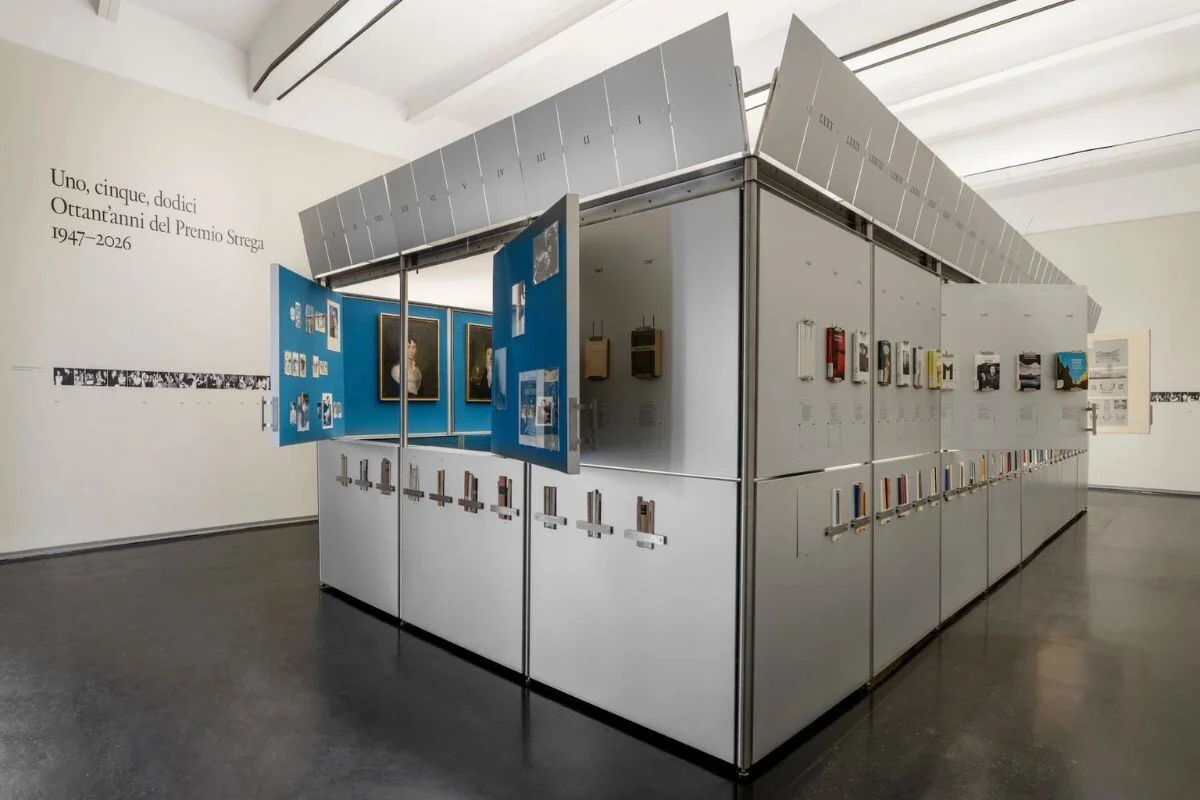
The exhibition “Uno, Cinque, Dodici. Ottant’anni del Premio Strega”, conceived by Supervoid, investigates the long and complex history of the Premio Strega, constructing a spatial experience that takes visitors on a journey through it.
The exhibition does not present the prize as a fixed historical narrative, but as something that has always evolved over time, shaped by literature, public debate, media attention and the people connected to it. Through books, architectural design, and visitor interaction, the exhibition reconstructs nearly eighty years of cultural history in a way that feels both reflective and immediate.
A central feature of the project is the large collection of books associated with the Premio Strega since 1947. More than one thousand volumes are displayed in chronological order, forming what can be understood as an imagined or “ideal” library. Moving through the sequence of books allows visitors to follow the development of the prize across different decades while also encountering the wider cultural atmosphere surrounding each edition.
Alongside the books, the exhibition refers to the various controversies, personalities, public discussions, and media narratives that have accompanied the Premio Strega throughout its seventy-nine editions. In this sense, the exhibition is not only about literature itself but also about the social and cultural environment in which literature circulates. The exhibition design is organised around a single pavilion positioned at the centre of the gallery space.
This structure functions simultaneously as architecture and exhibition device.As a room within a room, it creates a separate environment that removes the exhibition from the surrounding museum and also leads the visitor through different layers of interpretation.
The contrast between the interior and exterior of the pavilion is an important aspect of the overall experience. Inside, the atmosphere is deliberately intimate. The use of textiles, smaller enclosed spaces and warm colours recalls domestic interiors and evokes the social settings associated with the origins of the Premio Strega.
These references suggest the informal gatherings and intellectual exchanges that contributed to the creation of the Prize and to the literary community that developed around it over time. The interior spaces, therefore, emphasise the personal and human dimension of literary culture.
The outer surface of the pavilion adopts a very different character. It appears minimal, abstract, and restrained, functioning almost as a neutral shell designed to display the books within the context of a contemporary museum.
However, this apparent simplicity is interrupted by a series of carefully placed elements that animate the structure. Openings cut into the pavilion, together with displays of shortlisted and winning books, create rhythm across the surfaces and introduce a more dynamic visual quality.
The covers of the winning books are especially significant in this respect. Their differing sizes, colours, and graphic styles stand out against the aluminium surfaces, breaking the uniformity of the structure and adding visual movement to the composition. Through this balance between abstraction and archival material, the pavilion reflects the multiple identities of the Premio Strega, which exists at the same time as a private cultural circle, a public institution, and a nationally recognised literary award.
An important aspect of the exhibition is the active role given to visitors. The pavilion is not to be static or untouchable. By opening the inward-facing windows, visitors interact directly with the installation and change its configuration. Therefore, the exhibition is constantly morphing in response to movement and participation, making the experience more immediate and engaging. Studio Supervoid thus turns the exhibition into a space not only observed but activated by the public itself.

Kolkata Metro completes aluminium third rail upgrade on Blue Line underground section
Next article29-metre aluminium passenger vessel by SHM Group makes debut at Mumbai shipyard
Grow with
AL Circle