China’s wrought and unwrought aluminium imports in May 2025 displayed a reverse pattern compared to April. In May, imports rose year-on-year but declined month-on-month, while April had shown the opposite — higher imports than the previous month but lower than the same period in 2024.
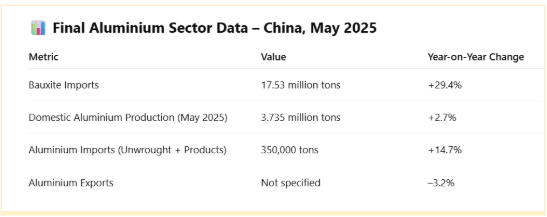
According to the General Administration of Customs, China’s wrought and unwrought aluminium imports in May 2025 were 350,000 tonnes, up by 14.7 per cent in May and down by 5.4 per cent from 370,000 tonnes. In contrast, the import volume in April, standing at 350,000 tonnes, was up by 2.94 per cent M-o-M from 340,000 tonnes but down by 7.89 per cent from 380,000 tonnes.
In the first five months of 2025, China’s wrought and unwrought aluminium imports totalled 1.67 million tonnes, down by 12.08 per cent from 149 million tonnes during the corresponding period of the previous year.
The above chart shows that there was a rise in China’s domestic aluminium production as well in the month of May, with the volume at 3.75 million tonnes, up 2.7 per cent Y-o-Y. The annual increase in both production and imports thus suggests a strong demand in the domestic market. On the other hand, aluminium exports during the same month decreased by 3.2 per cent, further indicating a robust domestic demand.
China’s improved purchase management index (PMI) for the aluminium processing industry to 49.8 per cent in May, recording an 8.7 per cent year-on-year increase, also hints at a strong demand.
With the increase in demand, China in future will rely more on import since the country is close to an annual 45 million tonnes cap.
The spurt in aluminium demand and imports was largely driven by a significant increase in solar panels installation. According to the National Energy Administration, solar PV installations in China grew 38.9 per cent year-on-year, reaching 104.9 GW by the end of April 2025.This surge in capacity has pushed China’s cumulative installed PV capacity to 1,241 GW, solidifying its position as a global leader in solar energy.
Electric vehicles was another industry that also significantly contributed to China’s aluminium demand, fuelling import growth. In May, China's electric vehicle (EV) production and sales reached 1.27 million and 1.307 million units respectively, representing year-on-year growth of 35 per cent and 36.9 per cent.
From January to May, cumulative EV production and sales stood at 5.699 million and 5.608 million units respectively, marking year-on-year increases of 45.2 per cent and 44 per cent.
Market analysts say the jump in imports also serves as a strategic buffer. Though global trade tensions and tariffs are always a matter of concern, Beijing wants to secure both raw material and finished metal in order to have the supply chain guarantee for its strategic sectors. Though Chinese exports of aluminium dropped a marginal 3.2% on a year-on-year basis, the strong domestic demand is a snapshot of an economy within that is going full-bore, pulling resources from everywhere in the world to build its future infrastructure.













_md.webp)
_md.webp)







