





Introduction
We need a new field of engineering within metallurgy and materials engineering, specifically process engineering, that is closely related to other engineering disciplines and highly compatible with engineering ethics: Recycling engineering.
At first glance, the basic functions of recycling engineering can be listed as follows:
- A holistic approach to “product-centred” metal production processes
- Converting waste into secondary “new” raw materials
- Production process design to produce “new” products from secondary raw materials
- Adaptation of ore preparation processes in primary metallurgy (especially for polymineral and low-grade ores) to secondary metal production, or adaptation of scrap preparation processes in secondary metal production to primary metal production
- Application of mine tailings utilisation processes to scrap and secondary process waste (dross)
- Refining process design to produce “acceptable quality” products from secondary raw materials
- Application of CCUS projects to secondary metal production
- New recyclable alloys and product designs, or modification of currently used alloys to make them suitable for recycling
- Engineering studies aimed at improving the mechanical properties of recycled products through microstructure control
- Optimising economic and environmental costs while doing all these processes
- Use of digital tools in processes
Can this new field of engineering, with a Veblenian perspective and using constantly evolving digital tools, reconcile engineering and economic truths that have been in conflict for centuries?
Designing the future
We are living in a period where long-term planning for a sustainable and secure world is critically important. The need for technological development and progress will continue. However, while some see economic growth as indispensable for a sustainable society, others view economic growth itself as a problem. Although the primary priority of policy decisions appears to be healthy economic growth that creates wealth to solve environmental problems, it is clear that the cost of repairing existing environmental damage will be far greater. Therefore, in all investments, improvement projects and new product and material designs in the coming period, “sustainability conditions” will increase in importance. Technological trends indicate a focus on renewable energy systems, lighter vehicles, low carbon emissions and greenhouse gas control and increased secondary metal production.
Everyone involved in the decision-making process regarding technical matters, especially engineers, should consider the advantages and disadvantages of various technological alternatives and make decisions not only based on technical criteria but also within the framework of long-term sustainable, desirable and high-quality life criteria. In other words, they must consider all the social, political, economic, environmental and even psychological impacts of technological choices. Because, to reiterate, technological choices shape not only the economy but the entire future.
In this context, changes in industrial design, inputs and processes are inevitable. Replacing fossil fuels, which are the main inputs of industry and produce significant emissions in both production and consumption phases, with energy-efficient products, services and processes and increasing the use of alternative renewable energy sources, is not a process that can be achieved in the short term. Undoubtedly, when the type of energy changes, systems and rules will change. When energy production begins from new sources, the infrastructure of industrial production must also change. This cannot be solved by simply purchasing new technologies, as has been the custom until now; scientific activities are necessary to implement these changes. In this context, the sustainable development model creates opportunities and time for change in the existing industrial infrastructure.
All of this has led to the birth of a new engineering discipline, although it has not yet been named: Recycling engineering.
Also read: Recycling as the seventh resource: How aluminium is powering the next metallurgical revolution
The labour instinct as the driver of productivity from a Veblenian perspective
When viewed from the perspective of historical economics, perhaps the most critical element in Veblen’s theory of technology, which has a Darwinian approach, is the “work instinct.” Veblen defines this as a general characteristic of human nature, manifesting as a tendency toward purposeful action and an almost aesthetic sense of economic value. In contrast to the neoclassical view, Veblen argues that humans possess an innate drive to do things well and a corresponding antipathy toward waste and frivolity. This instinct compels individuals to take control of the material environment and make it suitable for human use. In the early stages of human evolution, this peaceful inclination toward industry ensured the survival of the race despite the absence of natural predator defences.
However, science is the effort to perceive nature and the universe as a whole. The fundamental aim of technology, on the other hand, is not to comprehend nature, but to change it and then “produce something new.” This new thing is first conceptually produced at the level of thought. Then, the concept moves to design. The next stage after design, if it is a “production method,” is testing this new method in a pilot plant; if it is a newly designed “product,” it is testing its prototype. With the success of these tests, the specific “technological production process” generally comes to an end.
Scientific work is not purely “human-centred.” That is, it attempts to explain events occurring in nature and the universe, whether or not humans are involved. Technology, however, is a “human-centred” concept and humans are present at every stage of technology. The history of technology begins with the history of humanity. The evolution of technology, which began with the Stone Age two million years ago when weapons, tools, and implements began to be made, gained a new meaning with the Industrial Revolution, following the Bronze and Iron Ages. The Industrial Revolution was also the period in which the discipline of “engineering”, as we understand it today, emerged, a topic we will try to explain later.
Recycling: Beyond waste management, a new metallurgical paradigm
In practice, recycling is the process of returning products that have reached the end of their life cycle back to raw materials so that they can be reused in the production of new products. While end-of-life products are defined as “waste” in a linear economic understanding, they are “new raw materials” in a circular economic understanding. Therefore, recycling represents the step that closes the cycle, aiming to eliminate the need for virgin (primary) materials and conserve natural resources.
In contrast, from an engineering perspective, recycling, as a thermodynamic reality, is the physical and chemical “processing” of complex mixtures of products and materials that have reached the end of their useful life, transforming them into high-quality materials. Since modern products combine numerous variations (alloys, physical structures, etc.), recycling should be viewed as a rigorous industrial activity requiring energy and labour to overcome the high entropy (disorder) of mixed inputs.
In this context, waste symbolises disorder, while recycling describes a new order or a new integration.
Key similarities between primary and secondary metal production
A strong analogy can be drawn between primary and secondary metallurgical processes. In the context of circularity, it is a fact that end-of-life scrap metal can be described as a new type of “ore” obtained from an “urban mine” and that secondary technologies benefit greatly from the experience of primary technologies.
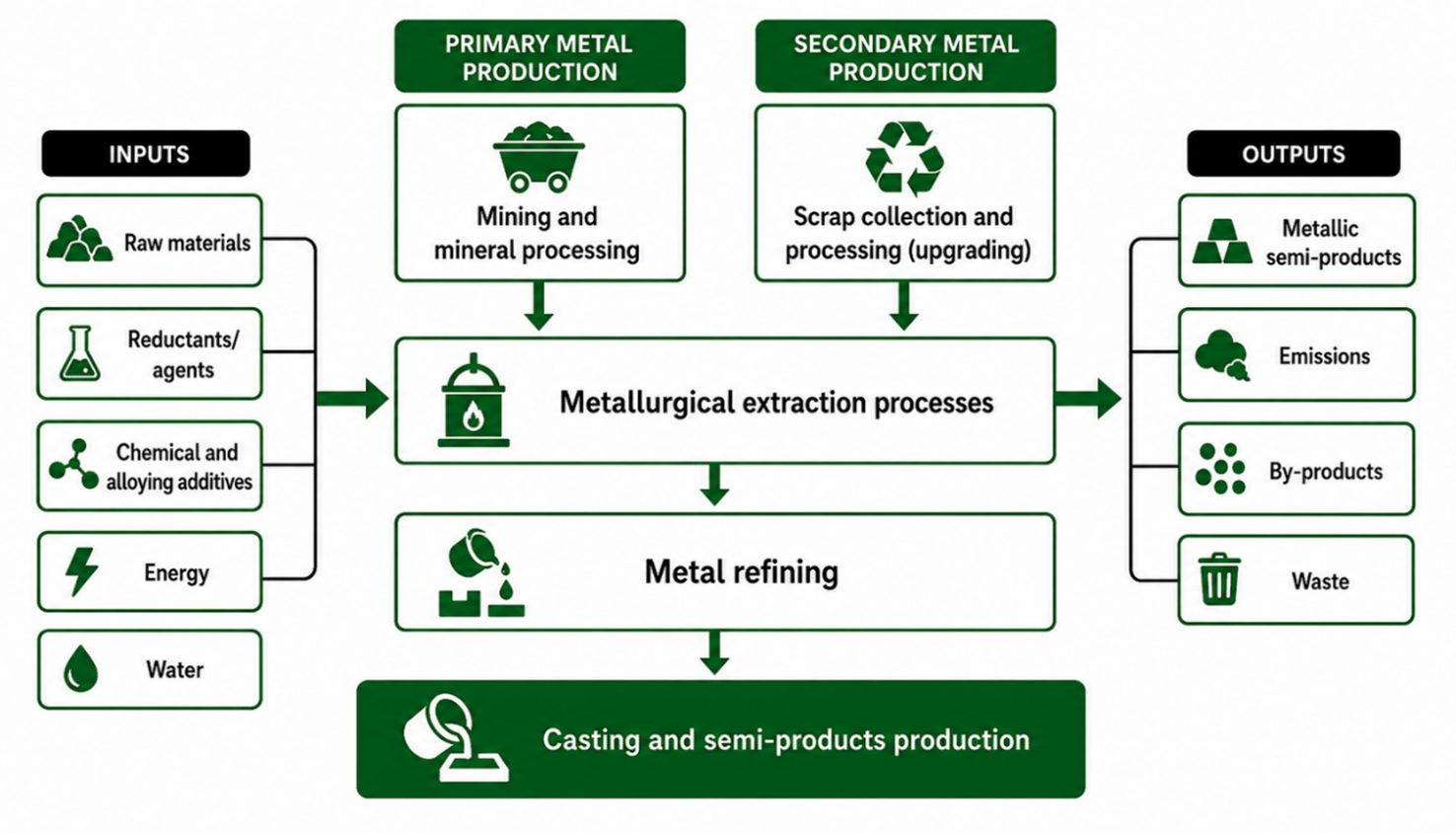
Processing Sequence: Both primary and secondary production follow almost the same operational sequence. The process begins with the “mining” of the resource (either ore extraction or scrap collection), followed by mechanical beneficiation operations (crushing/grinding for ore, dismantling/shredding/separation for scrap) and finally metallurgical extraction (smelting and refining).
Common Thermodynamic Principles: Both primary and recycling metallurgy rely on the same fundamental laws of thermodynamics, physical chemistry and kinetics to separate and purify metals. The basic technologies used in recycling, for example, pyrometallurgy (decoating and smelting) and hydrometallurgy (liquid metal refining by flotation) are directly inherited from primary metal extraction.
Presence of “Gang” (Waste Material): In traditional mining, geological ores contain unwanted “gang” minerals that differ from the base metal. Scrap metal contains its own version of “gang” with contaminants such as non-metallic attachments, plastics, paints and materials containing different alloys.
Key differences and limitations between primary and secondary metal production
Despite these strong parallels, there are significant differences that make recycling metallurgy challenging compared to primary ore processing metallurgy:
Predictability and Composition: Natural ores have formed over millions of years under specific geological conditions, resulting in their composition being predictable and relatively stable. In contrast, “urban mining” is entirely man-made and constantly changing depending on evolving needs, technology and geography. For example, over 400 aluminium wrought alloys, over 200 aluminium casting alloys and over 50 types of scrap are defined in REMA’s ISRI specifications. This makes secondary raw materials extremely heterogeneous and statistically unpredictable.
Separation and Sorting Challenges: In traditional ore processing, mechanical enrichment processes such as crushing and grinding are quite effective. However, for scrap containing both physical and chemical impurities, pre-smelting enrichment processes are much more complex. Removing non-metallic impurities, separating other metal attachments and cleaning up paint, oil, lacquer and other components is a much more demanding technological process than traditional ore enrichment.
Final Products: While primary metallurgy generally focuses on extracting and producing pure metals from ores, recycling metallurgy typically produces alloys as the final product. This is because some alloying elements mixed in scrap cannot be separated economically or thermodynamically during the recycling process. Therefore, it is difficult for products made from secondary raw materials to reach the quality of products made from primary raw materials.
Aluminium: The leading example of circular metal production
Secondary aluminium production is an excellent example of recycling engineering. Aluminium recycling engineering perfectly illustrates the transition to a product-centric from materials-centric approach and a thermodynamics-focused engineering era. As is known, aluminium recycling saves approximately 92-95% of energy compared to primary production from bauxite ore, while significantly reducing greenhouse gas emissions and solid waste (such as red mud); however, the process is far more complex than simply melting scrap.
The main challenge in secondary aluminium production processes is the downcycling risk, because aluminium is very rarely used as pure aluminium. Aluminium and its alloys, used in almost every sector, are generally used in alloy form for performance-enhancing reasons, primarily mechanical properties. A fundamental thermodynamic problem in aluminium recycling is that impurities, especially iron, dissolve easily in molten aluminium and are nearly impossible to remove through standard refining. Recycling engineering aims to recover, purify and seamlessly reintegrate materials into the global supply chain by treating products as complex material and energy flows, rather than simply managing waste.
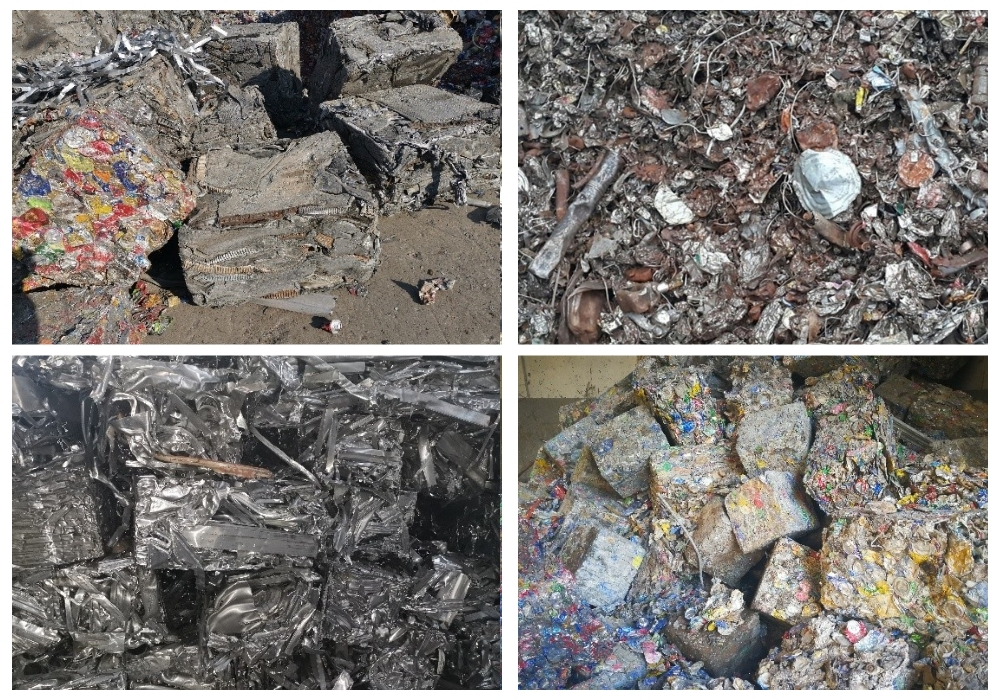
Since impurities accumulate each time metal is recycled, there are two solutions in industrial practice:
- Dilution: Adding high-purity primary (unprocessed) aluminium to the scrap melt to reduce the overall concentration of impurities to acceptable levels.
- Downcycling (Low Purity Recycling): Directing high-purity processed alloy scrap (such as sheets and foils) to the production of lower-purity casting alloys (such as engine blocks); these alloys have a much higher tolerance to accumulated impurities such as iron and silicon.
Key characteristics of recycling engineering
Deep Interdisciplinary Integration: Recycling engineering requires integration with multiple fundamental engineering disciplines. Primarily, it must work in an integrated manner with mechanical engineering, chemical engineering, environmental engineering and, naturally, materials engineering.
Materials engineering provides the fundamental intellectual framework for recycling by explaining how a material’s entire processing history affects its final structure and performance. In the context of recycling, a material’s “processing” history does not simply mean how it was initially produced; it also includes the degradation it has been subjected to throughout its lifecycle and the extreme physical and chemical stressors applied during recovery. From a materials science perspective, recyclability is not an inherent property of a material itself, but rather a measure of our ability to return that material to its original state. This ability is determined by thermodynamic limits, kinetic constraints, and the structural integrity of the material after use.
Basic Thermodynamics Knowledge: Recycling engineering is closely tied to the laws of physics and thermodynamics. Standardising and identifying complex end-of-life waste (with high entropy) requires an enormous amount of work. Engineers use advanced metrics such as Gibbs free energy and exergy (the quality of useful energy) to calculate the absolute limits of what can be recycled and minimise energy dissipation.
Product-Oriented Systems Engineering: Unlike the traditional bulk-type material-focused recycling approach, recycling modern and complex consumer products such as smartphones, electric vehicles, and solar panels requires a product-oriented approach. This is because these complex products contain intricate and functional combinations of a large number of different materials. Recycling engineering uses a “product-oriented” systems approach that evaluates the entire life cycle of a product, from physical decomposition to complex metallurgical processing.
Recycling-Friendly Product Design: A defining characteristic of this era is that recycling is no longer an afterthought. Engineers are now using digital tools to estimate a product’s full recycling rate, potential exergy losses, and environmental impact during the design phase, working to design materials in ways that allow for their later economical recycling.
Conclusion
In conclusion, choosing a recycling method is essentially an “economic and physics-based technological optimisation puzzle.” Engineers must balance the thermodynamic effort, the energy and physical work required to separate complex, mixed materials, with the environmental compatibility of the secondary processes and, conversely, against the fluctuating market prices of the recovered metals.
Recycling engineering effectively closes the global materials cycle by transforming “waste,” an environmental liability in a linear economic framework, into a critical strategic “new raw material” within a cyclical economic context. However, it should be remembered that this process must also be designed to be as environmentally friendly as possible.
References
- Patrick Wollants, Thermodynamic 101, Handbook of Recycling, State-of-the-Art for Practitioners, Analysts, and Scientists, Edited by: Ernst Worrel and Markus Reuter, Elsevier 2014
- Thorvald Abel, Geoffrey K. Sigworth, Anne Kvithyld, Principles of Metal Refining/Recycling, Oxford University Press, 2021
- Fred Erisman – Weber State, The Technological Utopias of Thorstein Veblen and Nevil Shute, Spring-Summer 1994, Volume 11.2
- Thorstein Veblen, on Labor(1898) – Classical Sociological Theory and Foundations of American Sociology – Open Educational Resources, https://open.oregonstate.education/sociologicaltheory/chapter/veblen-on-the-instinct-of-workmanship-1898/
- M.A. Reuter, A. Van Schaik, Product-Centric SimulatioBased Design for Recycling: Case of LED Lamp Recycling, Journal of Sustainable Metallurgy, 2015, 1:4-28
- E.V. Verhoef, Gerard P., J. Dijkema, M. A. Reuter, Process Knowledge, System Dynamics, and Metal Ecology, Massachusetts Institute of Technology and Yale University, Volume 8, Number 1- 2004
Read all the latest developments in Europe’s aluminium recycling industry: Click here


 Voyagerman Technology


Dear Sir, Madam,
Greetings to you !
We need all kinds of Aluminium Scrap in large quantities.
Kindly, please send us your price and procedure to review.
Looking forward to receive your soonest reply.
Thanks and regards,
Hi, please reach out to us regarding your enquiry through info@alcirclebiz.com our team will get back to you.