





Aluminium cans are everywhere. Your fizzy drink, your energy drink, your tinned soup – chances are, it came in an aluminium can.
But most people never stop to think about how that thin, lightweight container is actually made. It goes through more stages than you’d expect. And the precision involved is pretty remarkable.
This guide breaks down the full manufacturing process in plain terms. Whether you’re in the packaging industry, sourcing materials or just curious, here’s exactly how aluminium cans are made and where they’re used.
Why is aluminium the choice of metal for packaging?
Before getting into the process, it helps to understand why aluminium is the go-to material for cans in the first place.
- It is lightweight and is thus easier and cheaper to transport
- It can hold pressure without cracking or warping
- It doesn’t rust like steel
- It is 100% recyclable and can be reused indefinitely
- It acts as a good barrier by keeping out light, air and moisture
- It chills faster than glass or plastic
Aluminium also has a long shelf life and keeps contents fresh without affecting taste. That matters a lot in food and beverage packaging.
Aluminium can manufacturing process
Here’s a step-by-step look at how aluminium cans are made from a flat sheet of metal to the finished container on a shop shelf.
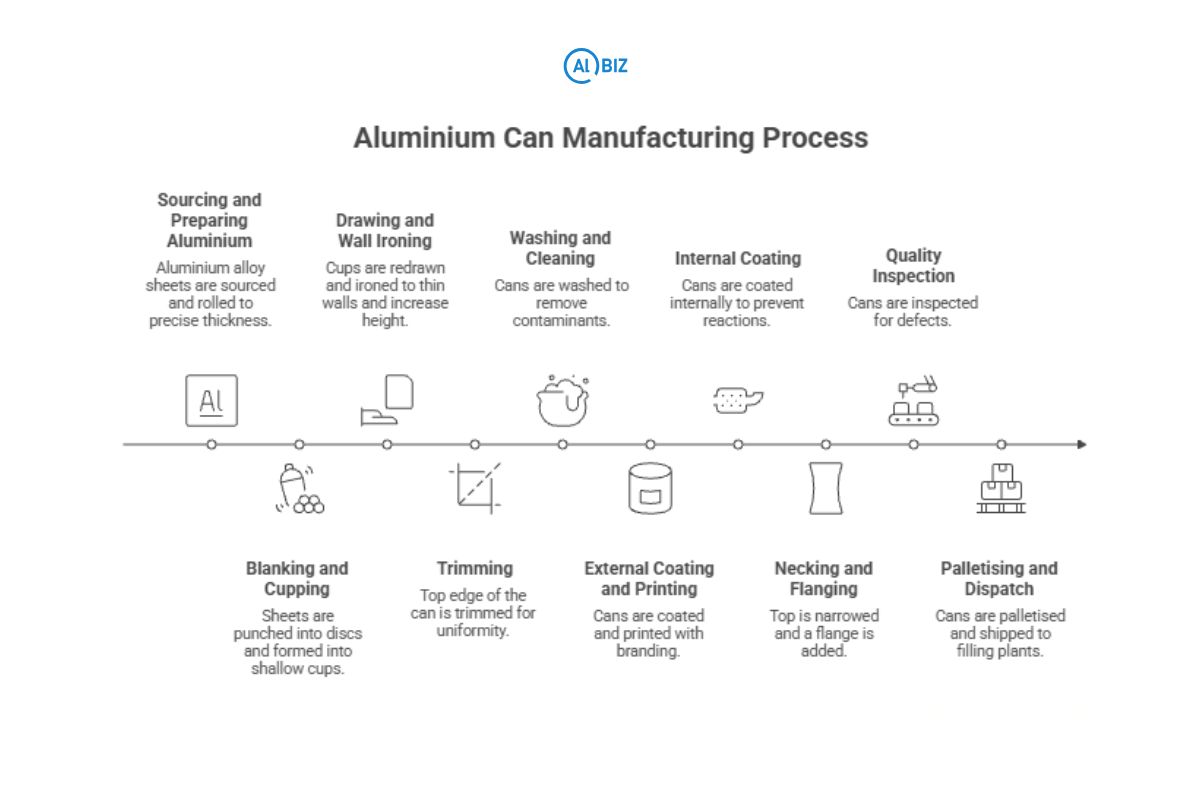
Step 1: Sourcing and preparing the aluminium
It all starts with aluminium alloy sheets. These are typically made from a mix of primary aluminium (from bauxite ore) and recycled aluminium. The sheets are rolled to a precise thickness, usually around 0.25 mm to 0.30 mm, at a rolling mill.
The alloy used for can bodies is usually 3004 aluminium sheet or 3104 aluminium coil, which offers the right balance of strength and flexibility. The lids use a slightly different alloy, often 5182, because they need to be stiffer.
Step 2: Blanking and cupping
The aluminium sheet is fed into a cupping press. This machine punches out circular discs (called blanks) and immediately forms them into shallow cups.
- Thousands of cups can be produced per minute
- The process is very fast and highly automated
- Scrap metal from the punched-out areas is collected and recycled on-site
Step 3: Drawing and wall ironing (DWI)
This is one of the most important steps. The shallow cup is pushed through a series of dies in a process called Drawing and Wall Ironing (DWI).
Here’s what happens:
- The cup is redrawn to reduce its diameter
- It’s then ironed; pushed through rings that thin the walls while making the can taller
- The base is shaped into a dome (this helps it withstand internal pressure)
By the end of this step, the can has reached close to its final height and shape. The walls are extremely thin, but very strong.
Step 4: Trimming
The top edge of the can isn’t perfectly even after the DWI process. A trimmer cuts the top to make it uniform and level. The trimmed metal is recycled.
Step 5: Washing and cleaning
The can is washed thoroughly to remove:
- Lubricants used during forming
- Metal particles
- Any surface contamination
This is important for food safety and to help the coating and printing bond properly.
Step 6: External coating and printing
Once clean and dry, the outside of the can is coated with a base coat (usually white or clear). Then it’s printed using a dry offset printing process.
- Up to 6 colours can be applied in one pass
- The ink dries almost instantly using UV or thermal curing
- A protective lacquer is applied on top to protect the print
This is where branding, nutritional info, barcodes and design elements are added.
Also read: Surface treatment guide for fabricators
Step 7: Internal coating
The inside of the can is spray-coated with a food-grade lacquer or epoxy lining. This coating:
- Prevents the contents from reacting with the metal
- Protects the aluminium from acidic or carbonated drinks
- Keeps the taste and quality of the product intact
The coating is then cured in an oven to harden it.
Step 8: Necking and flanging
You might have noticed that the top of the can is slightly narrower than the body. That shape is created in the necking stage.
- The top is compressed inward in multiple steps to form the neck
- A flange (a small outward lip) is then added at the very top
The flange is what the lid seals onto later, once the can has been filled.
Step 9: Quality inspection
Before cans leave the factory, they go through strict checks:
| Check | What it tests |
| Light inspection | Detects holes or thin spots in the wall |
| Air pressure test | Confirms that the can holds pressure |
| Coating thickness check | Ensures even internal coating |
| Visual/camera check | Flags printing defects or dents |
| Dimensional check | Confirms height, diameter and flange |
Faulty cans are rejected and recycled. Reject rates in modern plants are very low.
Step 10: Palletising and dispatch
Approved cans are stacked, wrapped and loaded onto pallets. They’re then shipped to filling plants, beverage companies, food manufacturers or contract fillers. Here, the cans are filled, sealed with a lid and packed for retail.
Aluminium can lid manufacturing
The lid (also called the end) is made separately from the can body.
Here’s how:
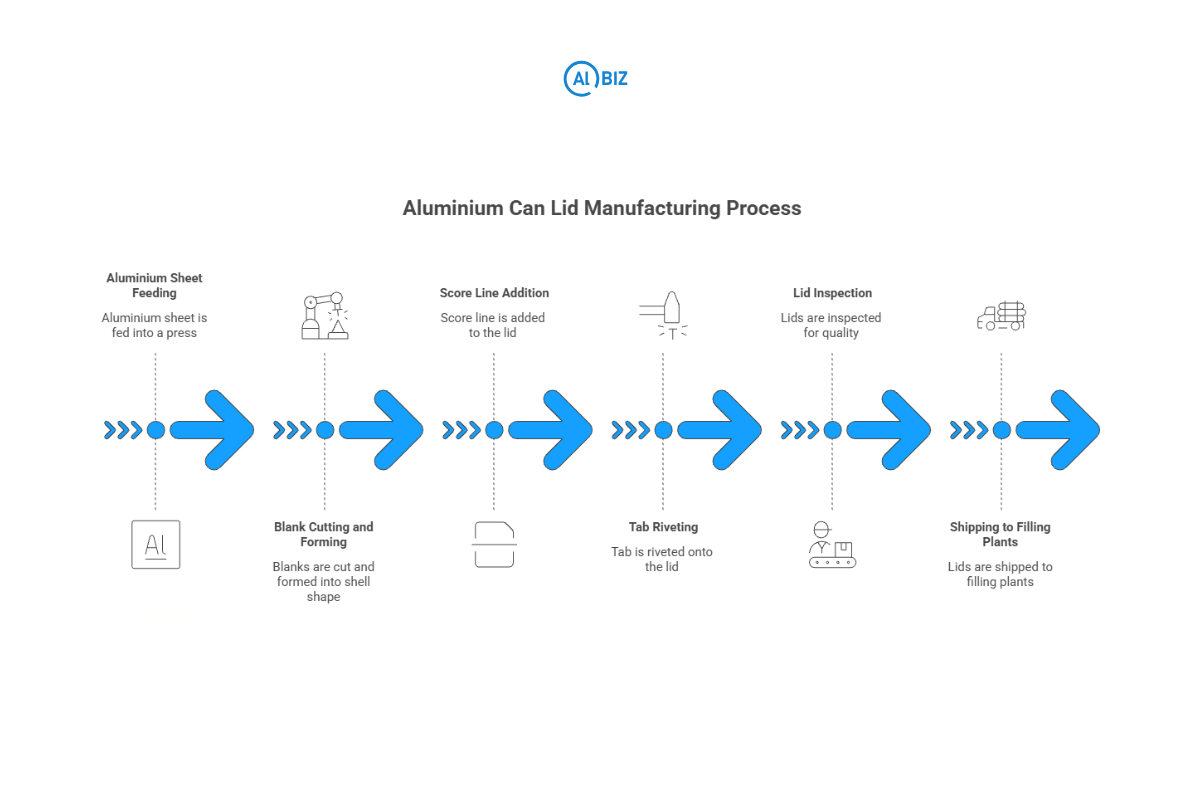
- Aluminium sheet (5182 alloy) is fed into a press
- Circular blanks are cut and formed into the shell shape
- A score line is added. This is what makes the ring-pull tab work
- The tab is riveted onto the lid
- Lids are inspected and shipped to filling plants
The lid is seamed onto the filled can using a double seaming machine, which folds and presses the lid flange and can flange together in two stages to create a hermetic (airtight) seal.
Applications of aluminium cans
Aluminium cans aren’t just for drinks. Here’s a broad look at where they’re used:
Beverage industry
| Application | Examples |
| Carbonated soft drinks | Cola, lemonade, sparkling water |
| Energy drinks | Standard 250ml and 500ml formats |
| Beer and cider | Standard and slim-line formats |
| Still and sparkling water | Increasingly replacing plastic bottles |
| Juices and iced teas | Ambient and chilled formats |
| Alcoholic ready-to-drink (RTDs) | Pre-mixed cocktails, hard seltzers |
Food industry
- Tinned vegetables like sweetcorn, tomatoes and peas
- Soups and broths
- Canned fish like tuna, sardines and salmon
- Pet food, such as canned food for cats and dogs
- Pulses and beans
Non-food and industrial applications
- Aerosol cans: Deodorants, hairsprays, spray paints
- Pharmaceuticals: Pressurised inhalers
- Household products: Furniture polish, insecticides
- Automotive: Some lubricant and fluid products
Check out our report: Aluminium Flat Rolled Products: Insights & Forecast to 2032
A quick reference to can sizes
| Can size | Volume | Common use |
| Slim / Sleek | 150ml – 250ml | Energy drinks, spirits |
| Standard | 330ml | Soft drinks, beer |
| Tall / King | 440ml – 500ml | Beer, energy drinks |
| Large | 568ml (1 pint) | Beer |
| Jumbo | 750ml – 1L | Iced teas, speciality drinks |
The recycling and sustainability angle of aluminium cans
Aluminium is one of the most recycled materials in the world and for good reason.
- Recycling aluminium uses 95% less energy than producing it from raw ore
- A recycled can can be back on the shelf in as little as 60 days
- Aluminium can be recycled indefinitely without losing quality
- In the UK, around 75% of all aluminium ever produced is still in use today
For manufacturers, this makes aluminium a smart long-term choice, both economically and environmentally.
Summary
Aluminium can manufacturing is a precise, high-speed process. From raw alloy sheet to finished container, every step matters. The tolerances are tight, the quality checks are constant and the output has to be consistent at scale, often millions of cans per day in a single plant.
It’s a well-established industry, but it’s also evolving. Thinner walls, lighter lids, better coatings and higher recycled content are all areas of active development.
And demand isn’t slowing down. As more brands move away from plastic, aluminium cans are picking up that business across food, drink and household products. For all types of aluminium packaging requirements, from raw materials to equipment, post your RFQ (request for quotation) on our marketplace to get quotes from trusted suppliers and manufacturers.


 Voyagerman Technology


