




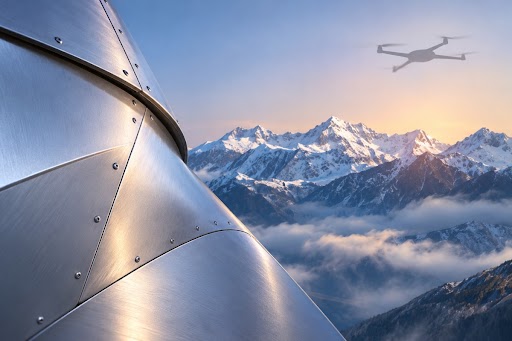
If you ask anyone who has flown a heavy drone above 15,000 feet, they will tell you that the aircraft they tested on the plains isn’t the one they get up there. At 19,000 feet, the air is about half as dense as at sea level; cold enough to sap a battery before rotors have done much work. Specifications and simulations developed around lowland operating conditions do not always translate into reliable performance at altitude.
Advances in software, autonomy and sensing are transforming what drones can do. But these capabilities are only as effective as the aircraft that carries them.
In high-altitude operations, structural engineering, propulsion and thermal management deserve equal consideration.
Where the trouble starts
A multirotor flies up by pushing air down. At higher altitudes, thinner air reduces the thrust produced by a given propeller operating at a given speed. To maintain the required lift, the propulsion system must work harder, often demanding higher rotational speeds and greater electrical power. But you can’t allocate more weight to a battery, as that will compromise the payload capacity. Every kilo spent on structure is a kilo that can’t be payload and the trade-off gets harsher as you go higher.
Why metal
The choice of an airframe material should not be made on theoretical advantages or specifications alone. It must emerge from repeated testing, evaluation and optimisation against the demands of the environment you want to operate in. Structural integrity, impact behaviour, thermal considerations, maintainability and weight all need to be assessed under real operating conditions.
For heavy-lift platforms working in remote, high-altitude terrain, a CNC-machined aluminium monocoque (where the skin itself carries the load) offers advantages that matter more than the weight saved. Five stand out:
Impact resistance: Aluminium may deform under load but the damage is visible and often repairable in the field. Carbon fibre, on the other hand, is brittle and can crack or shatter under point loads, and such damage can’t be repaired. You have to replace the entire equipment, leading to high costs.
Thermal behaviour: Aluminium is a thermal conductor and distributes heat evenly from motors and electronics across the airframe, which makes heat management easier. Carbon fibre is a thermal insulator; it traps heat, and over time this can lead to delamination.
Electromagnetic compatibility (EMC): A metal structure offers better EMI shielding and helps limit electromagnetic interference between wiring and avionics. Carbon fibre is less effective as a shield, which makes EMI harder to manage and can distort signals.
Vibration and fatigue: Aluminium copes well with low-frequency, high-amplitude vibration and resists the micro-fractures that can develop under it. Carbon fibre is more susceptible to fatigue damage and is less durable over the long term under these conditions.
Replaceability and maintenance: A modular, CNC-machined assembly creates a monolithic structure in which individual parts can be replaced or repaired in the field. Carbon-fibre airframes join multiple materials, which adds manufacturing complexity and failure points, and a failure often requires replacement of the complete module.
Why monocoque?
A monocoque structure uses its outer skin to carry and distribute structural loads, reducing the need for a separate internal framework. This can improve structural integration, reduce joints and fasteners, and simplify assembly. In environments with significant temperature fluctuations, multiple joints and interfaces can experience differential thermal expansion and contraction, potentially introducing stress and contributing to loosening, fatigue or structural damage. A well-engineered, single-piece monocoque can minimise these interfaces, improving structural continuity and reliability.
To sum it up, it is not a one-size-fits-all answer. Where speed matters, carbon fiber may seem like a tempting option. But for a heavy-lift logistics platform operating in high-altitude terrain, I would argue that metal makes more sense: you can compromise a little on weight, but you get an aircraft that can be kept flying where it counts.
Propulsion you can tune
Motors and propellers chosen for sea level don’t just carry over. Reduced air density changes propeller thrust and torque characteristics, while the motor must operate within different power and thermal constraints. Lower ambient temperatures can affect battery discharge performance, even as reduced air density influences the effectiveness of convective cooling. These factors make it important to develop the motor, propeller and battery as an integrated propulsion system, rather than treating them as independent components. Their performance must be constantly evaluated against the aircraft’s operating environment.
That’s why developing propulsion capability in-house can offer greater control over this process. It allows engineering teams to adapt the system to specific payload, altitude, endurance and environmental requirements, rather than relying entirely on off-the-shelf configurations designed for different operating conditions.
There’s also the plain matter of access. For strategic logistics, the ability to operate an aircraft is only one part of the requirement. The ability to maintain it, source spares and keep it mission-ready over time is equally important. A drone supporting an Army post in a remote mountain location, or delivering supplies to a flood-affected district, cannot afford to remain grounded because a critical component is unavailable or dependent on a disrupted overseas supply chain.
Flying where you can’t see
Mountain operations are routinely beyond visual line of sight (BVLOS): ridges block the view, winds change minute by minute, and distances are long, so the pilot cannot see the aircraft for much of the route. The two terms are not interchangeable. BVLOS describes where the aircraft is relative to the pilot; autonomy describes who is flying it. A BVLOS flight can still be piloted over a command link, but where that link is intermittent, the drone must be capable of autonomous flight, holding its route and making decisions on its own. At high altitude, that includes managing its power reserves carefully, because there is little margin to spare.
Heavy-lift UAVs are poised to play an increasingly important role in remote supply, medical delivery and disaster response, particularly in regions where conventional logistics networks struggle to reach. Their long-term value, however, will not be defined by the performance records they set, but by their ability to deliver reliably, mission after mission, week after week. Achieving that reliability demands an evidence-led approach to material selection, propulsion systems developed for their intended operating environments, and a continuous cycle of learning and refinement driven by field experience.
Ultimately, the measure of a high-altitude logistics aircraft is not merely how high it can fly or how much it can carry, but how dependably it can perform when conditions are at their most demanding. The future belongs to aircraft engineered not just to reach difficult places, but to deliver when reaching them matters most.