




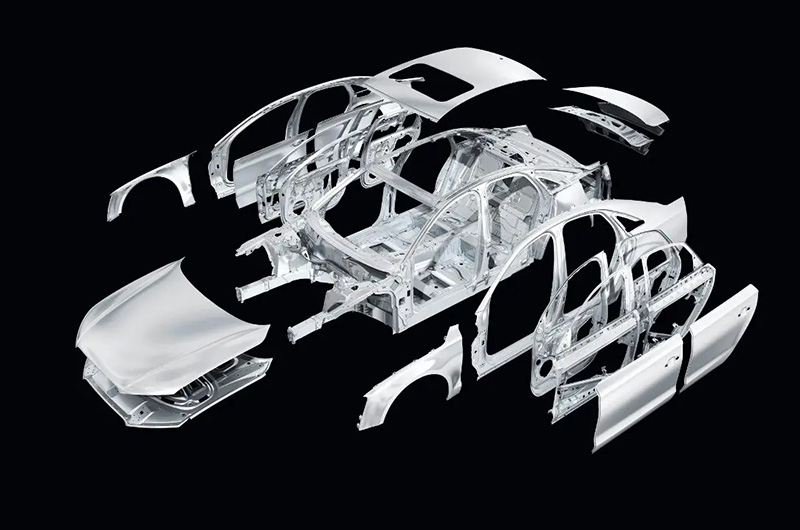
Automotive aluminium sheet is not a single, interchangeable product. A grade selected for a door inner or structural reinforcement has a different job from one selected for a visible bonnet or door outer. Buyers comparing 5182, 5754 and 6016 need to consider forming, strength, corrosion performance, surface quality and the vehicle maker’s process, not just alloy numbers or price per tonne.
5182 and 5754 are 5xxx-series aluminium-magnesium alloys strengthened primarily by work hardening. 6016 is a 6xxx series aluminium-magnesium-silicon alloy that can be strengthened by heat treatment. This distinction shapes how each grade behaves at the press shop and during paint finishing. The European Aluminium Automotive Manual lists 5182 for structural parts and inner panels, 5754 for chassis, axles and wheels, and 6016 for body-in-white and outer panels.
5182: Strength and formability for inner panels
EN AW-5182 is a higher-magnesium 5xxx alloy. In the annealed O temper, it combines relatively high strength with good formability, making it useful for press-formed components that need to retain strength after shaping. Automotive uses include inner body panels, door inners, hood inners, reinforcements and selected structural components. It may also appear in closures as the inner part of a multi-piece assembly, paired with an outer skin made from a different alloy.
A review of body materials records 5182 in inner panels and reinforcement members, including the weight-reduced front end of the BMW E60. This is a design example, not a universal specification; OEM choices vary by model and production route.
For a buyer, “5182” alone is not enough to qualify an offer. Confirm temper, thickness, width, coil or sheet format, surface condition, flatness, mechanical-property range and the required automotive specification. Also check forming performance for the intended part and any requirements for joining, coating or storage. 5182 typically offers a higher strength level than 5754, but the precise comparison depends on temper and supplier product variant. Novelis, for example, describes its automotive RC5754 as lower in strength than RC5182 and notes the difference in stress-corrosion-cracking sensitivity.
5754: A versatile medium-strength sheet
EN AW-5754 is another Al-Mg 5xxx grade, with less magnesium than 5182. It is commonly selected where a balance of medium strength, corrosion resistance, weldability and formability is needed. Automotive and transport applications can include inner panels, load floors, structural sheets, brackets and other formed parts. The European Aluminium Automotive Manual also lists chassis, axle and wheel applications, so the grade’s role is broader than visible car-body skins.
A published review identifies 5754 in inner body panels, structural sheet applications, load floors, door inners, hood inners and reinforcement components. It also reports examples of 5754 in cockpit carriers for the Audi A6 and A7.
For trade, 5754 can suit buyers seeking automotive-grade sheet for formed interior or structural parts, but it must still meet the end user’s defined standard. Ask whether the requirement is for a specific temper such as O or Hxx, and whether the buyer needs coil, cut-to-length sheet or blanks. Surface finish and dimensional tolerances matter too, particularly where forming, welding or coating follows. Do not assume that a general-purpose 5754 sheet certificate will meet an automotive approval or OEM qualification.
6016: Outer panels and paint-bake response
EN AW-6016 is a heat-treatable 6xxx alloy used extensively for automotive body-in-white and outer-panel applications. It is typically supplied in a T4-type condition: soft enough to form into complex panel shapes, then strengthened during the paint-bake cycle through age hardening. A technical paper on 6016 variants specifically addresses outer body panels, bake hardening, formability and surface quality.
Common applications include bonnet (hood) outers, doors, roofs, boot (trunk) lids and fenders, especially where visible surface appearance and dent resistance matter. In a door or bonnet assembly, 6016 may be used for the outer skin while a 5xxx grade such as 5182 or 5754 is selected for the inner panel, depending on design requirements. SAE research on closure selection describes a 6016 outer / 5182 inner combination as one option when torsional rigidity and weight reduction are important.
6016 sheet needs tight control of surface quality, thickness consistency, forming behaviour and paint-bake response. Buyers should specify the exact temper or supplier variant, surface class, thickness and width tolerances, intended panel, and the required forming and bake cycle. A coil that meets a broad alloy designation may still be unsuitable if it does not meet the automaker’s surface, hemming or paint-finish requirements.
How to compare the three grades
| Grade | Typical application starting point | Why it may fit | Key checks for buyers |
| 5182 | Inner panels and reinforcements | Higher strength and formability for press-formed parts | Temper, dimensions, mechanical-property range and automotive specification |
| 5754 | Medium-strength formed parts, floors and structural sheet | Corrosion resistance with a balance of formability and strength | Temper, product form, surface finish and dimensional tolerances |
| 6016 | Exposed outer body panels | Forms well and can gain strength during paint baking | Temper or supplier variant, surface class, forming and bake-cycle requirements |
Finding automotive sheet suppliers and buyers
For traders, processors and manufacturers, a relevant listing can make automotive sheet offers easier to discover and compare. AL Circle’s automotive sheet product listings provide a focused category for buyers and sellers to present automotive sheet requirements or available material. A clear listing should identify the alloy and temper, dimensions, product form, origin, quantity, surface condition, certificates and delivery terms. This helps reduce avoidable follow-up and improves the chance that an enquiry reaches a supplier with suitable stock or production capability.
The broader AL Circle B2B marketplace connects companies across the aluminium value chain. A listing does not replace technical approval, independent inspection or direct qualification with an automotive customer. It can, however, help traders make their offer visible to relevant businesses and help buyers find potential sources for a defined requirement.
Closing: Specify the part before the grade
5182, 5754 and 6016 each serve a distinct role in automotive sheet. The first two are magnesium-bearing 5xxx grades often used in inner and structural applications; 6016 is a heat-treatable 6xxx grade commonly used for outer panels. The right choice depends on the component and production route, supported by the exact temper, dimensions, surface and quality requirements. For support in connecting a defined aluminium requirement with relevant market participants, explore AL Circle’s trade assistance for buyers and sellers.