










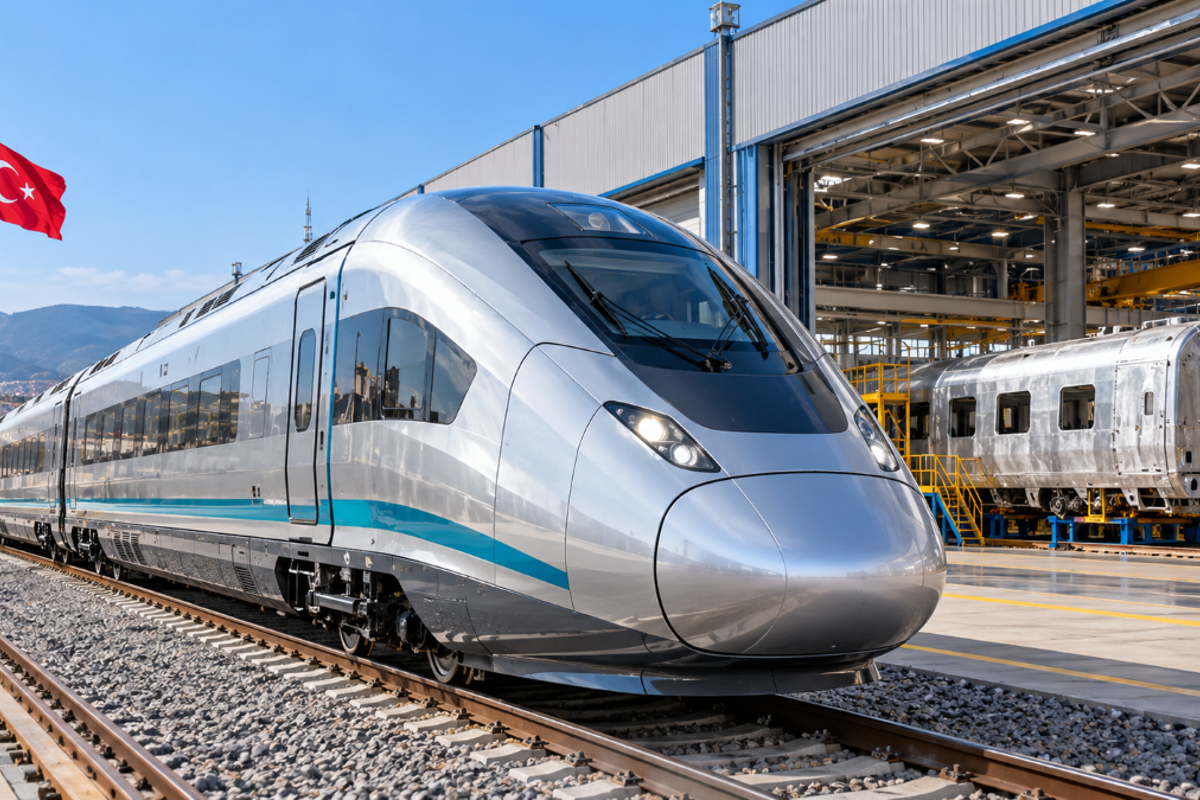

What does it take to move from a domestically developed high-speed train prototype to large-scale manufacturing? In Türkiye, aluminium-bodied railcars, locally developed train systems and a purpose-built production facility are bringing that ambition closer to reality.
State-owned TÜRASAŞ has begun manufacturing the second train set of Türkiye’s first domestically developed high-speed electric train, while the first continues its testing programme. With 14 train sets planned for production across 2027 and 2028, the project marks a significant step towards establishing a domestic high-speed rail fleet.
At the centre of this programme is aluminium, forming the body of a train designed to carry hundreds of passengers at high speeds.
When high-speed rail meets aluminium engineering
Each train will comprise eight aluminium-bodied railcars with a passenger capacity of 577 and a maximum commercial operating speed of 225 km/h. The first train set has already reached 250 km/h during dynamic safety testing, following an earlier run at 240 km/h.
The use of aluminium bodies places the metal at the heart of this next phase of rail manufacturing. In high-speed transport, material selection is an important part of vehicle engineering, where structural requirements, operating performance and passenger capacity must be considered together.
For aluminium, the application also highlights its role beyond conventional transport components. Here, the metal forms the body of a complete high-speed train, demonstrating its place in the development of advanced rail vehicles.
Beyond aluminium bodies, a locally developed rail ecosystem
The programme extends beyond the manufacture of aluminium-bodied railcars. Türkiye is also focusing on developing essential train systems domestically, bringing multiple elements of the vehicle under local engineering capabilities.
The Train Control and Management System (TCMS) and traction system were designed and manufactured in collaboration with ASELSAN. Other onboard features include automatic air conditioning, passenger information systems, CCTV cameras, fire detection systems and electromechanical doors.
The trains will also incorporate accessibility features, including dedicated spaces for people with reduced mobility and wheelchair access.
Together, these developments reflect a broader manufacturing objective. The transition from a domestically developed prototype to series production involves not only building the vehicle but also integrating the systems and infrastructure required to support its operation.
A new factory to support production at scale
Supporting this transition is TÜRASAŞ’s new high-speed train factory in Sakarya, where construction is 90 per cent complete. Spread across approximately 18,000 square metres, the facility is being developed to bring production, assembly and testing processes together under one roof. Once completed, it is expected to have the capacity to produce one high-speed train per month.
The manufacturing timeline is equally significant. TÜRASAŞ plans to produce seven train sets in 2027 and another seven in 2028, taking the total to 14 train sets over the two years. The second train set is already under manufacture, while testing of the first continues. This parallel progress in testing and production signals a move towards a more structured manufacturing programme, supported by dedicated industrial infrastructure.
Could high-speed rail create new opportunities for aluminium?
Türkiye’s high-speed train programme highlights how aluminium is being incorporated into the development of advanced transport infrastructure. With aluminium-bodied railcars forming the basis of the new trains, the project provides an example of the metal’s role in applications that demand integrated engineering and specialised manufacturing capabilities.
The planned expansion from prototype development to series production also places material selection within a broader industrial context. As domestic manufacturing capabilities develop, aluminium remains a key part of the vehicle architecture being brought into production.
The next milestone will be the completion of the Sakarya factory and the progression of the planned manufacturing programme. If the schedule advances as intended, Türkiye will move closer to establishing its own fleet of domestically developed high-speed trains.
For the aluminium industry, the project offers a reminder that opportunities extend beyond established applications. As rail systems evolve and countries invest in domestic manufacturing, aluminium-bodied trains represent another intersection of material engineering, transport technology and industrial development.
Source: Turkiye begins mass production of aluminium-bodied high-speed trains