




Abstract
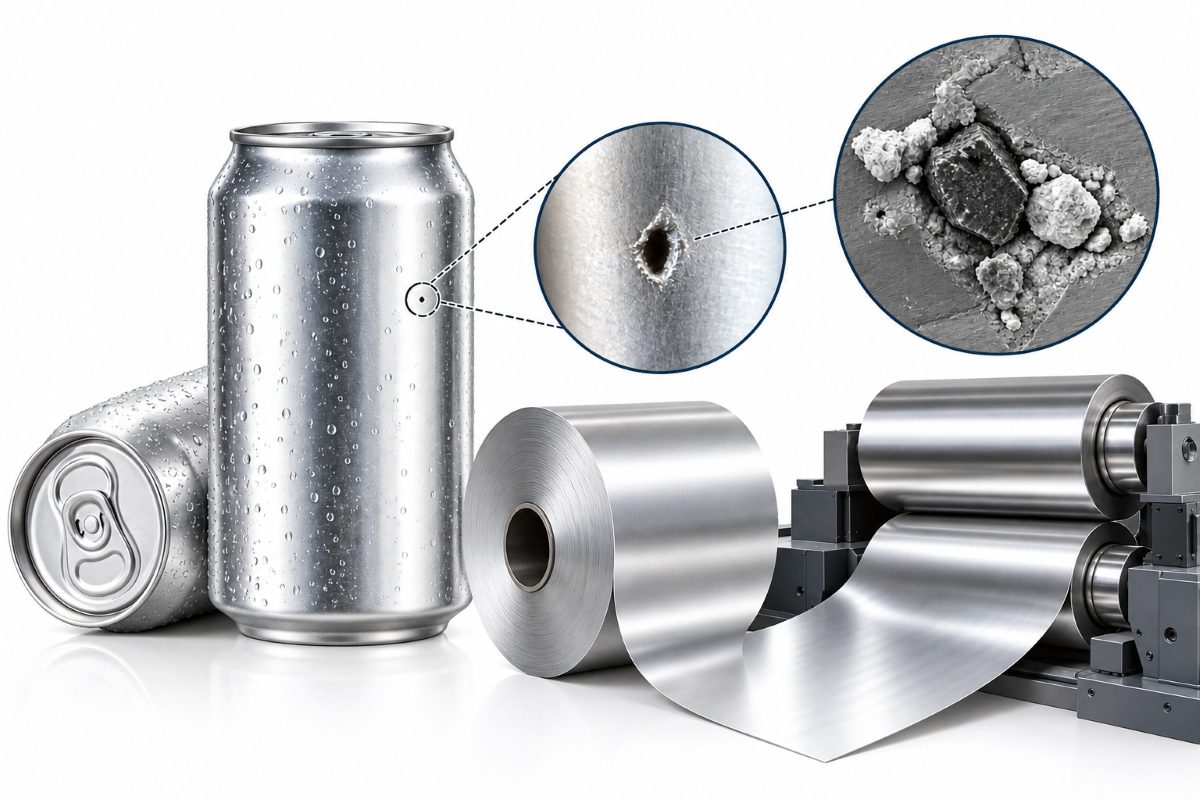
This study analysed the mechanism responsible for pinhole formation in the beverage cans made from the AlMn1Mg1 alloy during the forming stage. Evaluations using scanning electron microscopy coupled with energy-dispersive spectroscopy (SEM/EDS) revealed that the defect was caused by incrustation of (Al-O-Ti) and (Fe-Cr-Mn) particles originating from the sheet rolling process.
During the investigation, it was determined that the (Al-O-Ti) particle originated from a piece of peripheral equipment used in the aluminium hot rolling process. The detachment of this particle was caused by a manufacturing defect in the equipment. Meanwhile, the (Fe-Cr-Mn) particle was identified as the result of friction between the hard (Al-O-Ti) particle and the rolling mill roll.
After the defective equipment was replaced, the surface quality of the aluminium sheet returned to the level of excellence required for the application.
Introduction
The AlMn1Mg1 aluminium alloy is widely used in the manufacture of beverage cans, and this is no coincidence. Its combination of lightness, mechanical strength, excellent formability and high thermal conductivity makes it the ideal material for beverage packaging.
The aluminium can is one of the most common forms of packaging in everyday life and, at the same time, one of the most advanced in terms of engineering, sustainability and logistics.
Among its key advantages is its low specific weight, which makes the cans lighter, easier to transport and convenient to handle, especially in outdoor events such as gatherings with friends or leisure time at the beach. Furthermore, aluminium’s high thermal conductivity allows the beverage to quickly reach the ideal drinking temperature.
Another essential aspect is its ability to act as a protective barrier. Aluminium blocks the entry of light, oxygen, moisture and microorganisms, preserving the beverage’s flavour, aroma and quality for longer.
From an environmental perspective, the aluminium can stands out as the most sustainable packaging option due to its recyclability. It can return to the same application without any loss of properties, reducing greenhouse gas emissions by 95% when recycled. A can discarded today can return to store shelves in about 60 days, completing a rapid cycle that decreases the need for raw material extraction and significantly reduces environmental impacts.
A pinhole is a defect that arises during the ironing operation, caused by various factors such as microstructural inclusions, die chips, sidewall damage, scratches, or rolled-in dirt on the sheet surface.
Problem description
The canmakers operate high-precision equipment equipped with light-based inspection systems that check 100% of the units produced. Whenever a defect is detected, the can is automatically discarded. Because of the rigorous control, the factories achieve high levels of quality.
At a certain point, a canmaker observed an increase in the pinhole rate during the ironing stage and immediately notified the aluminium supplier. A technical visit was then conducted to better understand the issue, record process conditions and collect samples for detailed analysis.
Defect characterisation
The characterisation of the incrustation was conducted using scanning electron microscopy combined with energy-dispersive spectroscopy (SEM/EDS). The analyses revealed that the incrustation consisted of two distinct types of particles: One composed of the elements Al-O-Ti and the other containing Fe-Cr-Mn.
Investigating the root cause
The domestic market has consistently produced beverage cans made from the AlMn1Mg1 alloy while maintaining high standards of excellence. However, at one point, a canmaker reported the occurrence of pinholes in the can wall. Initial laboratory analyses indicated that the defect was associated with the presence of an incrustation formed by (Al-O-Ti) and (Fe-Cr-Mn) particles. Figure 1 shows this incrustation in the defect area, as observed via SEM.
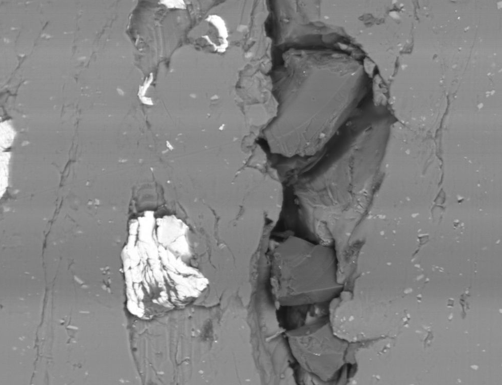
Figure 1: Embedded particles in the aluminium can surface. The dark particle corresponds to the composition (Al-O-Ti), while the light particles are composed of (Fe-Cr-Mn).
Several cans exhibiting the same defect were examined and the same incrustation was identified in all of them. To determine the origin of this incrustation, a multidisciplinary team was formed, comprising engineers, process technicians, rolling line operators, a technical assistant and a metallographic analyst specialising in SEM/EDS. The investigation was conducted using standard failure analysis tools, such as: The Is/Is Not matrix and the 5 Whys.
Specific actions were defined, including the inspection of the rolling mill, the rolling table and peripheral equipment. Another measure adopted was the collection of small samples of materials that could be related to the defect.
The analysis covered all stages of the process, from ingot preparation to hot and cold rolling. A total of 12 samples were collected, including fragments of furnace refractories, abrasive materials such as sandpaper, oil filter residues and debris from the rolling table. All samples were analysed using SEM/EDS. The results indicated the presence of particles containing (Al-O-Ti) in a peripheral equipment used in hot rolling. Meanwhile, the ferrous particles (Fe-Cr-Mn) exhibited a composition consistent with that of the rolling roll.
Corrective actions: Restoration of aluminium quality
A process audit of the equipment was conducted and a detailed inspection revealed that the particle was detaching very easily. Given this finding, the equipment was replaced and the supplier was immediately contacted.
A technical visit was conducted at the rolling line to collect samples and gather information regarding the failure. The supplier subsequently confirmed that the issue was linked to a defect in the equipment’s manufacturing process. In response to this failure, a specific action plan was developed and implemented to permanently correct the issue.
Conclusion
A failure occurred in the manufacturing process of the equipment coupled to the hot rolling mill, resulting in the detachment of particles containing (Al-O-Ti). These particles became embedded in the sheet surface during rolling. Meanwhile, the ferrous particle containing (Fe-Cr-Mn) was generated by friction between the hard aluminium oxide particle and the rolling roll, causing the removal of small metal fragments that also became embedded in the sheet.