




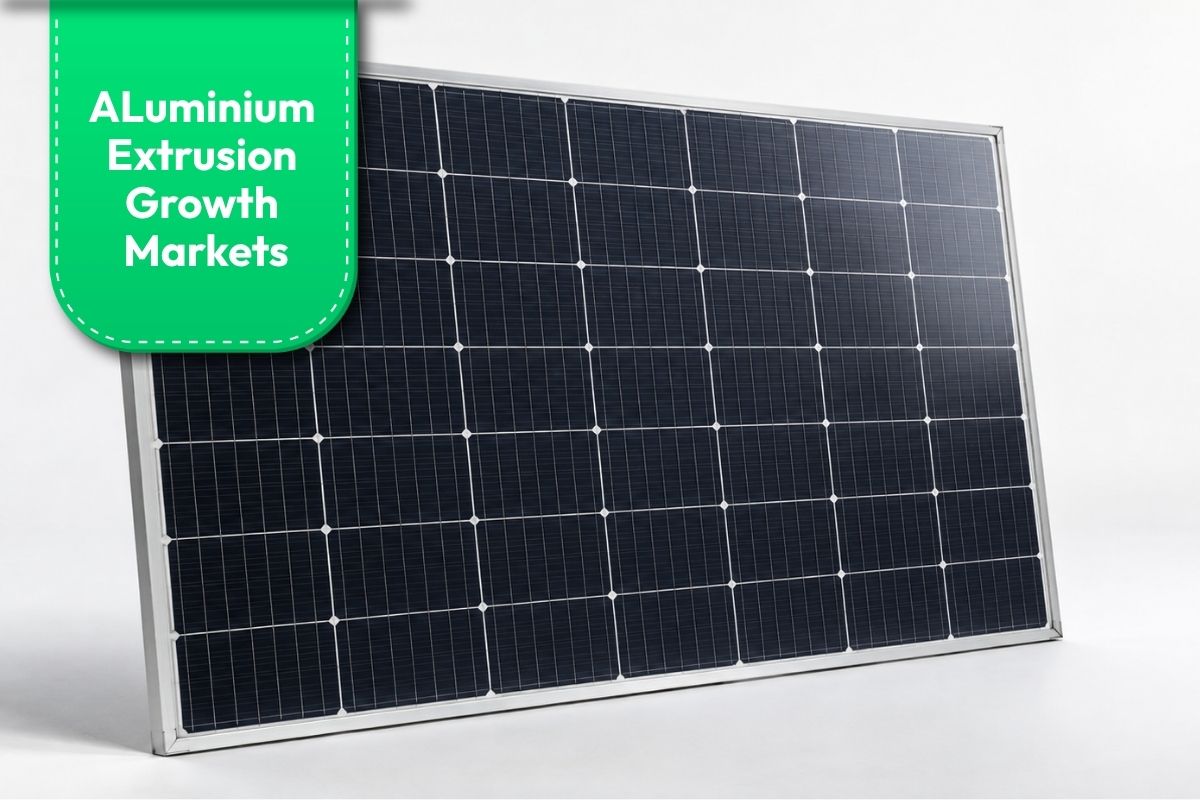
Solar installations must operate outdoors for decades while facing wind loads, temperature fluctuations, moisture, dust, salt and continuous mechanical stress. Although photovoltaic modules receive most of the attention, the mounting system determines whether those modules remain securely positioned throughout the project’s operating life.
This is why solar aluminium extrusion has become central to rooftop, ground-mounted and building-integrated photovoltaic systems. Extruded aluminium combines a high strength-to-weight ratio with corrosion resistance, dimensional accuracy and the ability to create complex, installation-ready profiles.
However, not every extruded profile is suitable for a solar project. Buyers must evaluate profile design, alloy, temper, tolerances, surface treatment and structural performance before selecting an aluminium extrusion for solar mounting.
Where are aluminium extrusions used in solar systems?
Extruded aluminium components are used across the module and mounting assembly. Common applications include:
- Solar panel perimeter frames
- Mounting rails and support beams
- Rooftop mini rails
- End clamps and mid clamps
- Brackets, connectors and splice plates
- Adjustable tilt structures
- Cable-management channels
- Tracker-system components
- Building-integrated photovoltaic profiles
Each component performs a different function. A solar panel aluminium frame, for example, protects the edges of the glass laminate, improves module rigidity and provides mounting points. The supporting rail must transfer wind, snow and dead loads to the roof or foundation.
Consequently, buyers should not specify every component using the same alloy, wall thickness or mechanical properties.
Common solar aluminium profile designs
Solar panel frames
A typical module frame consists of four precisely cut and joined aluminium profiles. The profile may incorporate cavities, ribs, drainage channels and screw ports. These features provide stiffness while controlling the amount of metal used.
The dimensional consistency of a solar panel aluminium frame is critical. Poorly controlled dimensions can create gaps at the corners, interfere with automated assembly or place uneven stress on the glass.
Important parameters include:
- Profile width and height
- Wall thickness
- Corner-key cavity dimensions
- Mounting-hole position
- Straightness and twist
- Cut-length tolerance
- Surface finish
- Drainage-hole configuration
Mounting rails
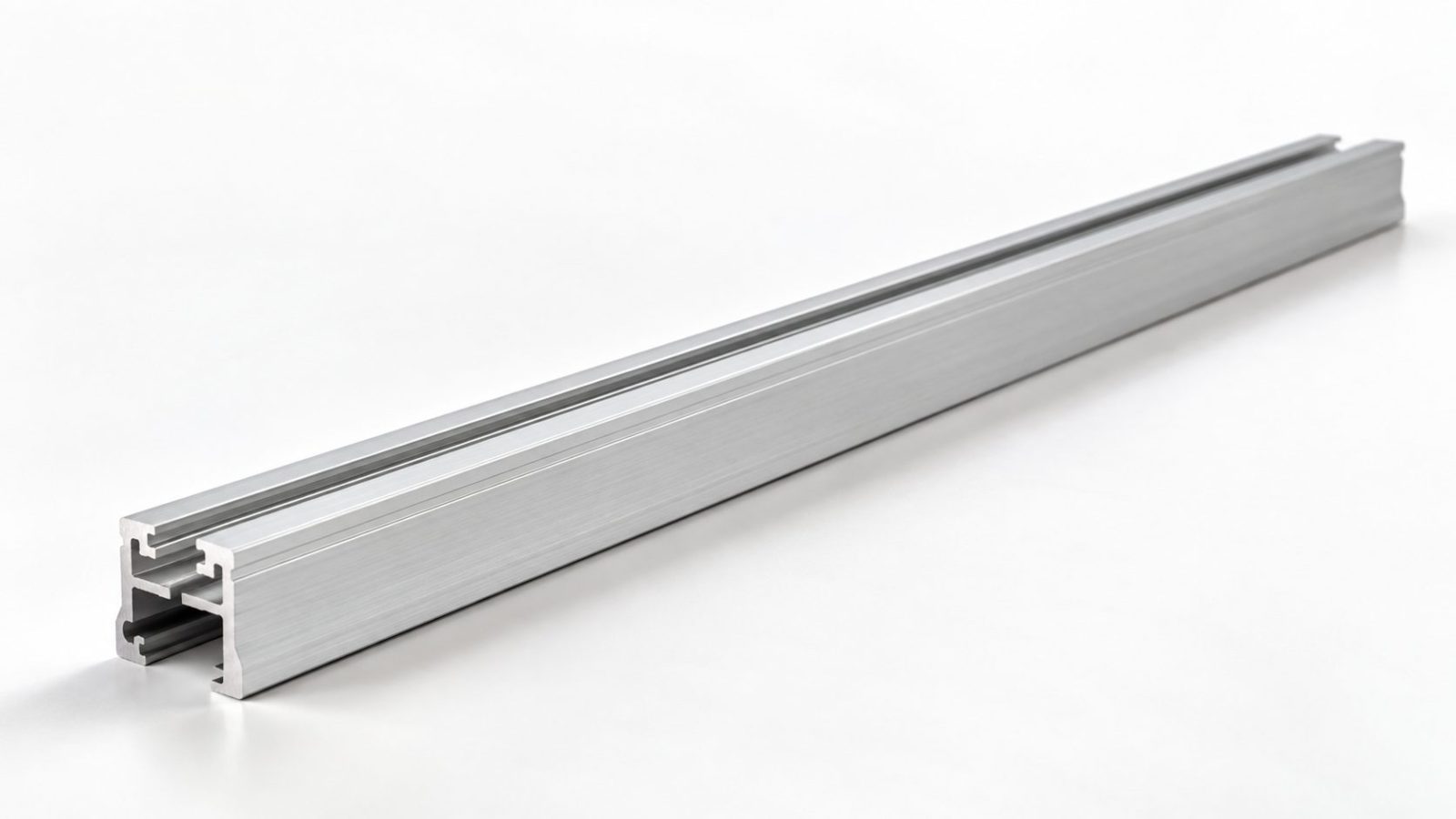
Mounting rails support framed or frameless photovoltaic modules and transfer loads to the underlying structure. Rail profiles commonly incorporate T-slots or other channels for clamps, bolts and accessories.
A well-designed solar mounting aluminium profile should balance structural strength, installation speed and material consumption. Simply increasing profile weight is not always the best solution. Rib placement, cavity geometry and section design can improve stiffness without unnecessarily increasing kilograms per metre.
Clamps and connectors
Mid clamps secure two adjacent modules, while end clamps hold the modules positioned at the outer edges of an array. Aluminium clamps are normally extruded, cut to length, machined and surface-treated.
Splice connectors join rail sections and must maintain alignment while safely transferring loads. These relatively small components should not be overlooked: incorrect dimensions, incompatible fasteners or inadequate material strength can weaken the complete mounting assembly.
Buyers can explore solar aluminium extrusion buying and selling leads when sourcing profiles and related products for solar projects.
Which aluminium alloys are used?
Alloy selection must be based on the profile’s function, mechanical requirements, manufacturability and exposure conditions.
Aluminium alloy 6063
Alloy 6063 is widely used for module frames and profiles requiring complex cross-sections, accurate dimensions and a high-quality anodised surface. It offers good extrudability and corrosion resistance.
Common tempers include 6063-T5 and 6063-T6. The required temper should be clearly stated because it affects tensile strength, yield strength and hardness.
6063 is particularly suitable for:
- Photovoltaic module frames
- Light-duty rails
- Clamps and trim profiles
- Profiles requiring an attractive anodised finish
Aluminium alloy 6005A
Alloy 6005A offers higher mechanical strength than 6063 while retaining good extrusion characteristics. It is frequently considered for load-bearing mounting rails and structural solar components.
It can be suitable for:
- Long-span mounting rails
- Ground-mounted structures
- Structural beams
- Tracker-system profiles
- Components exposed to higher mechanical loads
Aluminium alloy 6061
Alloy 6061, particularly in the T6 temper, provides good strength, corrosion resistance and machinability. It may be specified for brackets, structural connections and heavily loaded components.
However, 6061 can be more difficult to extrude into thin or intricate profiles than 6063. Buyers should therefore avoid choosing it solely because it has higher strength. The profile geometry, extrusion feasibility and total fabrication cost also matter.
Surface treatment and corrosion protection
Aluminium naturally forms a protective oxide layer, but solar applications frequently require additional surface treatment. Anodising is commonly used to improve corrosion resistance, surface hardness and appearance.
Specifications should identify:
- Anodising type
- Minimum coating thickness
- Colour, such as natural silver or black
- Permitted colour variation
- Sealing requirements
- Applicable testing standard
Coating thickness should be determined by the installation environment. A profile used in a mild inland location does not face the same exposure as one installed near the coast, in an industrial zone or in a high-humidity region.
Buyers should also evaluate galvanic corrosion when aluminium profiles come into contact with stainless steel fasteners or other metals. Appropriate washers, coatings, isolating materials and drainage provisions may be required.
Essential buyer specifications
A purchase enquiry stating only “aluminium solar profile required” is inadequate. Suppliers need a controlled technical specification to quote accurately and manufacture consistently.
A professional request for quotation should include:
1. Profile drawing
Provide a two-dimensional drawing with all critical dimensions, radii, cavities, slots and wall thicknesses. A three-dimensional model may also be required for complex profiles.
2. Alloy and temper
State the exact requirement, such as 6063-T5, 6063-T6, 6005A-T6 or 6061-T6. Do not leave the temper open if structural performance matters.
3. Mechanical properties
Specify minimum tensile strength, yield strength, elongation and hardness where applicable. Material certificates should be requested for each production batch.
4. Dimensional tolerances
The specification should cover wall thickness, cross-sectional dimensions, straightness, flatness, twist, cut length and angularity. Buyers should identify the governing standard, such as EN 755, EN 12020 or ASTM B221, depending on the market and application.
5. Unit weight
State the target or permissible profile weight in kilograms per metre. This helps control material consumption and ensures that wall thickness is not reduced without approval.
6. Surface finish
Define anodising or coating requirements, colour, coating thickness and acceptable appearance. Also specify the visible surfaces and any limits on scratches, die lines or handling marks.
7. Fabrication requirements
List all secondary operations, including precision cutting, drilling, punching, tapping, CNC machining, deburring and corner assembly.
8. Structural performance
For mounting rails and load-bearing members, provide the applicable wind, snow and dead loads. Deflection limits, support spacing, project location and design safety factors should also be communicated.
9. Packaging
Solar profiles can be damaged during transport even when their mechanical properties are correct. Packaging requirements should cover protective film, interleaving, bundle weight, moisture protection and pallet dimensions.
10. Inspection and documentation
Required documents may include:
- Mill test certificates
- Chemical-composition reports
- Mechanical-property reports
- Dimensional inspection records
- Anodising test reports
- RoHS or REACH declarations
- Country-of-origin documents
- Sample approval or first-article inspection reports
Common mistakes buyers should avoid
One common mistake is comparing suppliers only on price per kilogram. A cheaper extrusion can become expensive if it causes assembly delays, excessive rejection, structural redesign or premature corrosion.
Another mistake is accepting a profile based solely on nominal dimensions. Two profiles can look identical on a drawing but perform differently because of variations in temper, wall thickness, corner radii or heat-treatment consistency.
Buyers should also avoid ordering production quantities before validating samples. The sample should be checked for fit, assembly, fastener compatibility, surface quality and structural performance. If a custom die is required, die-trial and first-article approval procedures should be agreed before mass production.
Selecting the right supplier
The right supplier must do more than operate an extrusion press. Buyers should assess the manufacturer’s experience with solar profiles, available alloys, press capacity, die-development capability, heat-treatment controls, fabrication facilities and quality-management system.
Production capacity and lead time are particularly important for utility-scale projects. The supplier should demonstrate that it can maintain consistent profile geometry and mechanical properties across multiple batches.
Buyers can use our B2B marketplace to discover aluminium businesses, review product offerings and connect with potential suppliers. The platform’s verified aluminium suppliers section can also support the initial supplier-identification process.
Conclusion
Aluminium extrusions provide the strength, corrosion resistance, design flexibility and low weight required by modern solar mounting systems. But successful sourcing depends on matching the profile, alloy, temper and surface treatment to the component’s actual function.
For a reliable aluminium extrusion for solar mounting, buyers should issue detailed drawings, define measurable acceptance criteria and verify samples before approving mass production. The lowest quotation is not necessarily the lowest project cost. Dimensional consistency, structural performance, corrosion protection and dependable supply are ultimately what determine whether an aluminium solar mounting system performs throughout its intended service life.