





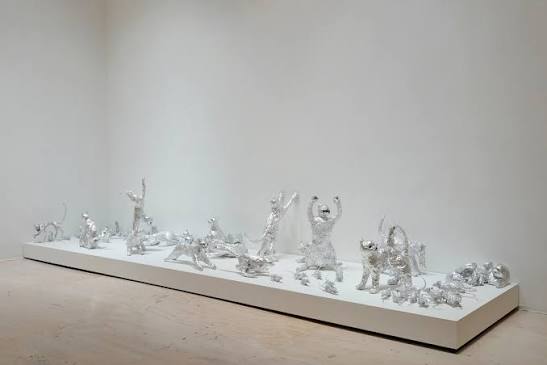
Aluminium foil is one of the most familiar forms of aluminium we encounter every day. Used primarily for packaging, food preservation and protection, it is rarely viewed as a material for something more creative. Yet its flexibility, light weight and ability to be shaped are giving it an unexpected second life as a medium for art and sculpture.
The work of self-taught artist Dean Millien, whose aluminium foil sculptures have been featured at MoMA PS1, offers a striking example of how an everyday aluminium product can be pushed beyond its conventional purpose.
When foil becomes more than packaging
Aluminium foil is designed to be thin, lightweight and highly workable. These same characteristics make it effective for packaging and also make it surprisingly adaptable for creative applications.
By folding, compressing, layering and shaping foil, complex three-dimensional forms can be created without relying on specialised materials. In larger sculptures, thicker aluminium pans can even serve as internal structures, with lighter foil built around them. What is normally used to protect a product becomes the product itself.
Formability opens new possibilities
Aluminium’s ability to take different shapes is one of the reasons it is used across such a wide range of industries. From automotive components to architectural systems, manufacturers rely on its formability to create complex and functional designs.
Foil demonstrates this characteristic in one of its simplest forms. Its thin structure allows it to be manipulated easily, while its metallic surface adds another visual dimension. In sculpture, these properties allow artists to create texture, contours and intricate forms from a material that is otherwise associated with everyday convenience.
From everyday material to creative reuse
The story also highlights an interesting aspect of aluminium’s circularity. Instead of immediately treating used foil and aluminium products as waste, they can sometimes be repurposed for entirely different uses. An aluminium pan can become a structural element, while foil can become the outer form of a sculpture.
Although creative reuse is different from industrial recycling, both reflect the same broader principle: aluminium can continue creating value beyond its original application.
Aluminium’s unexpected second life
The use of foil in sculpture may seem far removed from aluminium’s traditional industrial applications, but the underlying idea is familiar. Aluminium continues to enter new applications because its properties allow it to perform in different ways.
Its light weight, formability, durability and recyclability have already established it across packaging, transportation, construction and electrical applications. Creative reuse simply presents those capabilities from a different perspective.
The bigger picture
Aluminium foil may have been developed for practical purposes, but its story does not necessarily end there. From wrapping food to forming sculptures, the material demonstrates how innovation can sometimes come from looking at an existing material differently rather than developing an entirely new one. Aluminium foil isn’t just a packaging solution. It is a reminder that even the most familiar form of aluminium can still find an unexpected application.
Source: How everyday aluminium foil became art: Dean Millien’s scrap-to-sculpture story

 Voyagerman Technology


