








Introduction
Aluminium is widely used in applications such as beverage cans, flexible packaging, construction, transportation and household goods. Its properties, such as lightness, high thermal and electrical conductivity, good weldability, excellent formability and high recyclability, make this metal highly attractive and environmentally sustainable.
To meet the metallurgical and dimensional requirements of customers, especially regarding flatness, its production demands high-tech equipment and superior quality inputs. In hot rolling, an oil-in-water emulsion is used as a lubricant; in cold rolling, high-purity rolling oil is employed. In both processes, alcohol- and acid-based additives are added, essential for operational stability and the final quality surface of the material.
Rising rejections: When white stains became a production concern
Historically, the rolling of sheets intended for the manufacture of beverage cans had exceptional performance, with very low internal rejection rates. However, a progressive increase in these rejections was observed, accompanied by customer complaints. The problem evolved until it reached approximately 200 tonnes of internal scrap per month, associated with the appearance of a white stain.
To investigate the root cause, a multidisciplinary group was created, composed of process engineers, cold rolling and finishing machine operators, as well as an analyst from the metallographic laboratory (SEM/EDS).
Understanding the white stain: Appearance, spread & impact
The defect manifested as a white stain located on the side of the sheet (Figure 1). In most cases, the width of the stain was approximately 30 mm, which allowed for its natural elimination during trimming. In more critical cases, however, the width could reach values between 150 and 200 mm.
The stain appeared right at the beginning of the trimming process and extended for several meters along the coil, becoming consistently noticeable after the second rolling pass, with greater intensity on the upper face.
The phenomenon occurred in both wide and narrow materials, but was limited to a specific combination of thickness, alloy and temper defined by the process route.
SEM/EDS analyses revealed a transversal surface break in the affected region, suggesting that a residue was compressed during the second rolling pass, altering the hydrodynamic conditions of the rolling. A higher concentration of oxygen and carbon was also observed in the region of the defect, compared to other regions.
To eliminate the defect, it was necessary to scrap parts of the coil, resulting in losses ranging from 50 to 500 kg per coil. The plant has three rolling mills, A, B and C and the problem was identified exclusively in materials processed in rolling mill B.

Figure 1 – The stain on the surface of the sheet
From inspection to insight: How the defect was traced
To help in identifying the root cause, the cause-and-effect diagram (Ishikawa) was used, encompassing machine, method, manpower, environment, measurement and material. Based on this analysis, inspection, cleaning and process adjustment actions were established, aimed at both immediate containment and detailed investigation.
Also read: When stamping goes wrong: Investigating “Broken Surface” defects in aluminium cookers
During the inspections, it was observed that one of the rolling mill oil tanks had an excessive accumulation of a white, gelatinous residue (Figure 2). Samples were collected and analysed, revealing a composition consisting mainly of oxygen and carbon.
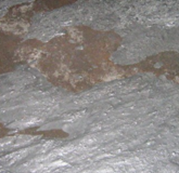
Figure 2 – White gelatinous residue
The team collected oil samples from various points in the rolling mill. Initially, they assessed the formation of residues on the surface of the samples. Subsequently, they were analysed by gas chromatography to identify additives, in addition to tests for moisture, acidity, viscosity and turbidity.
Temporary monitoring was established in the laboratory, in which oil samples were applied to aluminium sheets and kept for 24 hours to check for residue formation. After a few days of monitoring, it was found that the oil from rolling mill B left residues in different quantities.
During this period, it was also observed that the type of rolling oil was changed, along with adjustments to the parameters of the distillation unit, which decreased the efficiency of removing certain residues.
Another critical factor was the alteration of the filtration system in rolling mill B, implemented with the aim of increasing productivity, which ended up eliminating the component responsible for retaining chemical contaminants, including esters.
The root cause explained: Ester build-up & rolling impact
The reaction between alcohol and acid produces esters, which are normally removed during oil distillation. However, after oil replacement and improper adjustment of distillation parameters, some of these esters were no longer removed.
The oil filtration system is composed of several elements, but two of them are fundamental:
• One intended for the removal of solids;
• Another is responsible for retaining chemical contaminants, including esters.
With the removal of the chemical component from the filter and the lower distillation efficiency, there was an accumulation of ester in the system.
After the first rolling pass, some of the oil with residue is carried to the coil. Since ester has high viscosity, its presence alters the hydrodynamic regime in the second rolling pass, causing transverse break of the sheet surface and resulting in the white stain.
Corrective actions: Restoring oil quality & filtration efficiency
• Adjustment of the operating parameters of the distillation unit
• Reinstallation of the filtration system component responsible for removing esters from the rolling oil


 Voyagerman Technology


Interessante. Eu não fazia ideia desses detalhes no processo. Muito boa essa investigação técnica.