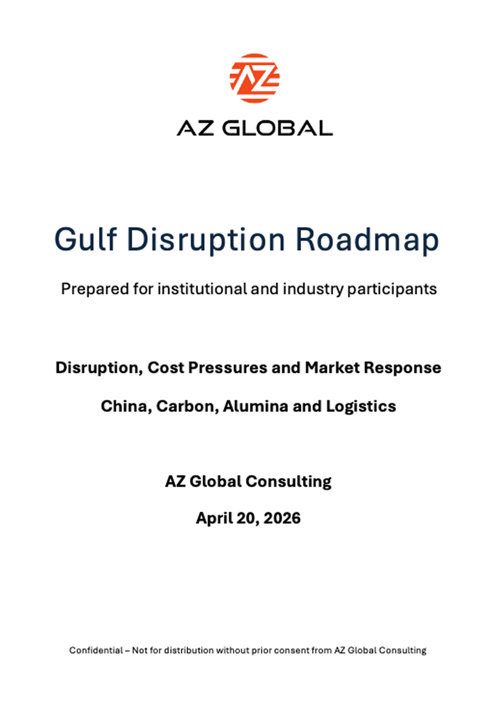
Strategic briefing on Gulf aluminium market risks, China impact, alumina supply, carbon costs, and logistics disruptions shaping pricing and trade.
Prepared for institutional and industry participants
Disruptions, Cost Pressures, and Market Response
China, Carbon, Alumina, and Logistics
A strategic briefing for decision-makers navigating a market shaped by tighter constraints and reduced flexibility
The Gulf aluminium market is entering a period of heightened strategic complexity, shaped by a convergence of structural disruptions rather than cyclical volatility. Rising energy costs, alumina supply uncertainty, carbon-related trade measures, and evolving logistics risks are redefining the operating environment for producers, traders, and downstream buyers alike. At the same time, China’s shifting export behaviour and growing influence across global aluminium flows continue to reshape pricing dynamics, trade routes, and competitive positioning. For institutional and industry participants, understanding these interconnected pressures is no longer optional—it is essential to managing exposure and identifying advantage.
Gulf Aluminium Disruption Roadmap provides a focused assessment of the forces reshaping aluminium market behaviour across the Gulf region. Prepared for institutional and industry participants, this report examines how cost pressures, supply disruptions, and market responses are unfolding across the value chain—from alumina procurement and carbon compliance to freight volatility and regional trade realignment. Designed as a strategic briefing for decision-makers, it offers a clear analysis of emerging risks, market implications, and the likely pathways through which Gulf aluminium producers and buyers will respond in an increasingly constrained global market.
This is not a conventional market environment
For years, aluminium market analysis has relied on standard signals: warehouse stocks, demand trends, regional premiums, and energy costs. However, these indicators are no longer sufficient, in isolation, to fully explain current market conditions.
The market is being shaped by a new ranking of constraints.
What began as a logistics disruption has moved upstream. Freight, transit routes, and regional dislocation were only the first signals. Today, the pressure has shifted into raw materials & consumables, energy systems, production continuity, and increasingly, carbon-linked inputs.
The result is a market that is no longer clearing efficiently. It is fragmenting.
China is operating under one set of conditions. The rest of the world is operating under another. Supply is not disappearing — it is becoming harder to reach, harder to replace, and harder to interpret.
This is the defining shift behind the aluminium market today.
Why this report matters now
Many market participants are still reading aluminium through the lens of a normal cycle. That is the mistake.
These assumptions are becoming less reliable and more commercially risky.
The aluminium market is no longer responding in a linear way. Traditional price signals are becoming less reliable. Procurement decisions based on cost optimisation alone are becoming riskier, and companies waiting for “normalisation” may be positioning too late.
This report helps decision-makers separate signal from noise — and identify where pressure is building before it becomes visible in price.
What this briefing reveals
Gulf Aluminium Disruption Roadmap provides a strategic framework for understanding how disruption is moving through the aluminium value chain — and what that means for market participants exposed to supply, pricing, procurement, and production risk.
Inside this briefing:
This is not a market commentary. It is a strategic operating framework for navigating aluminium under structural pressure and this report is particularly relevant for:
Whether you are managing physical exposure, pricing risk, procurement continuity, or strategic planning, this report provides the framework needed to navigate an increasingly constrained market environment.
Available as: