您想继续阅读英文文章还
是切换到中文?
是切换到中文?

THINK ALUMINIUM THINK AL CIRCLE

In 2019, Zambia’s real GDP growth decelerated to an estimated 2%, which was down from 4.0% in 2018. The economy was hit by drought in the south and west that lowered 2018/19 agricultural production and hydropower electricity generation considerably. Severe electricity rationing followed, and long periods of electricity load shedding dampened activity in almost all economic sectors. Zambia also faces slower mining, with reduced output and lower copper prices. Economic activity is expected to remain weak, with growth rebounding moderately to 2.4% in 2020 and 2.9% in 2021.
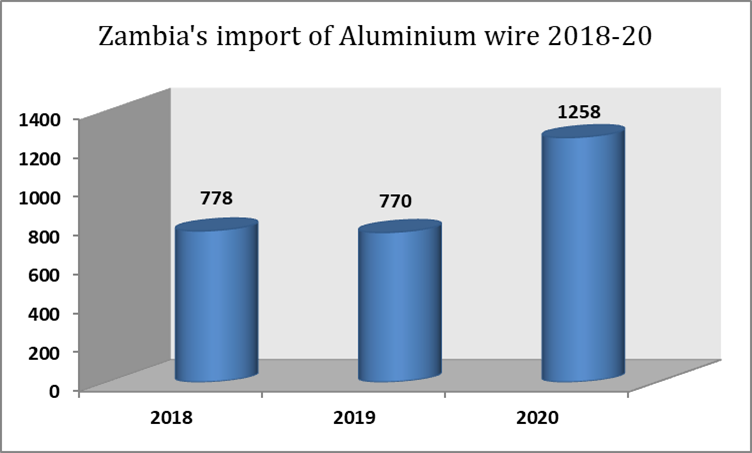
The landlocked nation at the crossroads of Central, Southern and East Africa has recorded 1548 tonnes of aluminium wire import during 2018-19. The import for 2020 stood at 1258 tonnes. However, when the import volume of 2020 gets merged with the preceding two years, it reveals 2806 tonnes.
Zambia’s import of aluminium wire in 2018 remained at 778 tonnes, whereas in 2019 the import saw a marginal drop by 1.02%, as the import volume fell to 770 tonnes.
The import for 2020 revealed an enterprising growth of 63.37%, as the import volume inclined to 1258 tonnes and the expenditure accounted at $24.22 million.

The major trading destinations for Zambia’s import of aluminium wire are China, India, Mozambique, South Africa, etc.
Responses


A proud
ASI member
AL Circle Private Limited | CIN: U72200WB2017PTC221175
Registered Office: Ecospace Business Park, Block 3A, Unit 401A, New Town, Rajarhat, Kolkata, WB 700160
Corporate Office: Ecospace Business Park, Block 3A, Unit 401A, New Town, Rajarhat, Kolkata, WB 700160
© 2026 AL Circle. All rights reserved. AL Circle is not responsible for content from external sources.