The United States bauxite imports in the first quarter of 2025 recorded both annual and quarterly declines, highlighting the nation’s ongoing shift from primary aluminium production to a greater reliance on recycled materials. This strategic transition has reduced the demand for imported bauxite.
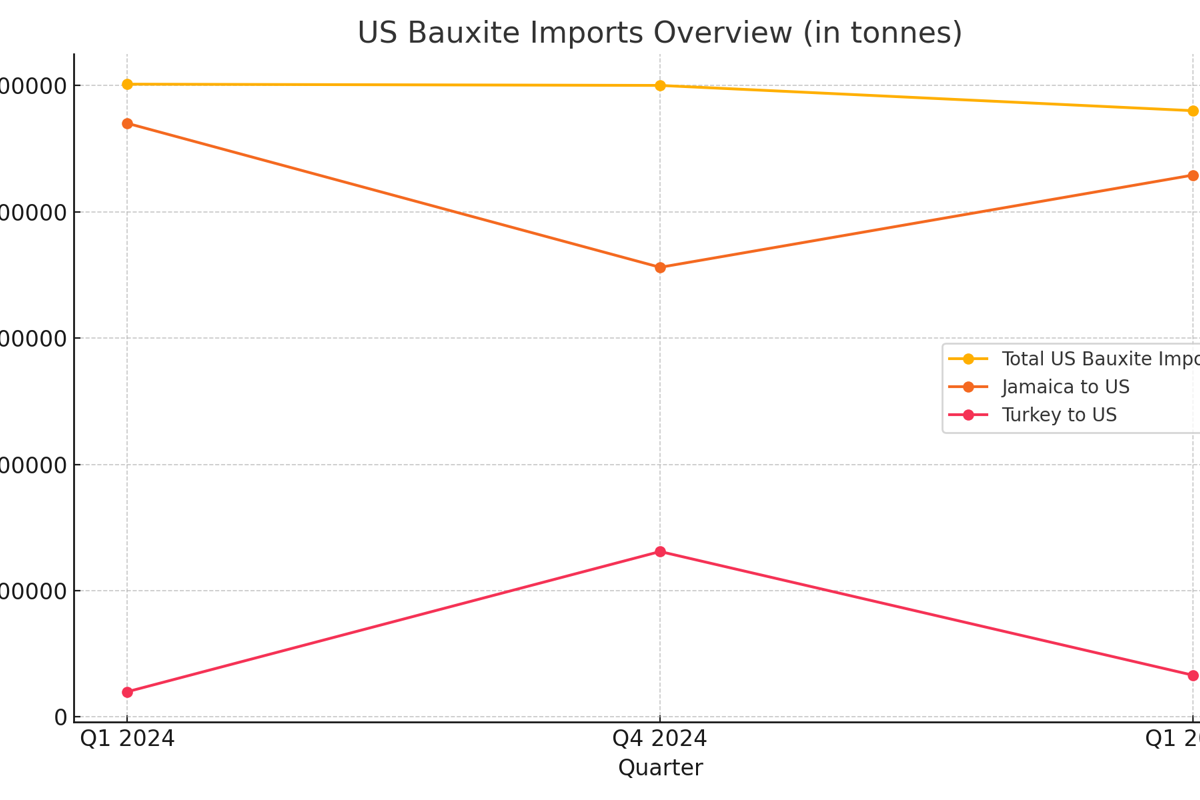
According to data from the United States Geological Survey (USGS), Q1 2025 bauxite imports totalled 480,000 tonnes, marking a year-on-year decline of 4.2 per cent from 501,000 tonnes and lower than 500,000 tonnes brought in during Q4 2024. This decrease occurred despite a notable rise in imports from Jamaica, the United States' largest bauxite supplier.
Imports from Jamaica surged to 429,000 tonnes in Q1 2025, up by 20.5 per cent from 356,000 tonnes in Q4 2024. However, this figure still marked an 8.7 per cent year-on-year drop from 470,000 tonnes in Q1 2024.
So, what factored in the quarterly fall then? It was a decreased import volume from Turkey, whose bauxite supplies had once reached 187,000 tonnes in Q3 2025 and 131,000 tonnes in Q4, contributing about 15 per cent to United States total 2024 bauxite imports. In Q1 2025, Turkey’s exports to the US plunged to 33,100 tonnes, although up by 65.5 per cent from 20,000 tonnes of exports in Q1 2024.
Beyond export, falling domestic demand
Beyond fluctuations in supply, the primary force behind the fall in bauxite imports is softening domestic demand. In the entire year of 2024, the reported quantity of bauxite consumed was 1.8 million tonnes, according to USGS data, down by 12 per cent year-on-year, with an estimated value of about USD 54 million.
Further in Q1 2025, the demand for bauxite must have declined further in the US, as alumina and primary aluminium production in North America decreased year-on-year from 1.116 million tonnes to 1.066 million tonnes and from 998,000 to 978,000 tonnes. While alumina production decreased by 4.48 per cent, primary aluminium production dipped by 2 per cent year-on-year.
Atalco crisis: An indication of slower bauxite demand
Going ahead, the demand for bauxite in the United States domestic market is likely to slow down further, as the last remaining alumina refinery - Atlantic Alumina, or Atalco, is combating a survival battle for being heavily affected by shifting trade policies on metals. The Louisiana-based refinery is the last operating alumina plant that processes Jamaican bauxite into alumina with 550 workers, and supplies nearly 40 per cent of the nation’s alumina needs.
Mark Hansen, CEO of Concord Resources, which took majority ownership of Atlantic Alumina in 2021, said: “It’s been a very difficult operation. If our company closed, we would be the only point of failure for that entire industry in the United States.” His statement highlights a growing disconnect in US trade policy. While aluminium tariffs aimed to rejuvenate domestic output, they’ve failed to address the vulnerability of upstream components like alumina. With no tariff protection and minimal policymaker attention, the future of the U.S. aluminium industry’s supply chain is increasingly uncertain.
Outlook: A cautionary crossroads
The Q1 2025 data paints a picture of an industry in transition—but also in turmoil. Unless corrective measures are taken to support foundational assets like Atalco, the US risks becoming overly dependent on external sources—not just for bauxite, but for the alumina that underpins all aluminium production. The stakes are high, and the time to act is now.