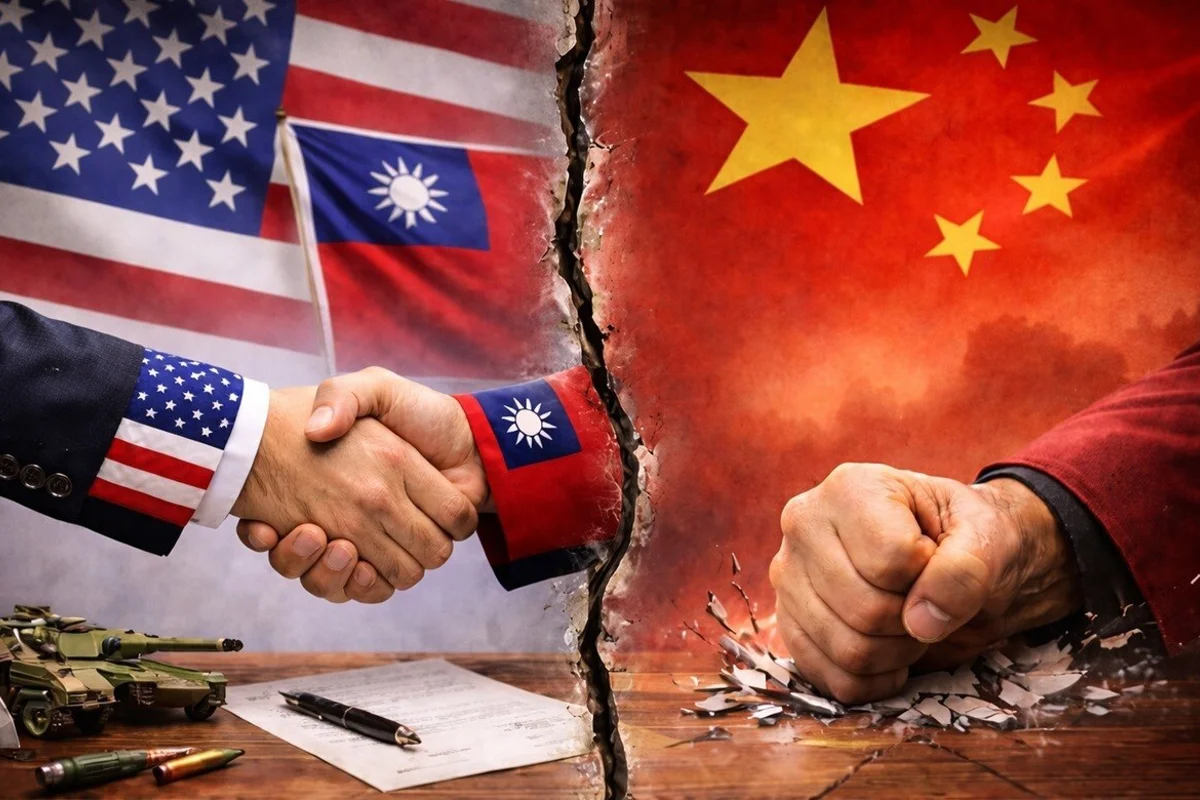
The US State Department announced a vital defence agreement to Taiwan worth USD 11.1 billion. The arms deal was announced in a nationally televised press conference addressed by Donald Trump, President of the United States, on December 17. Upon completion, it would be the greatest sales package covering advanced equipment such as HIMARS and ATACMS, with a considerable amount of aluminium content in them, from the US to Taiwan, as well as plant a seed of doubt in the heart of China.
Image for representational purposes only
Explore- Most accurate data to drive business decisions with 50+ reports across the value chain
Still awaiting approval from the US Congress, the contract was announced by the Defence Security Cooperation Agency, which handles the sales of US foreign military. The aim is to bolster the defensive capabilities of Taiwan, especially since the brewing tensions with China are rising to a peak. A deal between the two countries may send a loaded suggestion to China, which is the neighbour of Taiwan, but may wish to exercise territorial influence over the island. It has, therefore, elicited a strong reaction from the country.
According to the National Academies, modern aircraft alloys have about 80 per cent aluminium content. The US has dealt several aircraft parts or jets to Taiwan since the term of former US President Ronald Regan, such as F-104G interceptors, C-130 transports, F-16 jets etc., indicating a history of trade inclusive of aluminium-intensive products between the two countries.
Components of the agreement
The agreement covers 8 separate segments, adding up to an estimated amount of USD 11.15 billion. Associated Press reported the sales package consisting of 82 high-mobility artillery rocket systems (HIMARS), and 420 Army Tactical Missile Systems (ATACMS) of a range up to 186 miles, similar to those supplied to Ukraine from the Biden administration for defence purposes against Russia. Their valuation exceeds USD 4 billion.
Other components include 60 self-propelled howitzer systems and other implements worth over USD 4 billion, as well as drones costing more than USD 1 billion. Additionally, there are military software valued at USD 1 billion, Javelin and TOW missiles over USD 700 million, spare parts of helicopters worth USD 96 million and refurbishing kits for Harpoon missiles worth USD 91 million.
Official statement of the US
The official statement by the US State Department stressed the point that the sales uphold the “US national, economic, and security interests by supporting the recipient’s continuing efforts to modernise its armed forces and to maintain a credible defensive capability."
Moreover, focusing on the improvement of the defence scenario of Taiwan, the Pentagon has added, “The proposed sale will help improve the security of the recipient and assist in maintaining political stability, military balance, and economic progress in the region.”
Taiwan's Defence Ministry and Foreign Minister expressed gratitude, noting enhanced self-defence and deterrence in the Taiwan Strait. The defence ministry said in a statement that “The United States continues to assist Taiwan in maintaining sufficient self-defence capabilities and in rapidly building strong deterrent power.”
In October, the Taiwan President Lai Ching-te made an announcement regarding the construction of a dome-like air defence system for guarding the nation against “hostile threats,” suggestive of the implication toward China.
Karen Kuo, Taiwan’s presidential office spokesperson, mentioned that Taiwan would keep modifying and improving its defence sector and boost the “whole-of-society defence resilience” in order to “demonstrate our determination to defend ourselves, and safeguard peace through strength”.
Beijing has vehemently condemned Washington for this business agreement. Guo Jiakun, the Foreign Ministry spokesperson, voiced his criticism for both countries at a press conference, stating, "The US side has brazenly announced the plan to sell advanced weapons to Taiwan, which seriously violates the one-China principle and the three China-US joint communiques." This throws light upon the August 17 communique – an agreement signed with the US in 1982, whereby the US had committed to a gradual reduction of its supply of arms sales to Taiwan.
He further mentioned that the US’s plan to contain China by weaponising Taiwan was “doomed to fail” – it would only “backfire”, hampering the peace and stability at the Taiwan Strait.
Chen Binhua, spokesman at China’s Taiwan Affairs Office (TAO), said that the contract was a “flagrant interference in China’s internal affairs”. He deemed this step as a grave violation of “China’s sovereignty and security interests,” sending a dangerous signal to separatist forces.
Thus, strongly warning the US to tread carefully and treat this matter with utmost caution, he commented, “We urge the United States to immediately cease its policy of arming Taiwan and to stop condoning and supporting separatist forces advocating Taiwan independence.”
Moreover, he expressed sharp disapproval towards the Democratic Progressive Party in Taiwan because of its reliance on the US for “stubbornly pursuing independence,” through military means. Slowly, he warned, Taiwan might even transform into a “powder keg” and “arsenal” that would bring about “profound calamity” upon the citizens of the nation.
Don't miss out- Buyers are looking for your products on our B2B platform
President Trump’s second-term administration announced the agreement, which follows a smaller USD 330 million deal and aligns with the commitments made by the US for the self-defence of Taiwan under federal law. Taiwan’s strategy is to increase defence expenditure to 3.3 per cent of GDP in 2026, followed by up to 5 per cent by 2030. This would include an air defence initiative of the Taiwan Dome worth USD 40 billion.
While this may be a safety net for Taiwan, the Chinese backlash looms large in the backdrop, especially preceding the anticipated visit of President Trump to China, and throwing light on the US dual-track Indo-Pacific strategy amid the reunification threats from Beijing.
The US-Taiwan trade relationship overview
The US and Taiwan have maintained a trade relationship since the Taiwan Relations Act in 1979. The bilateral trade gained momentum post the US-China tariffs which brought about a shift in supply chains and Taiwan saw a jump by 7.8 per cent ( USD 3.2 billion), from USD 42.5 billion in 2017 to USD 45.7 billion 2018, in the context of overall trade. Its aluminium export too, experienced a hike from USD 28.66 million in 2017 to USD 1.28 billion in 2018.
On April 2, 2025, the US imposed a hefty 30 per cent tariff on Taiwanese imports, but later on lowered the margin to 20 per cent. This imposition, however, exempted the automotive and metal industries under Section 232, and the tariff percentage on aluminium and steel remained within 10 to 15 per cent. Significantly, Taiwan showed no retaliatory intentions by imposing tariffs on the US to counterbalance. Refraining from aggressive measures, it focused on mutual interests instead.
The US is risking strained ties with China, for it views Taiwanese security as a vital component of American interests, indicating a dual-track approach. While keeping trade relations open, it is arming the allies for self-defence purposes.
The aluminium industry may face disruptions in the US-China trade sector due to the escalating tensions over the arms sales to Taiwan. China has already marked several US defence-based companies on the Unreliable Entity List. These include names like Cubic Corporation, Huntington Ingalls Industries, and Teledyne Brown Engineering.
Ever since hitting the peak in export worth USD 1.82 billion in 2019, the US-Taiwan trade relations graph has seen a gradual decline, owing to the 2020 pandemic, and thereafter, the possible challenges stemming from the imposition of tariffs in 2025.
In its attempt to recover and improve its once-booming trade relationship with Taiwan, is the US willing to risk upsetting China and opening itself to future retaliation?
Must read: Key industry individuals share their thoughts on the trending topics













_md.webp)
_md.webp)







