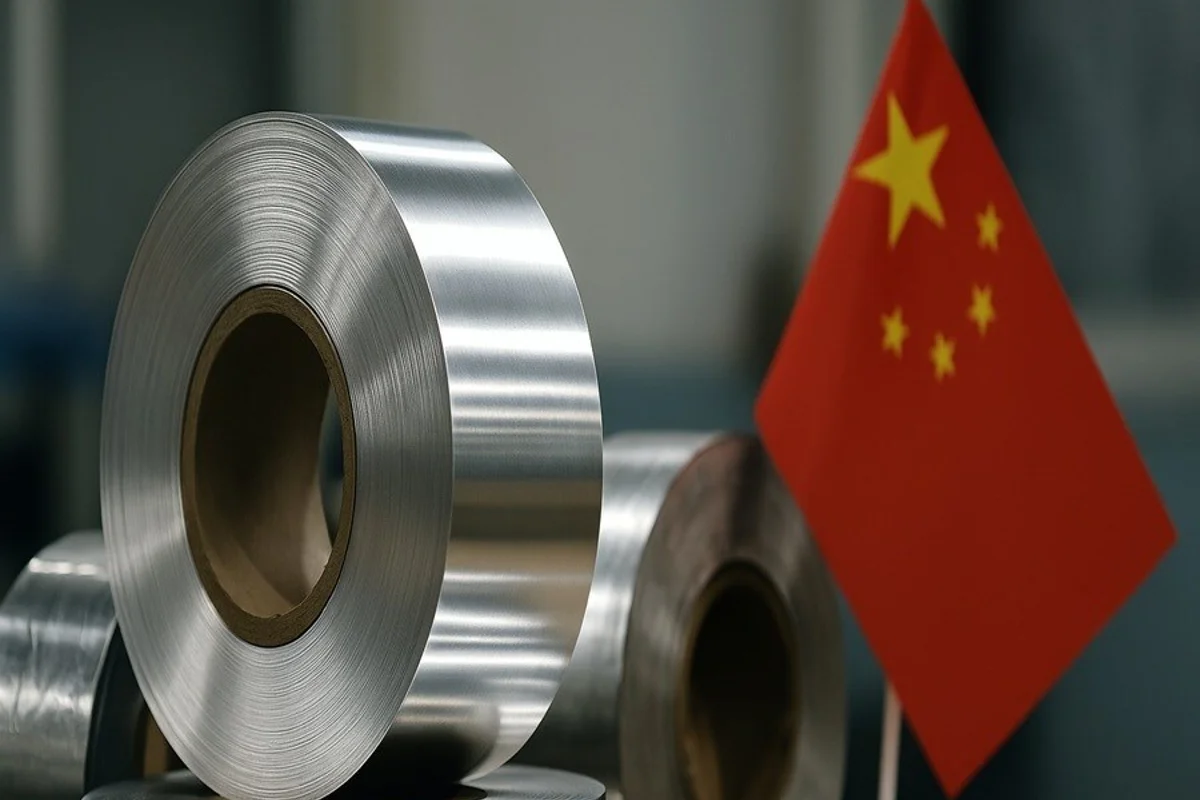
The UK’s Trade Remedies Authority (TRA) has recommended keeping anti-dumping duties on aluminium foil in rolls imported from China for another five years, citing continued risks of unfair pricing and potential injury to domestic manufacturers.
The recommendation, set out in the TRA’s 2025 Statement of Essential Facts (SEF), proposes maintaining existing tariffs — ranging from 14.2 to 35.6 per cent — for the period 6 June 2024 to 2029.
The review, launched on 20 May 2024, assessed whether the measure — first introduced by the European Union in 2013 and later carried into UK law after Brexit — remains necessary to protect UK producers.
The investigation covered the period from 1 January to 31 December 2023 and found that dumping of Chinese aluminium foil at prices below market value “would likely continue or recur” if the duties were withdrawn, undermining fair competition in the UK market.
The TRA’s review describes the UK aluminium-foil sector as “intensely competitive” and highly price-responsive, with both domestic and foreign suppliers competing on narrow margins. Even marginal price undercutting, it said, could quickly distort market shares.
The duty applies to aluminium foil of a thickness of 0.007 mm or more but less than 0.021 mm, not backed, not further worked than rolled but whether or not embossed, supplied in low-weight rolls not exceeding 10 kg. According to the TRA, the UK consumes roughly 14,500 tonnes of this foil each year, while domestic manufacturers meet only 40 to 45 per cent of demand.
Retailers and consumers are described as highly sensitive to price changes — a structure that leaves UK producers exposed if low-priced imports return unchecked.
Despite modest attempts to diversify sourcing, China remains the UK’s dominant foreign supplier of aluminium foil.
Data from UN Comtrade and the Department for Business and Trade (DBT) show that in 2024, the UK imported USD 84.46 million worth of aluminium foil (≤ 2 mm thickness) from China under HS Code 7607.
Total UK aluminium-foil imports (all origins) exceeded £ 77 million in 2023, with China contributing the largest single share.
By comparison, UK exports of aluminium foil to China were minor — around USD 1.4 million in 2023 — representing less than 1 per cent of total UK aluminium exports, which stood at USD 158.67 million across all aluminium categories, including plates, sheets, bars, rods, and scrap.
This 60:1 trade imbalance, the TRA observed, reinforces the risk that if duties are removed, Chinese producers could again sell at dumped prices, inflicting “material injury” on UK converters and foil makers.
Support for domestic producers
The TRA argues that keeping duties between 14.2 and 35.6 per cent will help stabilise UK market conditions, protect an estimated 500 to 700 jobs, and encourage long-term investment in plant modernisation and recycling-based production consistent with the UK’s net-zero industrial strategy.
The measure is also expected to preserve price stability and prevent market disruption from low-cost imports that could otherwise erode the viability of local producers.
Costs for businesses and consumers
However, the TRA acknowledges that maintaining the tariff comes at a cost. With domestic capacity unable to meet full demand, UK businesses will continue to depend on imports — now subject to higher duties.
Small and mid-sized converters — often with limited capital — will feel the sharpest squeeze, while large integrated firms may better absorb price shocks. Because the market operates on thin margins, even small price movements may feed through to consumer inflation, particularly in food and packaging products.
China faces barriers — and shifts strategy
For Chinese exporters, the TRA’s recommendation represents another obstacle in a previously lucrative market worth over USD 84 million a year.
The maximum 35.6 per cent duty has made Chinese foil less competitive in the UK, likely prompting a decline in shipments.
To offset these losses, Chinese producers are redirecting exports to tariff-free destinations such as India, which imported more than 140,000 tonnes of Chinese foil in the first eleven months of 2024. Others are investing in high-value coated and laminated foil products, better able to absorb tariff costs, or shifting production toward aluminium product lines not subject to anti-dumping duties.
The TRA’s move mirrors previous actions: in 2022, the UK imposed anti-dumping tariffs on Chinese aluminium extrusions ranging from 11.4 to 35.1 per cent, after finding that below-market pricing had endangered more than £ 155 million of UK production value.
Balancing fairness, cost, and industrial policy
The TRA’s recommendation illustrates the UK’s broader post-Brexit approach to industrial protection — balancing fair competition with economic efficiency.
While the proposed extension supports domestic production and job retention, it will also sustain higher input costs for UK businesses and moderate inflationary effects for consumers.
The duty is recommended, not yet confirmed, and will remain under consultation until 27 October 2025, when stakeholders can comment on the SEF through the TRA’s public file.
After that, the Secretary of State for Business and Trade will make the final determination on whether to keep the duties in force until 2029.
If approved, the decision would ensure that the UK aluminium-foil market continues operating under tariff protection — maintaining a equilibrium between supporting home-grown production and managing inflationary pressures in essential packaging materials.












_md.webp)
_md.webp)
_md.webp)







