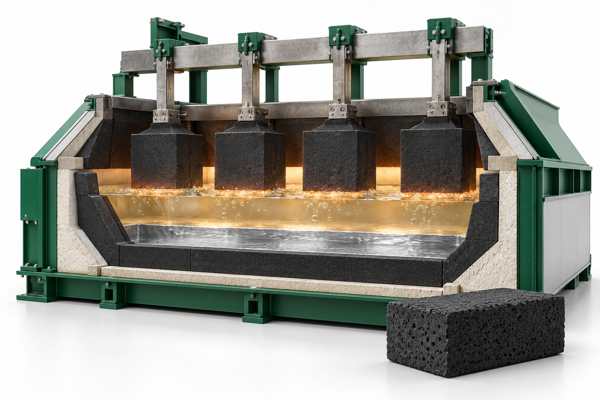
Aluminium’s decarbonisation challenge extends beyond the electricity powering its smelters. Inside the reduction cell, electrode quality influences how efficiently that electricity is used, how much carbon is consumed and how consistently the process performs. Improving electrodes therefore offers producers a practical opportunity to address operating costs and emissions together. For Switzerland-based R&D Carbon , understanding the relationship between raw materials, electrode quality and industrial performance has been a focus for four decades. Founded in 1986 by Werner K. Fischer, the company built on carbon research previously undertaken at Swiss Aluminium Ltd., or Alusuisse. Today, it operates from Granges, near Sierre, with a team of 30 specialists serving more than 150 customers...
Mexico’s aluminum industry is looking to capitalize on rising demand from artificial intelligence (AI) infrastructure, electric mobility, automotive manufacturing, and aerospace. Expanding technology investments and international market opportunities are expected to support sales growth, while the country’s reliance on imported aluminum highlights the importance of strengthening domestic processing capabilities. Ramón Beltrán, president of Mexico’s National Chamber of the Aluminum Industry (Canalum), expects the country’s domestic and international aluminum sales to gain momentum in 2026, supported by demand from advanced technology applications and established manufacturing sectors. “We expect to close out this year with growth of between 7.5% and 7.8% in domestic and international...
Grow with
AL Circle

A new study by Market Forces has shed light on Australia’s industrial gas consumption, revealing a striking concentration of demand among a handful of facilities. According to the findings, just 10 industrial sites are responsible for more than half (50.9 per cent) of the country’s total manufacturing gas use, with alumina and ammonia leading the way. The remaining 49.1 per cent of demand is driven mainly by the Liquefied Natural Gas (LNG) sector, underscoring its dominant role in Australia’s energy landscape. Five ASX-listed giants, Rio Tinto, South32, Orica, Dyno Nobel, and Wesfarmers, operate six of these major gas-consuming plants. Their reliance on gas drives both operational costs and climate exposure. At the same time, these companies have begun mapping decarbonisation pathways,...

The American aluminium industry is standing at a decisive moment. In 2025, producers, policymakers, and end-users are all wrestling with a dual reality, wherein on one hand, tariffs, energy volatility, and demand slowdowns are weighing heavily; on the other, a push for green metals and recycling is opening fresh opportunities. Against this backdrop, AL Circle has released its new e-magazine, ' American Aluminium Industry: The Path Forward ', offering a comprehensive lens on how the sector is adapting, competing, and redefining its future. Image for representational purposes only The numbers already paint a stark picture. US aluminium imports fell 12.2 per cent month-on-month in February 2025, underscoring the deep impact of tariffs on trade flows. Demand across North America dropped 4.1...

The aluminium industry has long sold itself as the ‘metal of the future’, well known for being lightweight, infinitely recyclable, and indispensable for decarbonisation in transport, construction and packaging. Yet, when scrutinised from a life-cycle perspective, the path from bauxite to ingot reveals an environmental footprint that is both energy-heavy and highly variable depending on geography. A landmark cradle-to-gate life cycle assessment (LCA) conducted by the International Aluminium Institute (IAI) brings forth one blunt truth, i.e., electricity supply is the single biggest determinant of aluminium’s environmental impact. Image source: https://www.researchgate.net/ The study, built on IAI’s global survey data and modelled using GaBi software, measured six core impact categories...

Norsk Hydro, the Norwegian aluminium and renewable energy giant, has announced plans to lay off about 750 white-collar employees. Just two months after signalling a temporary hiring freeze without specifying the affected business areas, the company has escalated the measure into targeted job cuts. The announcement comes against a backdrop of widespread job cuts in the aluminium industry, driven by the United States’ steep 50 per cent import tariff. In Canada, for example, Canada Metal Processing Group was forced to lay off 140 employees as a direct consequence of the tariff. Hydro, however, is largely insulated from this pressure, thanks to extensive domestic sourcing, pass-through pricing, and minimal cross-border exposure. Its Hydro Extrusions and Aluminium Metal division holds a 15–20...

Driven by the pursuit of greater sustainability, the global recycled aluminium industry continues to witness near-daily advancements in innovation. This momentum has now extended to the aluminium wire rod sector, with Kingdom of Bahrain-based Midal Cables, a leading manufacturer and distributor of a wide range of cables, announcing the launch of its new line of recycled aluminium rod products, branded as MiRecAL. The newly launched MiRecAL product line is available in two key variants, incorporating 15 per cent and 30 per cent recycled aluminium content. It is estimated that these recycled aluminium wire rods can reduce greenhouse gas emissions by approximately 29 per cent compared to conventional aluminium wire rod manufacturing processes, underscoring their strong sustainability efforts...

In a world racing toward decarbonisation, one metal that is quietly rewriting the rules of industrial sustainability is aluminium. Long valued for its strength and versatility, aluminium is now stepping into the spotlight as a cornerstone of the global green transition. From solar-powered smelters and electric furnaces to closed-loop scrap systems and low-carbon alloys, aluminium's evolution is no longer just industrial, it's ideological. Each year, approximately 30 million tonnes of aluminium scrap are recycled worldwide, a testament to its remarkable circularity. Nearly 75 per cent of all aluminium ever produced is still in use today, underscoring its longevity and unmatched recyclability. Sustainability & Recycling: Aluminium's Dual Commitment And this shift isn't happening in...

Emirates Global Aluminium (EGA), the world’s largest producer of premium aluminium, and Emirates Nuclear Energy Company (ENEC) have announced the UAE’s first delivery of aluminium manufactured using electricity generated from the Barakah Nuclear Energy Plant in Abu Dhabi’s Al Dhafra region. Image Source: EGA The breakthrough product, branded MinimAL, marks a significant step forward in the decarbonisation of heavy industry in the UAE and globally. The first batch of this low-carbon aluminium will be supplied to CANEX Aluminum, Egypt’s leading aluminium downstream producer, for use in infrastructure, solar energy, transportation, and architectural applications. Decarbonising aluminium through nuclear power Electricity generation accounts for around 60 per cent of the global aluminium...

The increasing environmental concerns are emerging in diverse sectors with the rising shift to low-carbon use. Similar action is seen within the global aluminium industry, where Capral, a leading provider of aluminium products and solutions across Australia, is on the road to launch new lower-carbon aluminium options. New innovation Capral is set to launch a new lower-carbon aluminium sheet offering this month, featuring an embodied carbon footprint of approximately six tonnes of CO₂ per tonne of aluminium. The sheets will be made available in standard two-and three-millimetre thicknesses, providing the market with an accessible, sustainable alternative for a wide range of applications. The enhanced LocAl® range will expand the range of sustainable supply chain solutions available to the...

The accelerating energy transition is creating significant growth opportunities, with industry leaders adopting forward-looking strategies for long-term impact. In line with this trend, Prysmian Group, recognised globally for its power and telecom cable expertise, is driving a new phase of progress through advanced cable solutions, strategic collaborations and sustainable manufacturing practices. These initiatives not only align with Europe's decarbonisation objectives but also position the company as a key enabler in the integration of renewable energy, AI-powered smart grids and electric vehicles (EVs). Investments in focus Prysmian's recent investments and strategic projects highlight its critical role in advancing Europe's energy infrastructure. In 2024, the company secured a EUR 450...

Swisstek Aluminium has committed to supporting Sri Lanka in achieving its 2030 renewable energy targets by providing advanced solar mounting solutions. As the nation accelerates its transition to clean energy, Swisstek offers modular, prefabricated systems specifically designed to endure Sri Lanka's diverse climate, from coastal humidity to high-wind zones. Sri Lanka is making significant strides toward its 2030 renewable energy targets, to generate 70 per cent of its electricity from renewable sources. The country is gradually shifting away from fossil fuels by expanding its solar, wind, and hydropower generation capacity. Manufactured from high-grade, corrosion-resistant aluminium, Swisstek's mounting systems are ideal for both residential and commercial use. They are compatible with a...

According to PMMI’s 2024 State of the Industry US Packaging Machinery Report, packaging machinery manufacturers are actively innovating to support aluminium and other eco-friendly materials, aiming to capitalise on the growing demand for sustainable solutions. This shift comes as sustainability becomes a defining force in reshaping the packaging industry. While the US continues to have less stringent packaging regulations than the European Union, leading companies across North America are increasingly embracing aluminium-based sustainable packaging solutions. Recognised for its recyclability, light weight, and relatively low environmental footprint compared to plastic, aluminium is playing a pivotal role as brands and manufacturers respond to mounting regulatory pressure and evolving...

Otto Junker, a globally renowned manufacturer of advanced industrial furnace systems for the metal processing sector, has successfully concluded a key decarbonisation project at Neuman Aluminium's Strangpresswerk facility in Lilienfeld, Lower Austria. Dedicated to aluminium component production, the facility is actively advancing its transition toward sustainable manufacturing practices. Image source: otto-junker.com Both companies have successfully transitioned a gas-fired billet heating plant to electric heating, marking a significant milestone toward climate-neutral production. Previously, commissioned as a gas-fired convective billet heater until 2016, the plant has now been upgraded to the energy-efficient EcoJet system. With this transition, the facility can now heat its 8-inch...

Aluminium Bahrain B.S.C. (Alba), the world’s largest aluminium smelter on a single site, has achieved a major safety milestone by recording 38 million safe working hours without a Lost Time Injury (LTI) as of 31 July 2025. Image Source: Alba PR and Instagram This marks a 1 million-hour increase from 27 June 2025 , when Alba reported 37 million LTI-free hours, demonstrating the company’s sustained commitment to workplace safety. The accomplishment highlights Alba’s strong safety culture and proactive risk management systems. In comparison, data published in June 2022 showed just 20 million safe hours without LTI, marking a significant improvement. Alba Chief Executive Officer Ali Al Baqali stated, “This tremendous achievement of 38 million safe working hours without LTI is a testament to...

Aluminz Corporation has unveiled plans to establish the United States’ first zero-landfill aluminium production facility in Titus County, Texas. The project, developed in collaboration with the Mount Pleasant City Council and the Mount Pleasant Economic Development Corporation (MPEDC), will span a 155-acre site under a 30-year lease agreement. Once operational, the facility is expected to create more than 130 permanent jobs in the region. “This initiative isn’t only good for Titus County and Aluminz; it will help drive growth for a wide ecosystem of partners and customers,” said Richard Mayenknecht, CEO of Aluminz. The project is set to generate 130 full-time jobs across operations, maintenance, and administration, all offering above-market wages, in addition to 75 skilled construction...

Amcor Flexibles Rorschach in Switzerland has once again secured re-certification under the Aluminium Stewardship Initiative’s (ASI) Performance Standard V3.1, reaffirming its leadership in responsible aluminium packaging. As of July 29 2025, ASI confirmed that the Rorschach facility met all requirements under the updated 2022 Standard, successfully transitioning its certification since the June 2023 deadline for re-certifications. Image source: https://aluminium-stewardship.org/ The ASI re-certification is a milestone, reflecting rigorous independent evaluation. ASI Performance Standard V3.1, introduced in mid-2023, builds upon the foundational V3 (2022) by embedding a stronger emphasis across 11 principles and 62 criteria spanning environmental stewardship, social responsibility,...

In a landmark move aligning economic ambition with climate strategy, China has commenced construction on the colossal Yarlung Zangbo Hydropower Project worth USD 168 million in Tibet. A massive clean energy initiative, this project is expected to reshape regional energy flows and significantly impact the aluminium industry by shouldering power supply responsibility with Yunnan. Powering a nation and its aluminium sector In Nyingchi, Premier Li Qiang announced the "project of the century", highlighting its strategic relevance for the nation. The five-dam complex along the Yarlung Zangbo River is expected to generate 300 terawatt hours (TWh) of power annually by 2035, which is greater than the UK's annual power consumption at present. The scope of this project, with a total estimated cost...

India’s climate ambitions just received a reality check. But it is going to be one with a USD 1.5 trillion price tag. A new Deloitte-backed report has laid out the math for New Delhi’s decarbonisation journey through 2030, and the numbers are not for the faint-hearted. To meet its commitments under the Paris Agreement, including 500 GW of non-fossil capacity and major emissions reductions across sectors, India will need to unlock an investment corpus that is nearly half its current GDP. Image for representational purposes only But this isn’t just a green finance problem. This is a hard-asset dilemma. What India is being asked to build at unprecedented scale and speed sits at the intersection of policy ambition and industrial inertia. And that makes this not just a climate story, but one...

Once known purely for its unmatched production scale, China’s aluminium sector is undergoing a fundamental transformation, wherein growth is no longer measured solely in tonnes, but in energy efficiency, carbon accountability, and global influence. Despite mounting trade barriers and domestic production limits, the world’s largest aluminium ecosystem isn’t slowing down. Instead, it is recalibrating its priorities, positioning sustainability, automation, and innovation as the next growth drivers. Image source: Iran Alumina Company A shrinking export market, or is it a conscious withdrawal “According to Aize Consulting ’s monitoring data, the share of China’s aluminium and aluminium product exports to the US dropped from 12.17 per cent in 2020 to 9.70 per cent in 2024. With the escalation...