While global investment in renewable energy continues to surge, a critical bottleneck is hindering progress: insufficient power grid capacity. According to estimates, solar and wind facilities capable of producing electricity equivalent to 480 nuclear reactors remain disconnected from transmission networks in both the U.S. and Europe.
This issue is not isolated to the West. South Korea's government recently denied U.S. asset manager BlackRock's proposal to build an offshore wind farm in Asia, citing a lack of available grid capacity, as reported by local media. The challenge of connecting new renewable projects to the grid is becoming a significant roadblock.
Data from the International Energy Agency (IEA) reveals that the world added approximately 560 gigawatts of renewable power capacity in 2023, marking a 64 per cent rise from the previous year. This rapid growth is a testament to the potential of clean energy. However, many of these projects are situated in regions without existing power plants or thermal infrastructure, leading to a mismatch between renewable capacity growth and grid expansion.
The U.S. is facing particularly stark challenges. According to the Lawrence Berkeley National Laboratory in California, renewable energy facilities lacking grid access reached 1,500 gigawatts in 2023. This marks a ninefold increase since 2015, with the majority of these projects being solar and wind plants.
As the world races to meet its renewable energy targets, the urgency of addressing the power grid bottleneck cannot be overstated. It's crucial to realize the full potential of clean energy and ensure a sustainable future.
Even with its extensive power grids, Europe faces similar challenges in the aftermath of the Ukraine-Russia geopolitical crisis as it attempts to reduce its reliance on Russian gas and accelerate its decarbonisation efforts.
This imbalance has become evident in its investments in renewables and power grids. According to BloombergNEF, the total capacity of solar and wind projects waiting to be connected to the grid in four major European nations has now exceeded 860 GW.
Junichi Ogasawara, Senior Research Director at the Institute of Energy Economics, Japan, stated, "The number of new renewable energy stations applying for grid connections in the U.S. has surged following the implementation of the Inflation Reduction Act, which promotes renewable energy through tax incentives."
According to estimates from the Lawrence Berkeley National Laboratory and BloombergNEF, adjusted for capacity utilisation, solar and wind power stations currently waiting in the interconnection queue across the U.S. and Europe could generate over 3,300 terawatt-hours of electricity annually—equivalent to the output of 480 standard nuclear reactors.
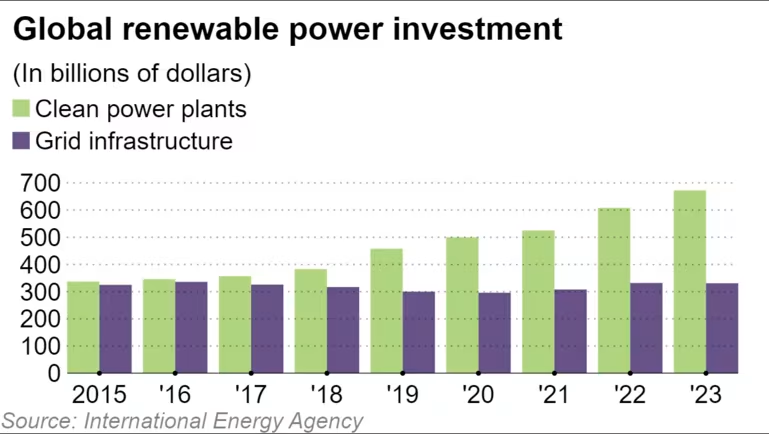
In 2023, global investment in clean power plants reached $670 billion, roughly double the amount invested in 2015. However, data from the International Energy Agency (IEA) indicates that investment in grid infrastructure has plateaued at around $330 billion. While renewable energy facilities can be constructed relatively quickly, building a large-scale grid can take ten years or more from planning to completion. Compliance approval processes and rising raw material costs can further delay construction, leading to hesitance among investors.
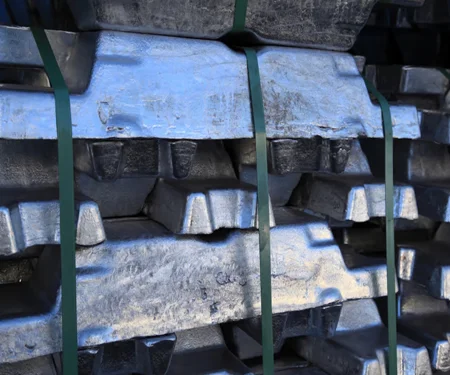
Aluminium plays a crucial role in various technologies essential for the energy transition. Still, it is also a significant source of CO2 emissions, contributing nearly 270 million tonnes of direct emissions in 2022—about 3 per cent of the world’s total direct industrial emissions. Over the past decade, the global average direct emissions intensity of aluminium production has been declining at a moderate pace of almost 2 per cent per year. However, to align with the Net Zero Emissions by 2050 (NZE) Scenario, this decline must accelerate to nearly 4 per cent annually by 2030. To achieve this, the aluminium sector must focus on developing and implementing near-zero emission technologies for alumina refining and for both primary and recycled aluminium production. Additionally, it is imperative for the industry and its customers to enhance scrap collection, sorting, and recycling efforts to drive significant emissions reductions.
Note: The information of this article has been sourced from Nikkei Asia.