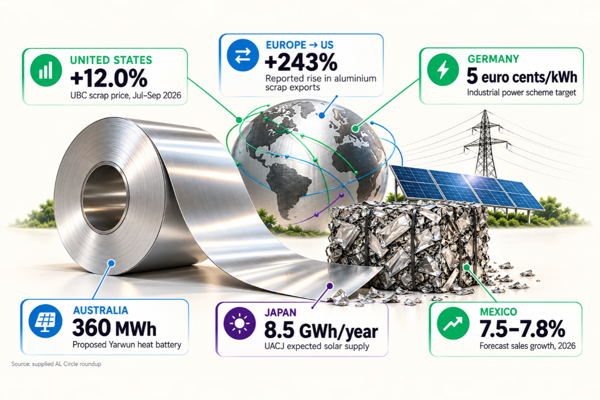
Aluminium’s trade map is no longer drawn by smelters alone. Scrap flows, power contracts, industrial policy and specialist grades now shape who secures metal, at what cost and under whose rules. Ten recent developments across Europe, the US, Australia, Japan and Mexico show how recycling, energy and regulation are becoming the new levers of aluminium competitiveness. They also show where traders, exporters and policymakers may need to adjust. Scrap tug-of-war: the US pull, Europe’s leak and the recycling base at stake The pull starts with price. The US UBC scrap benchmark averaged USD 2,322.89 a tonne in July, USD 2,491.22 in August and USD 2,602.51 in September. That is a 12 per cent climb, and it came after a July that opened at USD 2,464.98 and fell to USD 2,270.76 within two days....
Nespresso is expanding its aluminium coffee capsule recycling network across New Zealand, adding 25 JB Hi-Fi stores as collection points and bringing the total number of participating retail locations to 138. The move gives coffee drinkers more places to return used capsules, helping make recycling a little easier after that final, satisfying sip. The new collection points join existing locations at Briscoes and Noel Leeming stores. The expansion also complements other return options available through Nespresso, including its boutiques, public collection points, NZ Post drop-off locations and courier collections from customers’ homes. The aim is to make returning used capsules more convenient, recognising that a single collection method will not work for everyone. For those who enjoy...
Grow with
AL Circle

UK high-grade secondary aluminium ingot prices fell on Wednesday as deals at the top end dried up on continuing economic uncertainty. But demand remains healthy in the near term and producers are well sold through November at least. “We’re doing a few bits and pieces on the spot market, but we’re pretty well sold forward,” one producer said, adding that forward sales mean he does not have much material to sell for the rest of the year.
According to Ministry of Finance, Japanese secondary aluminum alloy import is increasing from China. The import was 40,840 tonnes in August increasing by 13% from a year earlier and by 21% from July. Several Japanese trader sources said that the import is likely to maintain a high level at around 40,000 tonnes per month until December at least. Toyota Motor's domestic completed car production is estimated to increase by 22% to 919,000 units for October from a year earlier,by 21% to 971,000 units for November and by 18% to 880,000 units for December. Several sources of Japanese secondary aluminum alloy industry recognize domestic alloy makers' production would not increase as much as Toyota's output expansion. They are concerned that domestic alloy makers' order receipt volume and Japanese...
While the EU seeks to curb its import dependency on raw materials through better re-use and recycling, the bloc remains a top exporter of all sorts of waste – including metals. Instead of being re-used in Europe, waste resources are increasingly being shipped overseas to fuel booming Asian economies, despite Brussels' push to promote waste as a valuable commodity. Out of the main categories of waste metals being exported are aluminium.But much more is being exported in the form of electronic waste such as mobile phones and laptops. For waste the export of waste copper, aluminium and nickel from the EU-25 was almost 1.6 million tonnes in 2005.
Tianjin Aotong Metal Products Co.Ltd has become the biggest export base of recycled aluminum alloy in north. The company has formed a production scale of 500,00tons aluminum alloy per year through technical innovation, investment and optimizing production factors. Aotong imports scrap metals as raw materials and produces high qualified aluminum alloy ingots through strict sorting, scientific proportioning and re-smelting. In order to enhance its international competitivenesss,Aotong has improved its production process which not only boosted the melting speed but also lowered energy consumption. So far, Aotong’s leading product ADC12 aluminum alloy ingot has been widely used in car engines and gearboxes.
Aluminum scrap prices have come under pressure after one large consumer stepped away from the market and others refuse to buy long. The lack of visibility on year-end production volumes has made scrap buyers wary of purchasing forward, they told AMM, noting that they have built sufficient inventory for the next 30 days. Prices for largely traded items like old sheet and old cast remained steady over the course of this past week.
Scrap input prices have come down over the past couple of months and have "found a floor," said an Italian alloy producer, adding: "It's not possible to push prices down any further otherwise we will be suffering again." Prices for scrap in Germany were said to be flat. Scrap buyers would be closely watching the LME for price developments, said an alloy producer. "Scrap prices are quite stable in Germany," said another alloy producer, who added that because of this he saw little downward movement in alloy. The market was awaiting 2012 discussions for direction on alloy demand and pricing. Most talks were expected to begin end-Oct/early November, sources said. "The car manufacturers are still positive for next year's production levels but they can cut output very fast," warned a German...
Secondary aluminium prices drifted lower in Europe this week in quiet market conditions as negative sentiment on the economy and future demand levels crept into the physical market, sources said. "Our plants are fully booked and sold out for Q4 but everyone is talking about the financial crisis," said a German producer. A German alloy buyer agreed that the sentiment in the market was much more "negative." "People are nervous about what will happen in November and December. I think we will reduce our demand levels slightly next month," he said. A second German alloy maker said that he felt buyers were being very careful not to over-order and were also seeking lower prices going forward. In addition, the recent drop in metals prices on the London Metal Exchange was prompting diecasters to...
UK aluminium scrap prices finally lost support and fell sharply on Wednesday, with all grades showing significant losses as the market succumbed to the continuing turmoil in European debt markets. “Prices have been pretty horrendous this week and have fallen significantly from just a couple of weeks ago,” a buyer said. The scrap market has been robust compared with others since fears of a double-dip recession resurfaced in recent months, giving up ground stubbornly and in increments even as secondary aluminium ingot prices fell more swiftly in the UK and continental Europe. But that resistance ended this week, in both pure and commercial.
A Bahrain-based company wants to expand its dross recycling operations throughout the world after opening a multimillion-dollar factory at Tiwai Point yesterday. Construction of the Taha Asia Pacific recycling plant began this year at New Zealand Aluminium Smelters and was officially opened yesterday with a ceremony and Maori blessing. The plant recycles aluminium dross – the waste byproduct of the smelting process – and the 40,000-odd tonnes stored in landfills at Tiwai.
Research and Markets has announced the addition of Dion Global Solutions Ltd's "Opportunities in Brazil Aluminium Market" report to their extensive offering of materials markets publications. Brazil is one of the rapidly growing aluminium markets in the Latin American region. The country has witnessed a continuous rise in the demand and import of aluminium. Consequently, the country's aluminium consumption has gone up by 8% between 2005 and 2010.Owing to its developing economy and a huge demand for aluminium among the consumers, the production of aluminium in the country has increased and reached approximately 1.54 million tonnes in 2010. The recycling rates of aluminium in the Brazil are highest globally which also contributes to the growth of the industry. The recycling rates of...
Alcoa announced today that its Canadian Global Primary Products Operations has made one of the most substantial financial contributions in its history, a partnership agreement totaling $3 million over five years with the new Centre for Sustainable Development. A portion of this contribution, coming from the Alcoa Foundation, has been earmarked for an information center that will be open to the public. The center will accompany its visitors in their journey to discover the concrete actions each can take to help resolve major environmental issues. In addition to the obvious link with the activities of the building's tenants, this comprehensive information center will offer materials on recycling and energy efficiency programs,and environmental regulations among others. Aluminum at the...
Delta Aluminium Industry, Chinese secondary aluminium alloy maker headed in Guangdong, starts production of aluminium alloy casting material and primary aluminum alloy in late October. The company introduces a new 12 tonne melting furnace dedicated to alloy casting material within October. As a result, Delta's output capacity will increase by 13% or 1,000 tonnes per month and reach 9,000 tonnes per month as total. Daiki Aluminum Industry, Japanese largest secondary aluminum alloy maker, holds 20% shares in Delta. Delta mainly produces AD12.1 grade secondary aluminum alloy for die casting at 7,000 tonnes to 8,000 tonnes per month. Daiki purchases about 80% of the alloy and supplies the alloy to the consumers in Japan and Southeast Asia. Delta sells the alloy in Chinese market at 800 tonnes...
Major secondary aluminum alloy makers and automotive component makers around Tokyo almost agreed to leave unchanged or to slightly decrease by JPY 1 per kilogram to JPY 3 per kilogram for secondary aluminum alloy for September 16th to 30th 2011 shipment. Relatively high prices were adjusted downward to reflect market price decrease in primary aluminum and aluminum scrap. Moreover, AD12.1 grade alloy import is remarkably increasing from China at low price of JPY 200 per kilogram to JPY 250 per kilogram. With these factors, domestic alloy makers failed to raise the selling price after tough negotiations. High prices were adjusted slightly downward and low prices were unchanged. Alloy selling price is estimated to decrease significantly for October shipment. One factor is that successful bid...
A Mexican secondary aluminium alloy producer may be setting up shop in Indiana to expand on an existing business relationship with Shelbyville, Ind.-based Ryobi Die Casting USA Inc. A senior executive at Ryobi confirmed that it had been in "strong negotiations" with Faeza SA de CV but no agreement had been reached. Faeza recently sent top executives to Indiana to determine whether it could start operations near Ryobi’s Shelbyville plant.
Secondary aluminum alloy prices nosedived this week as panic selling overtook what has been a fairly resilient market this year. Lower-priced sales continued this week after several producers dropped numbers in rapid succession late last week, according to market participants. Rumors are rife that the flagship A380.1 alloy was sold as low as $1.13 per pound vs. $1.16 to $1.17 per pound previously, but producers contacted by AMM denied the claims.
It is learned that aluminum scrap import customs cost(taxation + customs clearance fee) continues to rise in Guangdong,and September,import cost increased further. For example in Guangdong port customs clearance fee for aluminum shred was 1,650 Yuan/Ton in August, while in September it jumped to 2,250Yuan/Ton, rising by 600Yuan/Ton. Customs clearance fee for 6063 packaged aluminum was 2,250Yuan/Ton, 2,300Yuan/Ton in September.Compared to Guangdong port Ningbo and Tianjin port seems more stable. The increase in customs clearance fee and the more tight policies, lead to make certain impact on the total imports of aluminum scrap.
Cabinet has approved the Environment Management [Waste Disposal and Recycling] [Amendment] Regulations 2011, and the Environment Management [Container Deposit] Regulations 2011. The Regulations provide the legal framework for the establishment of the Container Deposit and Refund Recycling System. Cabinet based its decision on a submission by the Minister for Local Government, Urban Development, Housing and Environment, Colonel Samuela Saumatua. The Minister explained that Fiji consumes some 50 million containers of beverage per annum, and few of these containers are recycled and many (millions) are discarded improperly. “Large quantities of used beverage containers end up as litter on streets, in waterways and beaches. Many containers flow out to sea harming our marine life.” He said that...
Retail discounts will be offered to residents recycling bottles and cans under a new scheme. Being launched by a private company by year end, this will award people one point for every plastic bottle or aluminium can they chuck into Reverse Vending Machines (RVM). The RVMs will print a receipt of the points - essentially a voucher or coupon - that can be availed of at businesses in Dubai, Abu Dhabi and Sharjah. Over 100 such machines will be set up in malls, residential communities, schools and other "high-traffic" locations in the emirates. Each of these machines can accept about 500 units. A billion beverage containers are thrown away in the UAE every year, but only about a third is recycled, he added. The rest end up in landfills, where they will clog up space for decades.