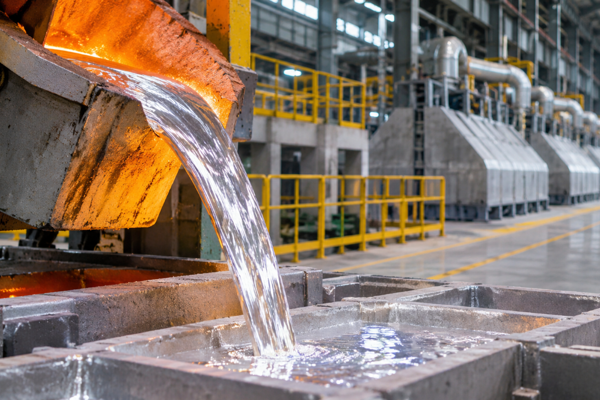
Vietnam’s first electrolytic aluminium project has reached another major milestone, with the second phase of the 450,000-tonne-per-year (tpa) Da Nong project producing its first batch of molten primary aluminium on October 31, 2026. The milestone, achieved by China Nonferrous Metal Industry’s Foreign Engineering and Construction Co., Ltd. (NFC), which is the project’s general contractor, came four months and three days ahead of the contractual schedule, officially moving the second phase from construction to trial production. The latest development builds on the progress made during the first phase, which produced its first batch of molten primary aluminium on July 14. By September 15, all electrolytic cells in the first phase had successfully started producing aluminium. The second...
The London Metal Exchange (LME) aluminium price graph dipped across the pricing and contract segments on the November 2 trading session, reporting declines over the October 30 close . The Asian Reference Price and alumina Platts price, on the other hand, reported nearly 1 per cent gains. The LME aluminium cash bid price dipped by 0.63 per cent from USD 3,113.5 per tonne to USD 3,094 per tonne. The offer price moved from USD 3,114 per tonne to USD 3,095 per tonne, down 0.61 per cent day-on-day. Explore: Most comprehensive and forward-looking industry-focused report — Global Bauxite & Alumina Market Forecast to 2036: Supply–Demand, Trade Flows & Price Outlook The LME aluminium three-month bid advanced from USD 3,078 per tonne from USD 3,059.5 per tonne, decreasing by 0.6 per cent. The offer...
Grow with
AL Circle

The clamour for using aluminium alloys in lightweight structures in environmentally friendly vehicles is seriously muted by weldability limitations of aluminium alloys. Welded aluminium alloy structures are weak, inconsistent and do not perform well in corrosive environments or when loaded cyclically in fatigue loading. Thick-thin structures with unfavourable thickness ratios are difficult to weld together. Robotic arc welds are notoriously inconsistent. The aluminium industry needs to lead and facilitate large-scale and high-quality welding technology implementation. They should not depend on the welding houses to do this and not be oblivious to the shortcomings of the vehicle manufacturers’ aluminium welding technology capabilities. Because of these issues, a number of opportunities are...

Performances of the Aluminium Industry are stressed not only to increase productivity while reducing costs, but also to improve environmental protection and preservation. Reduction of carbon footprint across the entire Aluminium production the chain is, therefore, a binding demand to the metal producers. Efficiency improvement in the metal production process well answers the demand to reduce production costs while at the same time protecting and preserving the environment. Recent reports are showing a decrease in the carbon intensity of the Primary Aluminium Production. Europe is leading the ranks in the decrease of the carbon footprint of its primary production. Several projects and studies are focused to reduce the emission of CO 2 and greenhouse gases, being a major challenge for the...

Aluminium is at the very heart of the sustainable industrial revolution, a ‘green’, highly-recyclable metal lauded for its superior physical and chemical properties that can technically last forever. However, elements of the production process are, undeniably, damaging to the environment, the production of grain refiner, for one. As a specialist in the field, the addition of grain refiner in the production of billets and slabs is absolutely vital for eliminating cracking, waste and poor quality material and ensuring better quality finished products. But its manufacture does produce noxious fluoride emissions. To make one tonne of grain refiner, you need 117 kg KBF 4 and 251 kg K 2 TiF 6 . This equates to 368kg of fluoride salts per ton of GR produced, or around 36,800t consumed per year...
By Miles Prosser, Secretary General, International Aluminium Institute Aluminium use has always been driven by the metal’s superior qualities. In the 136 years since the Washington Monument was capped with aluminium in 1884 for its conductivity, colour and non-staining qualities, aluminium has become an integral part of our lives. Seventy-five per cent of all the aluminium ever produced is still in use today, a function of the long lifetimes of many aluminium products, accelerated demand for the metal (particularly post 2000) and high recycling rates. As economies and societies enter a new phase post the Covid pandemic, the expectations on aluminium and our industry are changing, but we are well placed to meet and exceed them. Products will not only have to be fit for purpose, but they...

On 25 th January 2021, Hisham Tawfik, Minister of Public Business Sector announced that “Egypt’s government is warming up to implement the modernisation project of Egyptalum, a national company for aluminium industries listed in EGX as Egypt Aluminium (EGAL).” Tawfik also stated: “US-based Bechtel, the project consultant, is expected to finalise the project’s feasibility study by mid-2021.” “The project includes the replacement of old parts over two phases and adopting new technology that uses less electricity intending to increase the company’s production capacity to reach 250,000 tonnes annually”, according to the minister. Hisham Tawfik added that six international companies participated in the public tender the ministry conducted to provide consulting services and prepare feasibility...
When I joined Vedanta’s aluminium plant over a decade back, it was with the dream to work in one of the greatest aluminium smelters on the planet. Over the three decades of my experience in the Indian manufacturing industry, has allowed me to witness the transformation and evolution of the Aluminium industry into becoming India’s fastest growing metal and with its multiple applications across sectors being well poised to drive India towards becoming a self-reliant nation. The clarion call of an Aatma Nirbhar Bharat (Self-reliant India) from our Hon’ble Prime Minister is seeing Indians working on a war footing to fulfil this vision. The fortuitous offshoot of this has seen the creation of millions of mini entrepreneurs looking to shape their destiny and contribute to India’s future. Today...
The green transition is a business opportunity We often talk about the green transition as something that belongs to the future. But the green transition is happening now and it’s full of opportunities. It’s not about what we have to sacrifice, but rather about new business opportunities that will be both sustainable and profitable. As an energy and aluminium company Hydro has a great responsibility to respond to the megatrends of our time, such as sustainability, electrification and urbanization. Just as important, we also see great business opportunities in applying our capabilities to match these megatrends. Therefore, we spent parts of 2020 establishing a new strategic direction toward 2025, building on our profitability and sustainability agenda. We have a great starting point, with...

Alcoa Corporation revealed a full-year revenue of US$ 9,286 million for 2020 and US$ 2,392 million for the fourth quarter of the year. The full-year revenue stood down by 11 per cent year-on-year, while the fourth quarter revenue stood almost flat quarter-on-quarter. As a consequence, adjusted net income (loss) increased for the full year of 2020 from US$ 184 million in 2019 to US$ 215 million. In the fourth quarter, on the other hand, it decreased 77.52 per cent over the quarter and14.04 per cent on the year. Alcoa’s adjusted EBITDA excluding special items in 2020 stood at US$ 1,151 million, down by 30.50 per cent from US$ 1,656 million in a year ago. In the fourth quarter of the year, it increased by 27.11 per cent quarter-on-quarter from US$ 284 million to US$ 361 million; while over...

Want to reduce greenhouse gas emissions while meeting global aluminium demand? Here are the pathways Delivering emission reductions while meeting growing demand is a challenge to which the aluminium industry must rise in the coming years. However, there’s no simple fix to this, it’s not simply an environmental issue. Economic, political, social, logistical, and technological factors make this a complex process and variations in approaches will be required to deliver a solution. The unique qualities of aluminium make it an essential metal in the consumer goods we use daily, for example in mobile devices, and this is not about to change. There’s an overwhelming reliance on aluminium to make things work and to deliver them. Construction, transportation, telecommunications are just a few...

Efficiency in furnaces tending operations T.T. Tomorrow Technology SpA has been producing machines for more than 20 years for casthouses and anode plants. The board of directors responsible for this joint stock company and its entire staff are well prepared for the new challenges in the aluminium industry and for the new scenario brought about by the Covid-19 pandemic. The high ability to understand the customers’ needs for innovative solution, the flexibility in adapting the products, the perfect design and high-quality components characterize the company. This article describes the advantages of the current range of equipment for dross removal and furnace cleaning. T.T. Tomorrow Technology, which is located in Due Carrare near Padua, Italy, has always been focused on providing the best...
COVID-19 outbreak has been an unexpected global crisis that has resulted in health and social distress across the world in 2020. Like every other industry, this pandemic took its toll on the global aluminium business and Alba was not an exception. The Pandemic reiterated that nothing is more important than our Health and Safety. Alba was swift to deal with this crisis by activating its Emergency Preparedness and Business Continuity Plans, along with proactive COVID-19 initiatives for both employees and contractors’ personnel. Alba’s COVID-19 response was initiated as early as January 2020 and numerous measures were put in place to educate and protect our people -- personal video awareness messages; work-from-home and reduced working-hours; plant-wide temperature checks for all working...
Even with the challenges of 2020, the global aluminium industry and the various markets it supports are coming back, with the automotive industry seeing more demand and packaging production holding strong. As companies focus on “building back better” in the aftermath of the pandemic, the environment remains a crucial priority. Many organizations, including ALTEK, are having conversations with customers regarding what they can do to meet their sustainability objectives. Organizations are still prioritizing sustainability amid COVID-19 because of existing corporate social responsibility goals and mandates they need to meet. The circumstances of the past year prompted many in the industry to reflect on what is important to them and what their values are. Our travel habits changed, we flew...

How One Vehicle Is Driving Casthouses into the Future? With today’s demands on smelters, casthouse operations must be carried out quickly and efficiently, but also safely. Unfortunately, these concepts are often at odds. Casthouses are known for their high-risk factors, frequently tied to molten metal splashes and dangers of related explosions. The good news is that many of these dangers can be reduced, while still improving processes for more efficient operations. Twenty years ago, it might have been bold to think one singular vehicle could adequately perform all casthouse operations and auxiliary tasks. But an approach by Canadian-based Mecfor is helping aluminium manufacturers with its specialized focus and purpose-built tools. Mecfor’s line of multipurpose vehicles (MVR), known as the...

Three-month LME aluminium fell 0.28 per cent to close at US$ 1,994.50 per tonne on Friday, January 22, with open interest rising to 738,000 lots. It is expected to trade between US$1,920-2,030 per tonne today. LME aluminium cash (bid) price and LME official settlement price decreased to US$ 1975.50 per tonne from US$ 1992.50 per tonne on Friday, January 22, after the two consecutive days of hike. 3-months bid price and 3-months offer price stood at US$ 1976 per tonne, down by US$ 18.50 per tonne from US$ 1977 per tonne on January 21. Dec 21 bid price and Dec 21 offer price hovered around US$ 2049 per tonne, registering a downfall of US$ 20 per tonne from the previous day. The LME aluminium opening stock slipped to 1416775 tonnes from 1419250 tonnes. Live Warrants totalled 1250650 tonnes,...

On 24 th January 2021, Emirates Global Aluminium, and Geocycle UAE, part of the world's largest building solutions group LafargeHolcim announced that they have signed an agreement to extend their ground-breaking 10-year partnership in creating value from industrial waste in the UAE. Since 2010, EGA has worked with LafargeHolcim to find productive uses in the UAE for spent pot lining, the used inner lining of reduction cells, which is one of the aluminium industry’s most significant waste streams. The two companies jointly developed a technique for pre-processing and then using spent pot lining as an alternative feedstock in local cement manufacturing. LafargeHolcim established Geocycle UAE as a subsidiary focused on pre-processing spent pot lining and other materials. EGA has supplied...

Hindalco Industries Limited reduced its aluminium ingot and aluminium products prices by INR 2,250 per tonne on January 20 but increased a day later by INR 1,750 per tonne. On Wednesday, January 20, Hindalco’s aluminium ingot price had come in at INR 165,750 per tonne, which rebounded to INR 167,500 per tonne on Thursday, January 21. Hindalco’s aluminium wire rod price stood down at INR 176,850 per tonne on Wednesday, January 20, compared to INR 176,850 per tonne on Tuesday, January 19. On Thursday, January 21, the company’s wire rod price rose by INR 1,750 per tonne to INR 178,600 per tonne. Aluminium billets price hovered around INR 172,850 per tonne on January 20, up by INR 2,250 per tonne from INR 175,100 per tonne on the previous day. On January 21, the price increased to INR...

According to the latest data shared by the International Aluminium Institute, world primary aluminium production in December 2020 stood at 5.670 million tonnes, bringing the total output of the year to 65.267 million tonnes. The output in December edged 3.02 per cent higher month-on-month from 5.504 million tonnes and 4.25 per cent year-on-year from 5.439 million tonnes. The year’s total production recorded a hike of 2.53 per cent from 63.657 million tonnes in 2019. China, being the world’s leading primary aluminium producer, produced 3.280 million tonnes in December 2020 compared to 3.207 million tonnes in November 2020. This registers a month-on-month increase of 2.28 per cent in December 2020. On a year-on-year basis, China’s aluminium production in December stood 7.75 per cent higher...

The LME complex performed similarly on Thursday, with aluminium advanced 0.84 per cent. Benchmark aluminium price on the London Metal Exchange grew by 0.84 per cent to close Thursday, January 21, at US$ 1992.50 per tonne. LME aluminium cash (bid) price and LME official settlement price continued to increase by US$ 16.50 per tonne to stand at US$ 1992.50 per tonne on Thursday, January 21. 3-months bid price and 3-months offer price stood at US$ 1994.50 per tonne, up by US$ 17.50 per tonne from US$ 1977 per tonne on January 21. Dec 21 bid price and Dec 21 offer price hovered around US$ 2069 per tonne. The LME aluminium opening stock rose to 1419250 tonnes from 1417050 tonnes. Live Warrants totalled 1289300 tonnes, while Cancelled Warrants stood at 129950 tonnes. LME aluminium 3-months Asian...