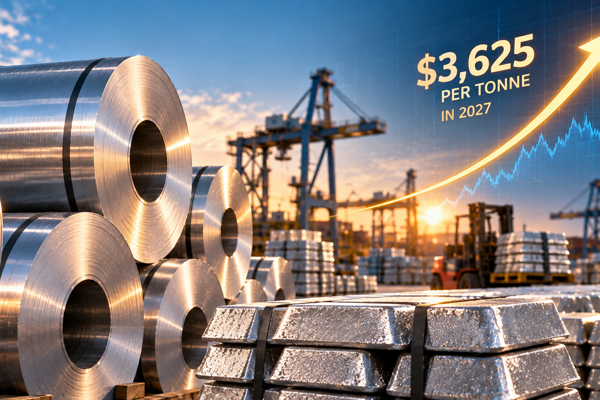
Aluminium prices recorded another gain on October 30, extending their late-month recovery as improving Chinese industrial indicators provided a supportive backdrop for the non-ferrous metals market. The latest movement comes amid a mixed demand environment, with stronger manufacturing activity and higher primary aluminium production in China contrasting with a broader slowdown in downstream purchasing. The benchmark aluminium quote reached USD 3,076.8, supported by a positive trading session. However, the recovery remains incomplete, with prices yet to return to the higher levels recorded earlier in the autumn. Aluminium rebounds from its late-October decline The daily price chart indicates a prolonged decline through June, followed by relatively stable trading and intermittent recoveries...
China's Yunnan Aluminium Co., Ltd. reported a sharp improvement in financial performance for the nine months ended September 30, 2026, with net income rising approximately 164 per cent Y-o-Y to CNY 11.6 billion (USD 1.74 billion), compared with CNY 4.39 billion (USD 660.96 million) in the corresponding period of 2025 The company's sales increased to CNY 52.61 billion (USD 7.90 billion) from CNY 44.07 billion (USD 6.62 billion) a year earlier, representing growth of approximately 19.4 per cent. The increase in net income significantly outpaced revenue growth, highlighting a substantial improvement in the company's reported earnings during the first nine months of 2026. Explore the production, demand and consumption forecasts of bauxite and alumina in our report: "Global Bauxite & Alumina...
Grow with
AL Circle

LME aluminium opened at US$2,275 per tonne on Wednesday, with its high and low at US$2,285 per tonne and US$2,261 per tonne respectively before closing at US$2,285 per tonne, an increase of US$15.5 per tonne or 0.68 per cent. On March 22, Wednesday, the LME aluminium cash bid price and the LME aluminium official settlement price slipped by US$3 per tonne or 0.13 per cent to halt at US$2,231.50 per tonne and US$2,232 per tonne. The LME aluminium price has been on a fluctuating spree this month with no sudden spikes and the average prices ranging between US$2,366.50 per tonne and US$2,232 per tonne. The 3-month bid price dived down by US$2 per tonne or 0.09 per cent, stopping at US$2,282 per tonne, whereas the 3-month offer price dropped US$3.50 per tonne or 0.15 per cent, closing at...

LME aluminium closed at US$2,269 per tonne, down US$14.5 per tonne or 0.63 per cent, from the previous trading day. On Tuesday, March 21, both LME aluminium cash bid price and LME aluminium official settlement price moved down by US$2.5 per tonne or 0.11 per cent to settle at US$2,234.50 per tonne and US$2,235 per tonne. 3-month bid price and 3-month offer price inched up by US$1.5 per tonne or 0.06 per cent and US$3 per tonne or 0.13 per cent to score at US$2,284 per tonne and US$2,286 per tonne. December 24 bid price and December 24 offer price climbed up by US$2 per tonne or 0.08 per cent and 0.07 per cent to rest at US$2,500 per tonne and US$2,505 per tonne. LME aluminium opening stock came in at 541875 tonnes. Live warrants and Cancelled warrants closed at 435925 tonnes and 105950...

When western countries turned back on Russian aluminium, China nearly doubled its imports from Russia. According to the data recently released by China customs, the country's imports of refined aluminium from Russia surged 94 per cent year-on-year to about 538,600 tonnes from March 2022 to February 2023, a record annual volume on a moving-average basis. Customs data also showed China's aluminium imports from Russia recorded more than three-fold growth in January and February 2023, surging 266.2 per cent. Compared to 28,759 tonnes in the first two months of 2022, China's aluminium imports from Russia amounted to 105,300 tonnes during the same period of this year. The total value of the two-month imports was $248.39 million, or an average price of $2,359 a tonne. Russian aluminium inflows...

In February 2023, the world's primary aluminium production totalled 5.273 million tonnes, reflecting a second consecutive drop this year. Compared to 5.823 million tonnes in January 2023, the world's primary aluminium output recorded a decrease of 9.45 per cent month-on-month, found the International Aluminium Institute. The production in January was down by 0.80 per cent from 5.870 million tonnes a month ago. However, on a year-on-year calculation, world primary aluminium production registered an increase of 2.69 per cent from 5.135 million tonnes. But despite the decline in monthly production, the world's daily average output of primary aluminium in February grew slightly from the previous month by 500 tonnes from 187,800 tonnes to 188,300 tonnes. On a year-on-year basis, the output...

LME aluminium opened at US$2,284.5 per tonne on Monday, with its high and low at US$2,300 per tonne and US$2,254 per tonne, respectively, before closing at US$2,284 per tonne, an increase of US$6 per tonne or 0.26 per cent. On March 20, Monday, the LME aluminium cash bid price ascended by US$7 per tonne or 0.31 per cent to halt at US$2,237 per tonne, and the LME aluminium official settlement price grew US$5.50 per tonne, officially settling at US$2,237.50 per tonne. The 3-month bid price shot up US$3.50 per tonne or 0.15 per cent, stopping at US$2,282.50 per tonne, whereas the 3-month offer price soared up US$3 per tonne or 0.13 per cent, closing at US$2,283 per tonne. December 24 bid price and December 24 offer price halted at US$2,498 per tonne and US$2,503 per tonne with no noticeable...

According to China customs data, China’s total aluminium imports in January and February grew by 11.3 per cent year-on-year, given the anticipated demand improvement once the country reopens. Customs data showed China imported 374,321 tonnes of unwrought aluminium and products, including primary metal and unwrought, alloyed aluminium, in the first two months of 2023, compared to 336,007 tonnes during the same period last year. In late 2022, China withdrew its strict COVID-19 restrictions, which led to economic recovery and improved demand for industrial metals. Consequently, manufacturing activity also ramped up at the highest rate in more than a decade in February 2023. In the first two months of 2023, China’s domestic primary aluminium output recorded an increase of 7.5 per cent...

LME aluminium opened at US$2,280.5 per tonne last Friday, with its high and low at US$2,314 per tonne and US$2,262 per tonne, respectively, before closing at US$2,278 per tonne, a drop of US$2 per tonne or 0.09 per cent. On Friday, March 17, LME aluminium cash bid price and LME aluminium official settlement price moved down by US$7 per tonne or 0.31 per cent and US$5.5 per tonne or 0.24 per cent to halt at US$2,230 per tonne and US$2,232 per tonne. 3-month bid price and 3-month offer price decreased by US$7 per tonne or 0.30 per cent to peg at US$2,279 per tonne and US$2,280 per tonne. December 24 bid price and December 24 offer price slipped by US$10 per tonne or 0.39 per cent to score at US$2,498 per tonne and US$2,503 per tonne. LME aluminium opening stock came in at 552350 tonnes....

The Paris Agreement is a landmark in the multilateral climate change process because, for the first time, a binding agreement brings all nations together to combat climate change and adapt to its effects, as stated by UNFCCC. The main objective of the Paris Agreement is to enhance the international response to the threat posed by climate change by limiting the rise in global temperature this century to well below 2 degrees Celsius and pursuing measures to further restrict the temperature increase to 1.5 degrees Celsius. The aluminium industry is among the most high-energy intensives in the global manufacturing sector. China is the world's leading aluminium producer, contributing to around 55-60 per cent of the worldwide output. The world's second-largest economy is also taking strict...

Rio Tinto increased its expenditure budget on Australian suppliers to more than A$15.3 billion in 2022 to support communities where it operates. Rio raised its budget by almost 9 per cent than the previous year and equally distributed among more than 6,200 businesses, including Australian-owned and operated businesses and locally owned and managed branches of overseas companies. This kind gesture supported tens of thousands of Australian jobs and contributed to the community growth across the country. Of the total amount spent, more than A$565 million was spent with indigenous businesses across Australia, up by 40 per cent from the earlier year. Kellie Parker, Rio Tinto Chief Executive, Australia, said: “Supporting local businesses in the communities where we operate is a key priority for...

According to the Shanghai Metals Market, China's primary aluminium inventories massively fell by 56,000 tonnes on a weekly basis across eight major consumption areas, including SHFE warrants. This can be considered a major fall after two months of successive inventory accumulation. On Thursday, March 16, the inventories came in at 1,211,000 tonnes, which in comparison with the second Monday of this month, March 13, hugely plummeted by 35,000 tonnes. The social aluminium inventories built up 121,000 tonnes Y-o-Y but have continuously fallen in the past two weeks. The inventory loss was spearheaded by Foshan, where augmented consumption and dropping prices instigated downstream purchase interests. Output cuts in Yunnan in late February also slashed supply in Foshan. Inventory stocks in Wuxi...

A billet is one of the most widely used aluminium product forms globally. Billets are created directly through continuous casting or extrusion or indirectly through hot rolling an ingot or bloom. The billet is normally suitable for alloyed aluminium. As per the data, on March 16, the aluminium billet inventories surged by 6,000 tonnes W-o-W to score at 169,400 tonnes. The figure below provides further information on the current state of aluminium billet inventories in China: As per the data, the inventories in Foshan and Wuxi had hiked by 6,700 tonnes and 2,200 tonnes to halt at 90,500 tonnes and 42,200 tonnes. On the same day, the inventory in Changzhou ascended by 100 tonnes to reside at 3,000 tonnes. Only in Huzhou the inventory plunged by 3,000 tonnes to stop at 30,000. On the other...

National Aluminium Company Limited (NALCO) has slashed its aluminium ingot and aluminium products prices for the third time in a row since the February end. With effect from Saturday, March 18, the company has cut its aluminium ingot price by INR 3,800 per tonne or 1.73 per cent to INR 215,850-219,350 per tonne versus INR 219,650-223,150 per tonne on March 10. NALCO’s aluminium wire rod price has also been reduced by INR 3,800 per tonne on March 18 to sell the product at INR 220,350-224,700 per tonne compared to INR 224,150-228,500 per tonne on March 10 . Aluminium billets price is no exception but also seen a cut of the same amount to come in at INR 220,300-222,950 per tonne as against INR 224,100-226,750 per tonne NALCO links its aluminium ingot and aluminium products prices to the...

The globally recognized world-class provider of high-quality cast house products and foundry alloys, Qamco, has projected a QR1.1 billion capital expenditure for 2023-27. The company will aim at its strategic plans to strengthen its market position and explore new international markets, focusing on enhanced shareholder value. The joint venture between Qamco and Qatar Aluminium, known as Qatalum, is on pace to increase output efficiency while reducing emissions through specialised process optimisation methods. The Qamco board revealed these in a report submitted before shareholders at the general assembly meeting, which approved all the agenda items on March 15, 2023. Abdulrahman Ahmad al-Shaibi, the Chairman of Qatalum, said, "Going forward, Qamco's JV will remain focused on its strategic...

This week, the primary aluminium sector has witnessed major impending issues, like the Slovenian aluminium producer Talum’s closed operations, directly affecting the jobs and livelihood of 189 workers. While on the other side, we see €1.2 million from the European Globalisation Adjustment Fund for Displaced Workers (EGF) was invested to fund new jobs for 303 Spanish aluminium smelter Alu Ibérica’s ex-workers. Alcoa’s Australian counterpart announced a 75 per cent production drop at its Portland aluminium smelter in Victoria. The US-based aluminium giant also declared the closure of its Intalco aluminium smelter after five years of operations. After a gush of disappointing news, the only positive occurring this week that can be mentioned is the Vedanta-Dalmia collaboration, which enables...

The voice of the aluminium industry in Europe, European Aluminium welcomed the latest publication of the Critical Raw Materials (CRM) and Net-Zero Industry Acts (NZIA). Together, these ideas mark a long overdue first step towards recognising the necessity for a European industrial strategy that aids in securing access to the raw materials necessary to support the twin transition and many other strategic initiatives. European Aluminium asks authorities to include aluminium in the CRM Act by highlighting its significance and generally acknowledged importance as a strategic raw material in the green transition.. Being a fundamental component of almost all renewable energy technologies prioritised in the Net-Zero Industry Act, such as solar PV systems, wind turbines, grid technologies, and...

After being declared bankrupt, Alu Ibérica LC S.L., located in the Galicia region of Spain, arranged for a €1.2 million loan from the European Globalisation Adjustment Fund for Displaced Workers (EGF) to fund new jobs for 303 of its ex-employees. On March 16, the European Commission joined in to support the initiation. This €1.2 million investment will aid the ex-Alu Ibérica workers to find new opportunities through enhanced vocational training, specific job profiling, expert guidelines and customised career paths. Spain promptly opted for the EGF funding to completely support the Alu Ibérica workers already abandoned by the company after it declared bankruptcy. Alu Ibérica excelled in producing primary aluminium from mined bauxite ore but had to shut down its operations owing to...

The US-based aluminium giant Alcoa announced it would close down its Intalco aluminium smelter after five decades of operations. With the closure announcement, the company begins preparing the site for new economic development opportunities. Roy Harvey, the President and CEO of Alcoa, said, “The Intalco smelter site operated for nearly 55 years, and we’ve spent significant time evaluating options for the asset, including a potential sale. Our analysis, however, indicates that the facility cannot be competitive long-term." Harvey added, “The site is an important part of our history. We are encouraged by the prospects for potential economic development via another entity that will own and control land at the site. As we transition, we will continue engaging with our stakeholders, including...

On Friday, March 17, Rusal announced a higher aluminium production in 2022, mitigating several challenges like Australia’s alumina export ban to Russia, suspension of alumina production at the Mykolaiv refinery, and inflated production cost due to energy and raw materials price hike. Rusal’s aluminium output in the full year stood at 3.835 million tonnes, up by 1.9 per cent from 3.764 million tonnes in 2021 amid a 31.8 per cent rise in production cost to US$2,190 per tonne versus US$1,661 per tonne last year. Thanks to the efficient management model, Rusal could rebuild raw material supplies and supply chains and successfully diversify sales channels, redirecting finished product flows to domestic and Asian markets. Thus, the company’s aluminium sales recorded no significant downfall but...