On the right track: The application of aluminium in railways

With the rapid advancement of human civilisation, air pollution and greenhouse gas (GHG) emissions have posed a significant threat to humanity for years. Energy conservation and emission reduction have become crucial priorities in the transportation industry.
According to AL Circle's report, "Global Aluminium Industry Outlook 2024," aluminium usage in the transportation sector was 27.5 million tonnes in 2023. This demand is expected to increase to 28.2 million tonnes in 2024.Today, millions of people and tonnes of goods are transported on trains yearly because they are the most efficient, convenient, and comfortable means of transportation. Since their inception during the Industrial Revolution of the 19th century, railways have undergone constant development to increase their efficiency, security, and ability to incorporate new technologies. The use of aluminium in trains has been steadily growing in recent years, and 2023 was no exception.
Pioneering use of aluminium in trains
The pioneering use of aluminium in trains, a significant moment in engineering and historical timeline, traces back to 1894 when the New York, New Haven, and Hartford Railroad introduced a groundbreaking lightweight car featuring aluminium seat frames. This was a remarkable technological advancement for its time, marking a pivotal shift in the materials used in railway construction.
The 1930s, a period of transformative experimentation, witnessed trials of constructing all-aluminium railway cars, intended for both freight and passenger transport. The 1933 Chicago World's Fair showcased the world's premier main-line aluminium passenger cars, a significant milestone that exemplified the rapid progress in railway engineering and the potential of aluminium in this field.
Subsequent decades saw sustained experimentation and targeted applications of aluminium in railway engineering. However, it wasn't until the 1960s that aluminium's utilisation gained momentum, eventually becoming ubiquitous in the industry by the 1980s. This evolution positioned aluminium as a preferred material across diverse railway applications, notably in urban metro and high-speed train networks.
Major end-use markets for aluminium, such as transportation, building and construction, and the packaging sector, together accounted for about 65 per cent of the total usage in 2023. In 2024, the transportation sector, followed by electrical and electronics and packaging, is expected to witness good growth.
Aluminium can cut the total weight of a rail car body by half
Material substitution presents a promising option for lightweighting. Traditionally, low-carbon and stainless steel have been the primary materials used to construct transportation equipment. However, titanium, aluminium, and magnesium are emerging as viable lightweight alternatives to steel and cast iron.
Among these materials, aluminium stands out due to its balanced performance characteristics, including lightweight, good corrosion resistance, excellent formability, high specific strength, and relatively low cost. The density of aluminium alloys is only one-third that of steel. By optimising structures with aluminium, the overall weight of a rail car body can be reduced by 50 per cent, making it a valuable focus for engineering applications.
Despite aluminium constituting approximately 8 per cent by weight of the Earth's crust, its high affinity for oxygen and the stability of aluminium oxides and silicates long hindered its extraction. Consequently, aluminium only became economically viable for engineering applications at the end of the nineteenth century.
Aluminium is crucial in modernising trains and boosting energy efficiency, and using aluminium results in a 50 per cent reduction in the total weight of a rail car body. Aluminium, a prominent construction element used in modern train manufacturing, is currently being utilised to fabricate contrails that connect several components of the train's structure, including the floor, sidewall, ceiling, sideboards, and floor panels.
Aluminium shows immense potential in revolutionising railway construction, embracing not just coaches and waggons but also diverse signalling systems and station decor. Its intrinsic corrosion resistance may significantly lengthen the duration of railway coaches, stretching their operating lives to over 40 years while needing decreased maintenance.
Characteristics of aluminium alloy
The unique properties of aluminium alloys, combined with the special operating environment of trains, have facilitated their widespread adoption in the transportation industry, particularly in high-speed rail. In rail transit vehicles, aluminium offers several advantages:
- Significant weight reduction - Using aluminium alloys can substantially decrease the net weight of rail passenger cars while meeting safety requirements for strength and rigidity. Generally, aluminium alloy car bodies are 30 per cent to 50 per cent lighter than their steel counterparts. Increasing the proportion of aluminium is the most effective way to achieve significant weight reduction for high-speed and double-decker trains.
- Excellent fire resistance - Although its melting point (660 °C) is much lower than that of steel (1530 °C), the fire resistance of a car body is influenced not only by the melting point but also by the material's thermal conductivity. Compared to steel, aluminium alloy has superior thermal conductivity and better heat dissipation.
- Corrosion resistance- A dense oxide film forms easily on its surface, providing strong anti-oxidation properties in the atmosphere. As a result, aluminium alloy car bodies have better corrosion resistance than steel, especially in components that are difficult to coat, such as box structures and internal beams and columns. Moreover, the surface of aluminium alloy can be coloured, painted, or sprayed using chemical methods, significantly enhancing corrosion resistance and improving the decorative appearance of the components.
What type of aluminium alloys used
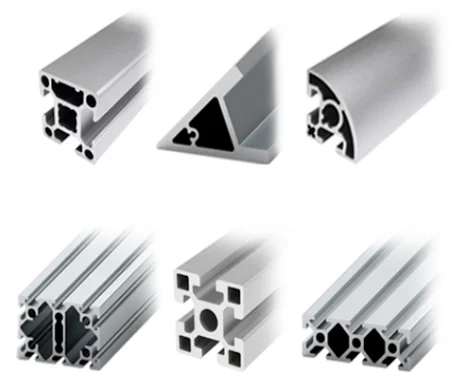
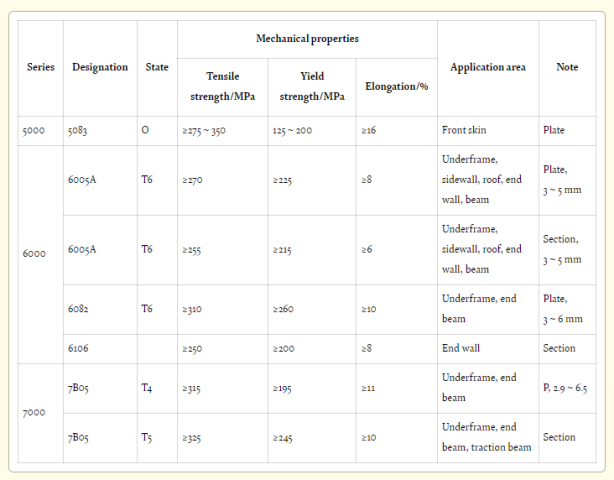
Aluminium alloys are extensively used in high-speed trains, with three common series being the 5000, 6000, and 7000 series. The 5000 series stands out for its remarkable strength and exceptional corrosion resistance, making it ideal for welded structures. Meanwhile, the 6000 series alloys offer moderate strength coupled with excellent corrosion resistance. Notably, they excel in extrusion formability, enabling the creation of intricate and thin-wall hollow sections. Lastly, the 7000 series alloys boast outstanding strength, particularly after age-hardening processes. This attribute allows significant weight reduction, enhancing performance in high-speed train applications.
Detailed application of aluminium in railways
- Car body –Advancements in aluminium alloy materials and the production of large extruded profiles have catalysed the modernisation and weight reduction of railway vehicles. In recent years, fuelled by the growing popularity of lightweight design principles and the imperative for simplified construction and maintenance, significant strides have been made in developing large, integral, thin plates and intricate hollow profiles.
In Japan, a notable breakthrough is the 6N01 (6005 alloy), prized for its enhanced extrusion capabilities, weldability, and corrosion resistance. This alloy has successfully paved the way for the creation of porous, complex thin-wall hollow profiles, replacing erstwhile 7N01 and 7003 profiles in key car-body components like floors, side plates, and roofs.
Meanwhile, Western Europe predominantly employs 6005A extruded profiles for aluminium alloy body construction. This choice is underpinned by several factors, including the superior extrusion performance of 6005A, streamlined production processes, and the ability to circumvent stress corrosion issues commonly associated with 7000 series alloys.
- Gear Box—To further lighten the train's weight, focusing solely on reducing the car-body weight isn't sufficient, as it constitutes only around 20 per cent of the total mass. Due to their favourable attributes, alloys like AlSi7MgA and AlCu4Ti are commonly employed in gearbox casting. These include good flowability, low thermal expansivity, and minimal shrinking percentage.
High-speed train gear boxes are typically manufactured using cast aluminium rather than wrought alloy, primarily due to their complexity and uneven thicknesses. Low-pressure casting has emerged as a preferred method for non-ferrous alloy casting. Its advantages, such as high feeding pressure, controlled temperature gradients, and stable filling, contribute to improved casting density and product yield.
Attention has turned to key components of the bogie, including the traction motor, wheelsets, frame, and braking system, in the pursuit of lightweight solutions. One notable area of focus is the gearbox, where the application of aluminium alloy is gaining prominence.
- Axle Box -The axle box plays a crucial role as a bearing component in the train bogie, serving as a pivotal transfer joint for motion. Positioned on the axle journal through a rolling bearing on the left side and connected to the frame via an elastic node on the right swivel arm, it withstands vertical, longitudinal, and transverse forces during train operation. Given this multifaceted role, the axle box's structural integrity and performance stability are paramount for ensuring safe train operation.
7050 aluminium alloy forgings have gained traction due to their remarkable combination of strength and toughness. This material significantly reduces unsprung weight, offering a substantial advantage over traditional carbon steel counterparts. Forged aluminium products exhibit a weight reduction of up to 62.5 per cent compared to their carbon steel counterparts, making them a preferred choice for high-speed trains.
Key manufacturing techniques
The utilisation of aluminium alloy in rail transportation engineering faces several challenges, spurring the advancement of key manufacturing techniques. These include:
- Casting
- Forming
- Welding
- Anti-corrosion process
Casting
Casting stands as a crucial process in fabricating intricate structures like gearboxes. The primary challenges encountered in gearbox casting encompass several aspects:
- Ensuring the absence of cold shuts, porosity, and other defects in thin-walled sections to meet casting appearance standards.
- Preventing excessive shrinkage porosity, shrinkage cavities, and defects on critical areas such as box surfaces, flanges, and supports to meet internal quality requirements for radiographic inspection.
- Meeting stringent requirements for surface smoothness on both machined and non-machined surfaces is particularly crucial for aluminium alloy castings prone to pinhole defects.
Porosity, pinholes, and shrinkage cavities are common casting defects in the production of aluminium alloy gearboxes for high-speed EMUs. Two measures are essential to mitigate pores while controlling the air content in moulding sand.
- Firstly, venting near the inner runner and riser should be enhanced by increasing the number of air holes and hollowing out the outer moulding’s foam core.
- Secondly, a sufficient coating thickness is ensured to minimise surface voids on the sand (core), utilising coatings with high thermal conductivity like zircon powder. Increasing filling and holding pressures appropriately enhances gas resistance into the molten metal.
Effective pinhole elimination primarily hinges on controlling hydrogen content in liquid aluminium. Refining processes diminish oxidation inclusions and hydrogen content, thus reducing pinhole formation tendencies. Addressing shrinkage cavities atop the gearbox involves simulating solidification with tools like MAGMAsoft. Optimisation of chilling blocks and riser locations ensures unblocked feeding channels for the top riser under a reasonable temperature distribution.
Forming process
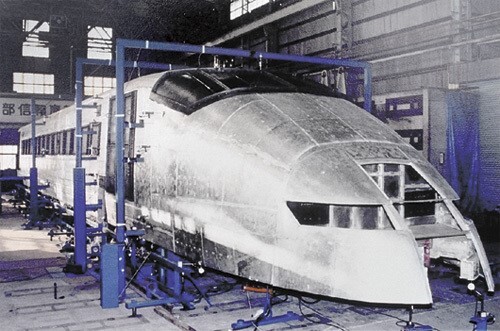
Four distinct technologies are available for manufacturing the front skin panels of the head car. The primary method, hammer pressing, involves using a hammer machine to shape the panels conveniently. However, the dimensional accuracy of the resulting product relies heavily on the worker's expertise. Once installed on the structural frame, any further adjustments to the geometric features necessitate manual tools such as hammers. This manual intervention makes achieving high repeatability of manufactured components nearly impractical.
The second technique, expanding-stretching, is suitable for panels with curved profiles, albeit with limitations. Additionally, the rotating press machine produces panels with small and uniform curvature. Lastly, a process known as mould pressing utilises moulds to shape panels with a complex and subtle curvature. Each method caters to specific requirements and constraints in achieving the desired front skin panel designs.
Welding
Aluminium alloy's unique thermal and physical properties pose distinct challenges during welding. Factors such as low melting point, high thermal conductivity, elevated electrical conductivity, significant expansion and shrinkage tendencies, and higher alloy element content compared to carbon steel and stainless steel contribute to the increased likelihood of welding defects.
These can include pores, cracks, lack of penetration, incomplete fusion, substantial welding deformation, rough edges, and slag formation. Given these complexities, the welding process plays a pivotal role in determining high-speed trains' assembly precision, quality, and performance. As such, meticulous attention to welding procedures is imperative throughout manufacturing.
Anti-corrosion process
The rapid operation of trains exposes them to diverse environmental conditions within short periods. For rail vehicles, a specialised organic coating system safeguards aluminium against corrosion. The outer surface employs a distinct coating from the internal surface to address diverse environmental challenges. The outer coating confronts harsh natural conditions, while the internal coating handles condensation and potential leaks from washing rooms, demanding higher performance.
Evaluations of the outer coating system involve rigorous accelerated corrosion tests, including salt spray, damp heat, and high-low temperature tests. This system comprises several layers: sandblasting pre-treatment, epoxy primer, polyurethane putty, polyurethane interlayer, polyurethane finishing coat, and varnish.
Conversely, the internal coating system involves cleaning, etch coating, rust-inhibiting primer, and polyurethane topcoat. When aluminium components interface with other alloys, surface pre-treatment, accompanied by rust-inhibiting primer, is essential.
Conclusion
Overall, using aluminium in trains is a positive trend that will likely continue in the future. As aluminium technology improves, we can expect to see even more lightweight, efficient, and sustainable trains on the tracks. Aluminium alloy is easy to process, manufacture, and maintain. The development and application of large, hollow, and complex section aluminium profiles have advanced aluminium welding technology, leading to increasingly mature vehicle manufacturing techniques. Aluminium alloy parts are easy to replace and suitable for various surface treatments. Additionally, the workload required for manufacturing an aluminium rail car body is significantly less than that needed for a steel one.
Unlock full access – sign up for FREE.
Key benefits
Oslo welcomes its newest flagship: Trosten floating sauna featuring Hydro CIRCAL recycled aluminium
Next articleMotorola unveils edge family's newest member in sandblasted aluminium with advanced moto AI camera
Grow with
AL Circle












_md.webp)