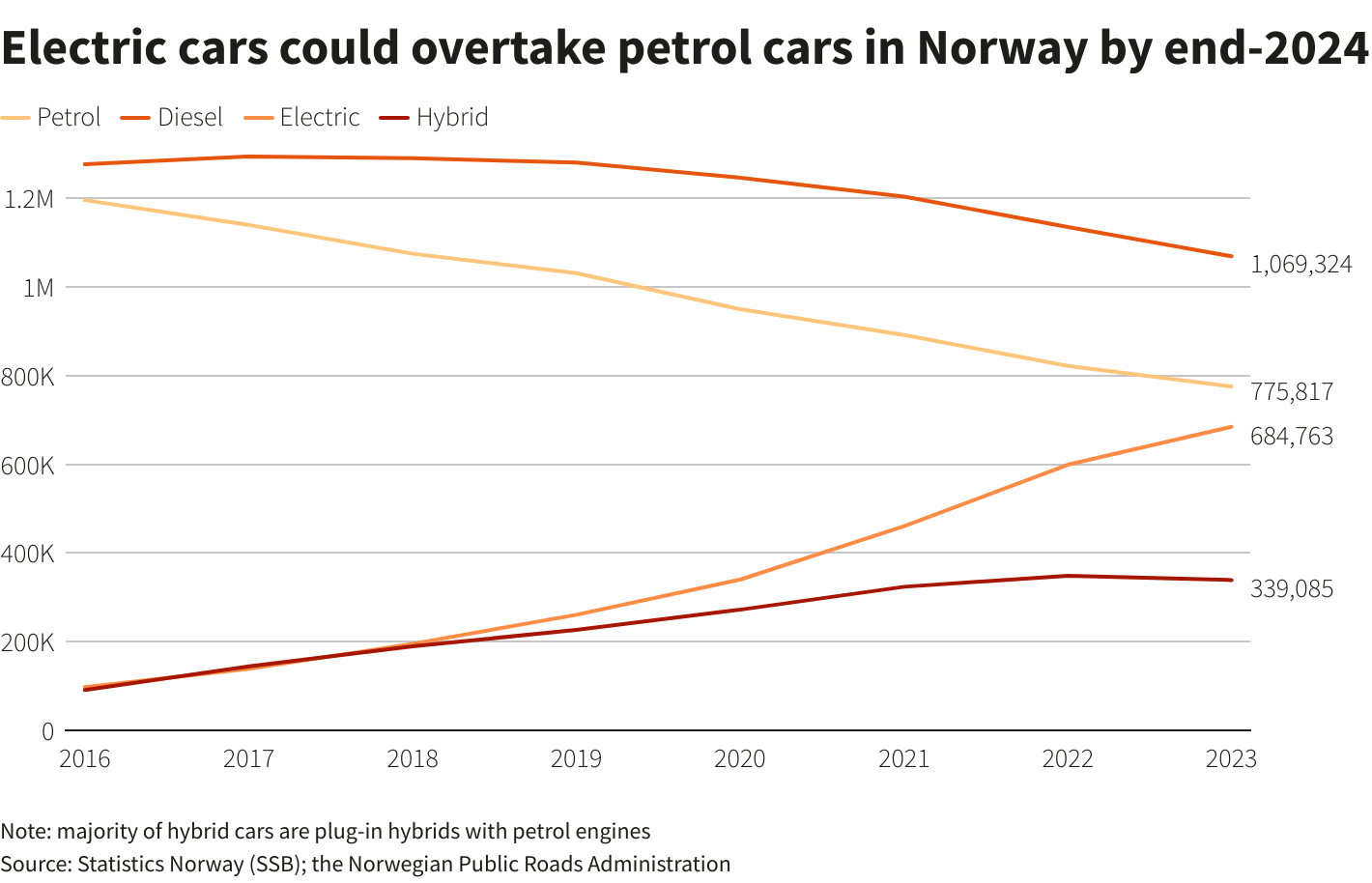
Norway is poised to achieve a historic milestone as the number of battery electric vehicles (BEVs) on its roads is projected to surpass petrol cars by the end of 2024 or early 2025, marking a significant achievement for any nation, as per Reuters analysts.
Generous incentives, partly fuelled by Norway's significant oil and gas wealth, have propelled this shift. However, analysts anticipate that it will be a few more years before Battery Electric Vehicles (BEVs) outnumber diesel vehicles in Norway.
Norway, a contemporary nation abundant in energy resources, boasts a population of 5.5 million. It is one of the world's most prosperous countries, boasting a GDP per capita of USD 106,148. With income distribution relatively fair, everyone contributes to the consumer base. Forecasts suggest that the policy rate will persist at 4.5 per cent until autumn, gradually decreasing. Economic expansion is anticipated to be sluggish in the initial half of 2024, with an eventual uptick anticipated. While unemployment may rise slightly, the increase is expected to be less pronounced than previously projected in December.
AL Circle research unveiled that net-zero, carbon-neutral, and sustainability will be major subjects and drives in the global aluminium industry. The transportation sector will largely drive aluminium demand, with EVs playing a significant role.
In September 2023, Speira stated, "Today, Norway is Europe's largest producer of primary aluminium and the largest single supplier of aluminium to the EU, ahead of China, Turkey, and Russia."
According to the most recent industry-focused report from AL Circle, "The World Of Aluminium Extrusions—Industry Forecast to 2030," the use of aluminium extrusions reached an estimated 31.5 million tonnes in 2023. Approximately 18% of this usage was attributed to the transport sector.
Norway is striving to become the world's first nation to cease the sale of new petrol and diesel cars by 2025. At the beginning of this year, nine out of ten new cars sold were battery electric vehicles (BEVs). If other countries follow Norway's example, global oil demand could reach its peak earlier than anticipated. The International Energy Agency predicts this peak to occur before 2030, with cars and vans contributing to over 25 per cent of the total oil demand.
Norway's shift to electric vehicles hasn't been without costs. The country has chosen to waive taxes on battery electric vehicles (BEVs) while committing to significant investments in public charging infrastructure.
According to data from the Norwegian Public Roads Administration, as of March 15, battery electric vehicles (BEVs) made up 24.3 per cent of Norway's 2.9 million cars, slightly trailing petrol vehicles, which accounted for 26.9 per cent. However, despite this, petrol cars maintained a lead of nearly 76,000 over BEVs. This gap is notably smaller than the 104,590 new BEVs sold in Norway last year.
Robbie Andrew, a senior researcher at climate change think-thank CICERO, stated, "If that (trend) is continued for the next 12 months and given that sales of pure-petrol cars are negligible now, this time next year, there will be more BEVs on the road than pure-petrol cars, and probably before the end of this year."
Andrew suggested that it might take three to four years for battery electric vehicles (BEVs) to surpass diesel cars on Norway's roads, considering the current surplus of nearly 370,000 diesel cars.
Ingvild Kilen Roerholt, who leads transport research at Oslo's Zero think-tank, observed that this year in Norway, electric vehicles (BEVs) have surpassed petrol cars in numbers despite a recent sales downturn.
Last year, Norway experienced a decline in new car sales, with electric vehicles (BEVs) also affected, dropping by approximately 25 per cent. This dip coincided with a general downturn in car purchases, partly due to increasing interest rates and reductions in specific tax incentives by the government. Despite these challenges, BEVs achieved a remarkable milestone, comprising 92.1 per cent of total car sales in January, as the Norwegian Road Federation (OFV) reported. However, by March, their dominance slightly decreased to 89.3 per cent of total sales, reflecting a broader decline in new car purchases, which plummeted by 49.7 per cent compared to the previous year, according to the latest OFV data.












_md.webp)