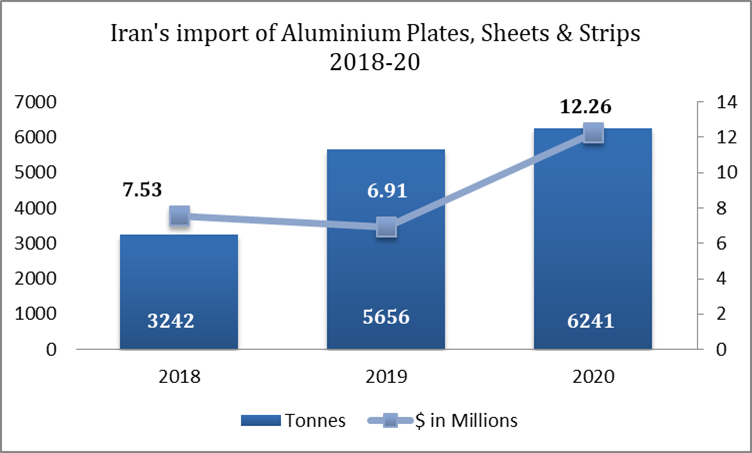
Iran’s import of Aluminium Sheets, Plates and Strips during 2018-20 reflects an upward trend
Iran’s economy is a mixed and transition economy with a large public sector. It is counted as the world's eighteenth largest by purchasing power parity. Some 60% of Iran's economy is centrally planned. Although, FocusEconomics Panellists see the economy contracting 7.3% in SH 2020, which is up 1.2% points from last month's forecast. In SH 2021, the economy is seen growing by 2.6%.
The Western Asian nation’s import of aluminium sheets, plates and strips during 2018-19 was recorded at 8898 tonnes and the expenditures occurred due to the import stood at $14.44 million. The import for 2020 is expected to reach at 6241 tonnes, with expenditure to stand at $12.26 million. However, when the import volume and expenditure for 2020 gets added with the preceding two years, it resembles 15,139 tonnes and $26.70 million respectively.
Iran’s import of aluminium sheets, plates and strips in 2018 stood at 3242 tonnes and foreign revenue expenditure accounted for $7.53 million, whereas, in 2019, the import reflected growth by 74.46%, while the expenditure dropped and remained at $6.91 million.
The import for 2020 has also been marked with growth by 10.34%, as the import expected to reach at 6241 tonnes and expenditures to also rise at $12.26 million.

Iran’s major trading destinations for the importation of Aluminium sheets, plates and strips are China, Greece, Italy, Japan, Slovenia, Turkey, etc.
Aluminium billet inventories in China rise by 4,400 tonnes to 94,500 tonnes
Next articleIndia has a long way to match the global average consumption of aluminium in auto industry: Vedanta Aluminium’s Ajay Kapur
Grow with
AL Circle