According to official data released on April 27, 2024, industrial profits in China fell short in March and showed reduced growth for the quarter compared to the preceding two months. This raises concerns about the robustness of the recovery in the world's second-largest economy.
In the first quarter, China's industrial firms saw a 4.3 per cent increase in cumulative profits, reaching RMB 1.5 trillion ($207.0 billion), as per data from the National Bureau of Statistics (NBS). This growth rate is slower compared to the 10.2 per cent rise observed in the initial two months of the year.
In March, profits experienced a 3.5 per cent decline compared to the previous year. While the National Bureau of Statistics (NBS) didn't provide a breakdown of monthly figures for January and February, they indicated in March that monthly figures had been on the rise since August 2023. This information aligns with various economic indicators for March, including retail sales and industrial output, which all indicate a weak domestic demand despite robust GDP growth in the first quarter.
Apprehensions regarding sluggish domestic demand have gradually eclipsed the initial signs of economic resurgence in the early months.
Bruce Pang, Chief Economist and Head of Research for Greater China at JLL warned that if the deceleration in profit growth persists, it could impact the repair of manufacturing firms' asset and liability structures and their inclination to pursue investment expansion.
The National Bureau of Statistics (NBS) reported that the high-tech manufacturing sector spearheaded profit growth in the first quarter, surging by 29.1 per cent. However, the NBS noted that firms recovered their profits differently.
In the first quarter, profits within the automobile manufacturing sector surged by 32.0 per cent compared to the previous year. Beijing hosted China's largest auto show on April 25, featuring leading companies showcasing their newest electric vehicles (EVs). This highlights the dominant presence of electric vehicles in the world's largest auto market, signalling a steadfast commitment to an all-electric future.
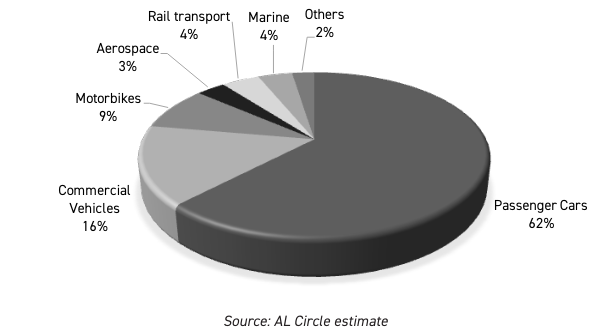
AL Circle's industry-focused report, 'Global Aluminium Industry Outlook 2024', revealed that aluminium usage in the transportation sector reached 27.5 million tonnes in 2023, with a projected increase to 28.3 million tonnes in 2024. Among the various transport sectors, passenger cars emerged as the largest user segment of aluminium, a trend further bolstered by the rise of EVs. Notably, aluminium also found applications in bus coaches, trains, and shipbuilding, indicating its diverse and growing role in the transportation industry. To know more, get access to your copy here.
Global aluminium usage in transportation by end-use, 2023 (%)
Total usage: 27.5 million tonnes
Aluminium has emerged as a pivotal material in the electric vehicle (EV) market, which has witnessed significant growth in recent years. A key driver of this growth has been the proactive investments by numerous downstream companies. These companies have established facilities to cater to the specific needs of the EV industry, such as battery casing and battery foils, thereby contributing to the overall development of the sector.
Additionally, in April, CATL, a prominent Chinese electric vehicle battery company, experienced a rebound in profits during the first quarter. However, its revenue declined for the second consecutive quarter due to sluggish demand and heightened competition.