Canada played host to this year’s G7 summit, marking its seventh turn at the helm of the influential bloc. In addition to the heads of state from G7 member nations and the European Union, which also participates in the summit, Canadian Prime Minister Mark Carney extended invitations to several non-G7 leaders. Among them were Mexican President Claudia Sheinbaum, who confirmed her attendance just days before the event following weeks of indecision, as well as Indian Prime Minister Narendra Modi and Saudi Crown Prince Mohammed bin Salman. The high-level gathering was convened in Alberta, underscoring Canada’s renewed diplomatic posture under Carney’s leadership.
“As vibrant democracies bound by deep people-to-people ties, India and Canada will work together with renewed vigour, guided by mutual respect and shared interests. Look forward to our meeting at the summit,” the Indian prime minister said.
The decision to invite Indian Prime Minister Narendra Modi drew scrutiny in both Ottawa and New Delhi, given the diplomatic chill that followed former Prime Minister Justin Trudeau’s explosive allegation in 2023 that India was behind the assassination of a Sikh separatist on Canadian soil.
The World Sikh Organisation condemned the invitation as a “betrayal of Sikh Canadians”, while the Sikh Federation of Canada branded it “a grave insult”. Yet Prime Minister Mark Carney, who assumed office in March and is keen to steer Canada’s trade beyond its heavy reliance on the United States, stood firm.
For Carney, India’s status as the world’s fifth-largest economy and its central role in global supply chains made its presence at the G7 not only logical but necessary. New Delhi, for its part, responded to Trudeau’s departure by expressing hope for a reset in bilateral ties—this time anchored in “mutual trust and sensitivity”.
“In addition, bilaterally, we have now agreed, importantly, to continue law enforcement dialogue, so there’s been some progress on that, which recognises issues of accountability. I extended the invitation to Prime Minister Modi in that context,” Carney told reporters in Ottawa.
In March, Carney also invited Ukrainian President Volodymyr Zelenskyy to the gathering. Leaders of Australia, Brazil, Indonesia, South Africa and South Korea were also expected to attend.
Trade and geopolitical tension ensue
Here is the rephrased version of the paragraph in your editorial style:
This year’s G7 meeting unfolded amid geopolitical and economic turbulence. Delegates engaged in high-stakes deliberations over the rapidly deteriorating situation in the Middle East following Israel’s sweeping airstrikes on Iranian military and nuclear infrastructure just days earlier. Trade tensions added further strain, with the United States’ sweeping tariff measures taking centre stage. While the Trump administration temporarily paused most tariffs for countries, while China remained excluded until a separate bilateral deal with Washington was struck. The G7, despite representing just 10 per cent of the global population, commands a staggering 44 per cent of the world’s GDP.
The G7 2025 summit website listed three core actions on the agenda: “Protecting our communities around the world”; “Building energy security and accelerating the digital transition”; and “Securing the partnerships of the future”.
India’s trade relations with G7 member countries
In June 2023, India and the United States reached a landmark agreement resolving six outstanding WTO disputes, including one on aluminium. Under the deal, the US agreed to exempt many Indian aluminium products from Section 232 security tariffs, allowing approximately 80 per cent of Indian aluminium import requests to be approved for tariff exclusion. This marked a major reprieve following the Trump-era imposition of 10 per cent duties on aluminium and 25 per cent on steel. As part of ongoing bilateral trade talks in 2025, India is pushing for all steel and aluminium tariffs, especially those reimposed in March 2025, to be formally addressed within a proposed comprehensive India-US Bilateral Trade Agreement (BTA).
India has also advanced negotiations with the United Kingdom. The recently signed India–UK Free Trade Agreement (FTA) eliminates import duties on 99 per cent of Indian exports, including aluminium products, while reducing tariffs on UK-origin aluminium exports to India by up to 90 per cent. However, future implementation may face hurdles due to the UK’s Carbon Border Adjustment Mechanism (CBAM), which could impose additional environmental compliance costs on Indian aluminium producers to meet UK emission standards.
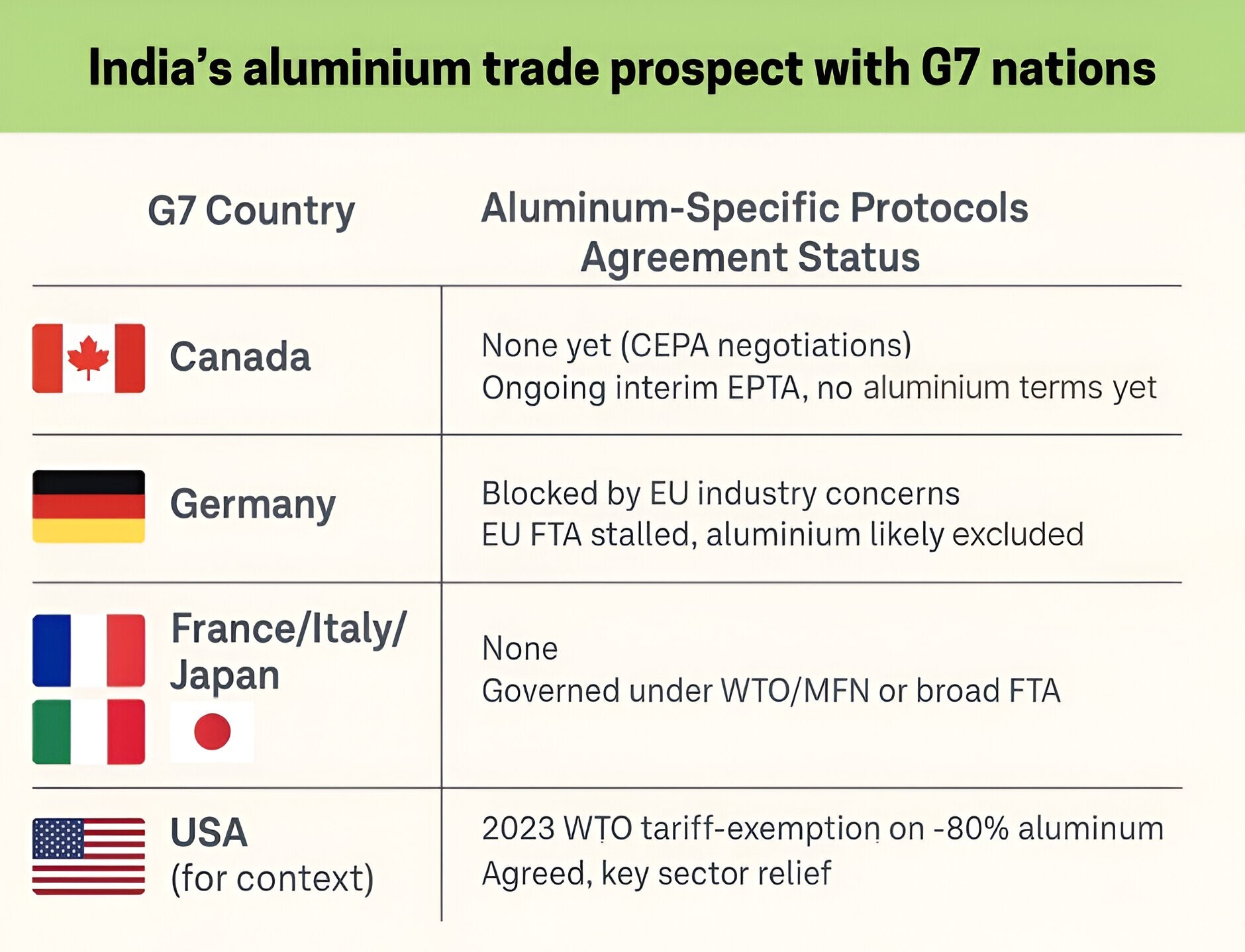
Negotiations between India and Canada have had its own course under the Comprehensive Economic Partnership Agreement (CEPA, previously called CEPA/EPTA), covering goods, services, investments, technical barriers, and dispute resolution. In early 2022, both governments agreed on an interim “Early Progress Trade Agreement” to accelerate mutual commitments, including recognition of pest management systems for pulses and broader tariff-reduction frameworks. However, there is no aluminium-specific clause currently agreed upon, and the CEPA remains under discussion without tariff lines or quotas targeting aluminium.
Aluminium trade with Germany falls under the broader EU-India Trade Agreement, which is still under negotiation. The EU aluminium industry has actively lobbied to exclude aluminium from liberalisation, citing competitiveness and environmental concerns. As a result, the current negotiating stance indicates that aluminium tariffs will likely remain outside the FTA’s scope until rules on carbon, origin, and emissions are addressed.
There are no bilateral aluminium trade agreements between India and France, Italy, or Japan. Trade in aluminium products continues under Most Favoured Nation (MFN) terms governed by WTO obligations and general FTA frameworks (e.g., India–Japan CEPA), but no sector-specific concessions or tariff quotas currently exist.
Expansion from G7 to G20: What does it mean for India?
India’s inclusivity in the G20, as the earlier G7 expanded, is not merely symbolic. It reflects a deeper realignment in global power dynamics and the country’s growing ambition to act as a bridge between developed and developing economies. While the G7 (comprising the US, UK, Canada, Germany, France, Italy, and Japan) remains a powerful bloc of industrialised nations, its share of global GDP and influence is increasingly being complemented (if not challenged) by the broader and more inclusive G20. For India, this evolution presents both an opportunity and a test of its diplomatic and economic agility.
India’s bilateral trade with G7 countries still forms a vital part of its export economy. The United States alone accounted for over USD 129 billion in bilateral goods trade in FY 2023–24, while trade with the UK stood at around USD 52 billion. Exports to Italy, France, and Japan are growing steadily, particularly in pharmaceuticals, automobiles, chemicals, and IT services. However, the G7’s increasingly protectionist stance, like the recent US tariffs on Indian aluminium and steel, has made these markets more complex and less predictable. The aluminium sector, in particular, has been hit hard by the US’s tariff hike from 25 per cent to 50 per cent, potentially endangering India’s USD 860 million worth of aluminium exports to the US.
In contrast, India’s inclusion into the G20, specifically with emerging economies like Brazil, South Africa, Indonesia, Mexico, and China, opens up a broader canvas for sustainable and inclusive trade growth. The G20 accounts for nearly 85 per cent of global GDP and 75 per cent of international trade, making it a more representative platform for shaping global economic policy. India’s presidency of the G20 in 2023 further cemented its role as a voice of the Global South. During its presidency, India pushed for reforms in global institutions, equitable climate financing, resilient supply chains, and digital public infrastructure — initiatives that align closely with its domestic development goals.
Moreover, G20 partnerships allow India to bypass the regulatory and environmental barriers often encountered in G7 economies. Countries like Indonesia and Brazil offer high-growth markets for Indian pharmaceuticals, agritech, and digital services with fewer protectionist hurdles. Energy and critical mineral cooperation with Australia and South Africa has also become crucial for India’s clean energy transition. The newly proposed India–Middle East–Europe Economic Corridor (IMEC), backed by several G20 nations, underscores India’s rising geo-economic centrality.
In essence, while the G7 remains a legacy trade bloc with high-value markets, the G20 represents a future-facing, multipolar economic order where India is not just a participant but a key agenda-setter. Transitioning from G7 to G20 engagement doesn’t mean abandoning traditional allies; rather, it signals a more balanced and pragmatic foreign policy.
For Indian businesses and investors, the inclusivity and the attendance both mean steering two worlds: one of high standards and high friction and another of high growth and high potential.













_md.webp)
_md.webp)







