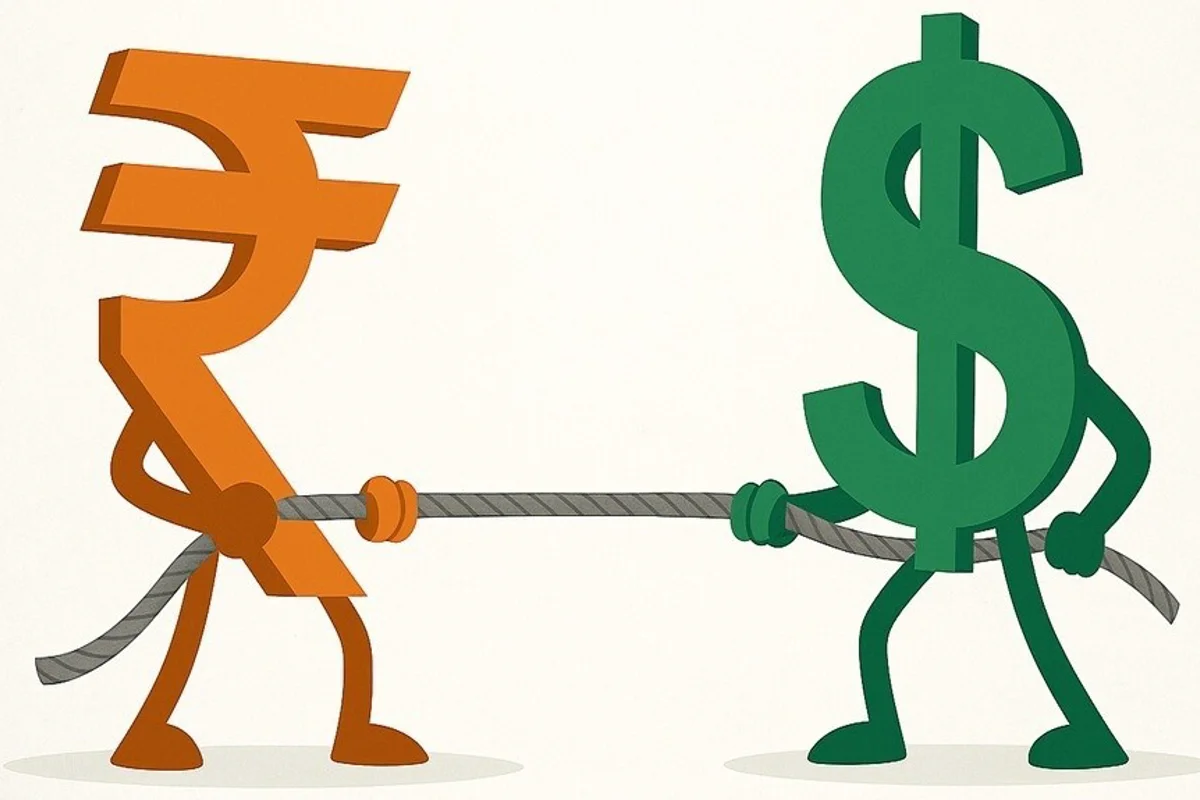
India is at the centre of global trade discussions after reports suggested that the Reserve Bank of India (RBI) had issued a circular enabling BRICS nations to settle 100 per cent of their trade in Indian Rupees (INR). Analysts argued that such a shift could weaken the US dollar’s dominance in international trade and strengthen BRICS’ collective bargaining power.
Though there is no such official mandate for BRICS to conduct all trade in rupees. Instead, several outlets noted that the RBI has relaxed norms by allowing banks to open Special Rupee Vostro Accounts (SRVAs) without prior approval, a move aimed at promoting INR-based trade at a time when US tariff measures continue to create uncertainty for BRICS countries.
The latest circular, issued on August 5, 2025, builds on an earlier framework introduced on July 11, 2022, under which exports and imports can be directly invoiced and settled in INR. Exchange rates between partner countries are to be determined by market forces, giving greater flexibility to traders.
Reports in The Economic Times and BusinessLine confirmed that the RBI had “tweaked” its rules, removing the requirement for prior approval when banks open SRVAs for correspondent banks. However, the central bank has clarified that banks must still comply with all norms under the Foreign Exchange Management Act (FEMA) and continue strict due diligence in line with KYC standards.
Under the revised arrangement, authorised dealer (AD) banks can now open SRVAs to settle cross-border trade transactions more quickly. These accounts allow invoicing, payment, and settlement in rupees. In practice, a Vostro account is an account maintained by an Indian bank for a foreign partner’s bank in INR. When an Indian importer pays a foreign trader in rupees, the amount is credited to the SRVA; when an Indian exporter receives payment, the corresponding amount is debited from the SRVA and credited to the exporter’s account.
This mechanism not only simplifies rupee-based settlements but also reduces the procedural delays associated with earlier RBI approvals, potentially making the INR more attractive in international trade.
India clarifies stance: “de-dollarisation not our agenda”
Despite speculation, India has firmly stated that de-dollarisation is not part of its financial agenda. Ministry of External Affairs (MEA) spokesperson Randhir Jaiswal reiterated this on August 14, 2025, following remarks by Brazilian President Lula about BRICS exploring an alternative currency.
External Affairs Minister S. Jaishankar has also underlined that India is not working to phase out the dollar but to “derisk” its trade by diversifying partners and exploring alternative payment systems. India has already signed currency-settlement agreements with Russia, the UAE, and the Maldives but remains opposed to a BRICS common currency, citing limited economic integration and political differences, particularly with China.
India’s expanding trade agreements
India has signed several high-impact trade deals in recent years to strengthen its global position:
- India-UK Comprehensive Economic and Trade Agreement (CETA) (July 24, 2025): Provides near-complete duty-free access to Indian exports, including aluminium, estimated to boost bilateral trade from USD 56 billion in 2025 to double by 2030. Industry leaders such as Vedanta, NALCO, and BALCO expect stronger market access in the UK for both primary and secondary aluminium.
- India-European Free Trade Association (EFTA) TEPA (March 2024, in force October 2025): Expected to bring USD 100 billion in investments over 15 years and create nearly one million jobs in India.
- Ongoing India-EU FTA Negotiations: The EU remains India’s largest trading partner, with negotiations expected to conclude by the end of 2025.
Other ongoing talks include India-US, India-Chile, India-Oman, India-ASEAN, and India-Qatar trade agreements, showing India’s intent to diversify and expand trade channels.
Aluminium trade between India and the EU
The aluminium industry forms a critical part of India-EU trade relations. Bilateral trade between India and the EU reached approximately EUR 124 billion (USD 135 billion) in 2023-24, with aluminium exports including unwrought and semifabricated products to the EU valued at USD 919.4 million.
The EU recorded an aluminium trade deficit of EUR 11.1 billion in 2024, importing EUR 29.5 billion worth of aluminium products while exporting EUR 18.4 billion. India ranked among the top suppliers, with about EUR 800 million (USD 880–920 million) worth of exports.
India produces around 4.1 million tonnes of aluminium annually, valued at nearly USD 13.77 billion in 2024, but also imports about 1.4 million tonnes to meet demand in infrastructure, automotive, and manufacturing.
While the RBI’s SRVA framework will make INR-based trade smoother with BRICS and other willing partners, trade with the EU largely continues in euros and dollars. Thus, the rupee settlement mechanism is unlikely to directly reshape India-EU aluminium trade but could gradually reduce dollar dependence in the long term.













_md.webp)
_md.webp)