Iceland’s import of aluminium bar rods and profiles during 2019-21 illustrates a sharp downfall followed by marginal growth; 5% rise predicted for 2022
The economy of Iceland rose at a steady pace but onwards 2017 decelerated its speed through 2019, crashed in 2020, and again recovered in 2021, which resulted in a five-year average annual growth rate of 2.20%. The Nordic island country has maintained strong levels of economic freedom for the past half-decade.
According to OECD, the economy of Iceland is projected to grow by 5.2% in 2022 and 4% in 2023, navigated by rebounding foreign tourism and resilient exportation of goods. However, it has been notified that business investment will slow down as financial conditions are tightening and restrained projects are being terminated.
A nation with impressive poverty rates, Iceland imported 6355 tonnes of aluminium bar rods and profiles during 2019-21. Machine and equipment parts are frequently made with aluminium bars, while aluminium profiles are used in architecture and engineering for structural components, frames, and other key parts.
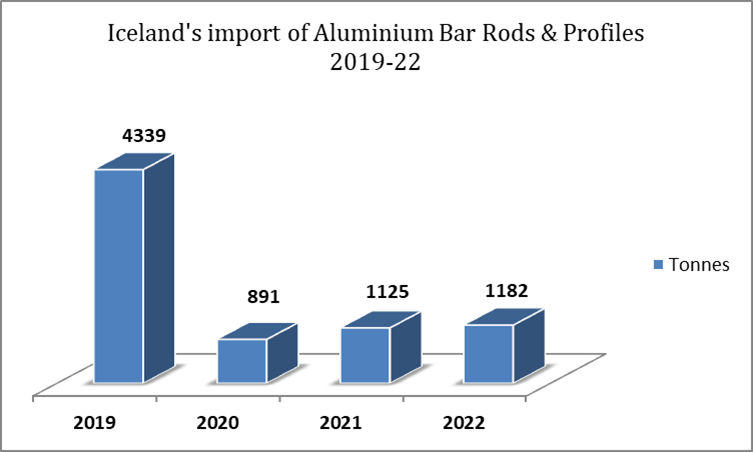
In 2019, Iceland imports 4339 tonnes of aluminium bar rods and profiles, incurring an outflow of revenue of $11.64 million, whereas, in 2020, the import of the aluminium product has illustrated a sharp downfall of 79.49%, as the import volume plunged to 891 tonnes and the expenditure also dipped to $4.38 million.
Iceland’s import of aluminium bar rods and profiles in 2021 was registered at 1125 tonnes, a rebound of 26.26%, following the barriers of the Covid pandemic.
Iceland’s import of aluminium bar rods and profiles in 2021 was registered at 1125 tonnes, a rebound of 26.26%, following the barriers of the Covid pandemic. The import for 2022 is analysed with further growth of 5.06%, as the import volume of aluminium bar rods and profiles is anticipated to score at 1182 tonnes.

The major trading destinations for Iceland’s import of aluminium bar rods and profiles are Belgium, China, Denmark, Germany, Finland, Greece, etc.
Japan’s semi-finished aluminium product export market during 2019-21manifests strong demand; 4% dive estimated for 2022
Next articleNovelis to expand aluminium capacity with $30 million in Plettenberg-Ohle facility for the growing coffee capsules market
Grow with
AL Circle