High purity alumina market by 2036: Supply shifts, price volatility and future growth drivers
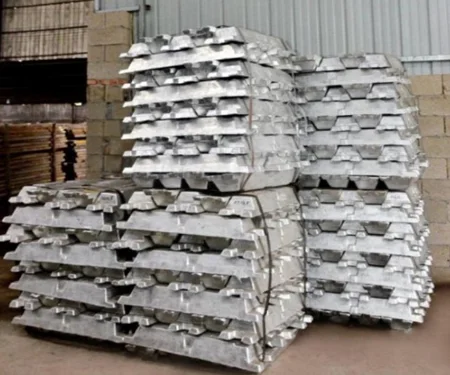
Stock image for referential purposes only
Within the global aluminium industry, where demand is rapidly growing, especially from the advanced technology sectors, high purity alumina (HPA) is deemed to emerge as a high-value material. Because of characteristics like ultra-high purity levels and requirements based on application-specific, unlike conventional alumina products, HPA is making significant input within the industries, like optical materials, energy storage and electronics.
AL Circle's latest report, "Global Bauxite & Alumina Market Forecast to 2036", states that in comparison to the bulk alumina industry, the HPA market remains small but holds higher strategic value and role in enabling the next-generation technologies. The market dynamics are influenced by strict quality standards, evolving end-use applications and complex production processes.
High Purity Alumina and its market at a glance
HPA refers to the alumina that enhances the purity level of 99.99 per cent (4N) and higher, which is deemed to be much higher than the smelter-grade alumina, which has a purity level of 99.5 per cent, if compared. HPA is mainly used and applied for applications that require superior thermal stability, corrosion resistance and insulation.
According to the AL Circle's report "Global Bauxite & Alumina Market Forecast to 2036", HPA holds the global market of nearly 40 thousand per year, whereas the smelter-grade alumina holds 140 million tonnes. Although HPA is produced in smaller quantities, it is priced much higher, almost USD 25 thousand per tonne, whereas smelter-grade alumina is usually priced at USD 350 per tonne. The high price of HPA is because of its specialised uses and limited supply.
Because HPA is regarded as a non-fungible product, replacing it in between various applications is not feasible. This is more so because each specific use required a unique level of purity, morphological characteristics and particle sizes. This results in highly segmented and technically driven market dynamics.
Also read: Bauxite supply shifts by 2036 as Guinea rises, China depends and new projects reshape global trade
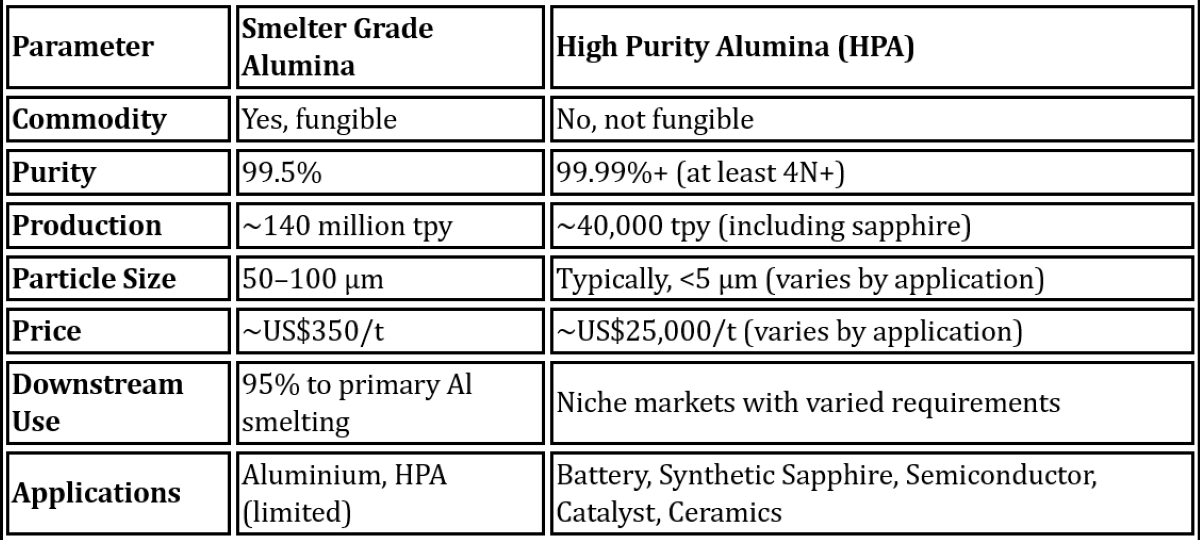
Parameter: Smelter Grade Alumina vs High Purity Alumina
HPA: Production process & related technologies
There are multiple and different methods used for the effective production of the HPA. Each of the methods provides distinct levels of purity, scalability and cost-effectiveness. The required technologies for HPA production are chosen based on factors like feedstock availability, economic aspects and the use purpose.
Modified Bayer Process: This process is said to be cost-effective, as for the feedstock, the method uses alumina or aluminium hydroxide. In this process, impurities are removed via acid washing and calcination. The only drawback of this method is the presence of residual impurities, which hinder the ability to reach the ultra-high purity levels and limit the use in more advanced applications.
Aluminium Alkoxide (Hydrolysis) Process: This method is deemed to be the most popular choice, aiding in making HPA, which typically ranges from 4N to 5N. In this method, the aluminium metal is dissolved in alcohol, followed by hydrolysis and calcination. Irrespective of its promise of the highest purity, it increases the production costs because of the costly feedstock and the process complexity.
Choline-based Process: This method is considered to be completely different from the above two-mentioned processes in order to achieve the highest purity HPA and boost the shorter processing time. However, this process also faces some similar challenges, such as costly feedstock and a shortage of high-purity aluminium.
Don’t miss out- Buyers are looking for your products on our B2B platform
Aluminium Chloride Hexahydrate (ACH) Process: This method offers an alternative means that makes use of affordable raw materials like kaolin or clay. By using this method, the production can add sustainability benefits, but still pose some hurdles like high initial costs, lack of widespread commercial validation and relevant operational challenges.
At the technology front, there are multiple emerging technologies, like Solvent Extraction, which are getting traction as they cut down the production costs while upholding sustainability. These technologies focus on selectively extracting and purifying aluminium ions, which can help recycle waste streams.
Rising HPA in end-use application
As per AL Circle's report "Global Bauxite & Alumina Market Forecast to 2036", in terms of high-performance and tech-driven sectors, the application of HPA is rising rapidly. In this scenario, synthetic sapphire is deemed to hold the lion's share, raising the overall demand and is also responsible for nearly half of the global consumption. This is highly applied in LED substrates, optical components and speciality glass, highlighting just how essential it is for cutting-edge material applications.
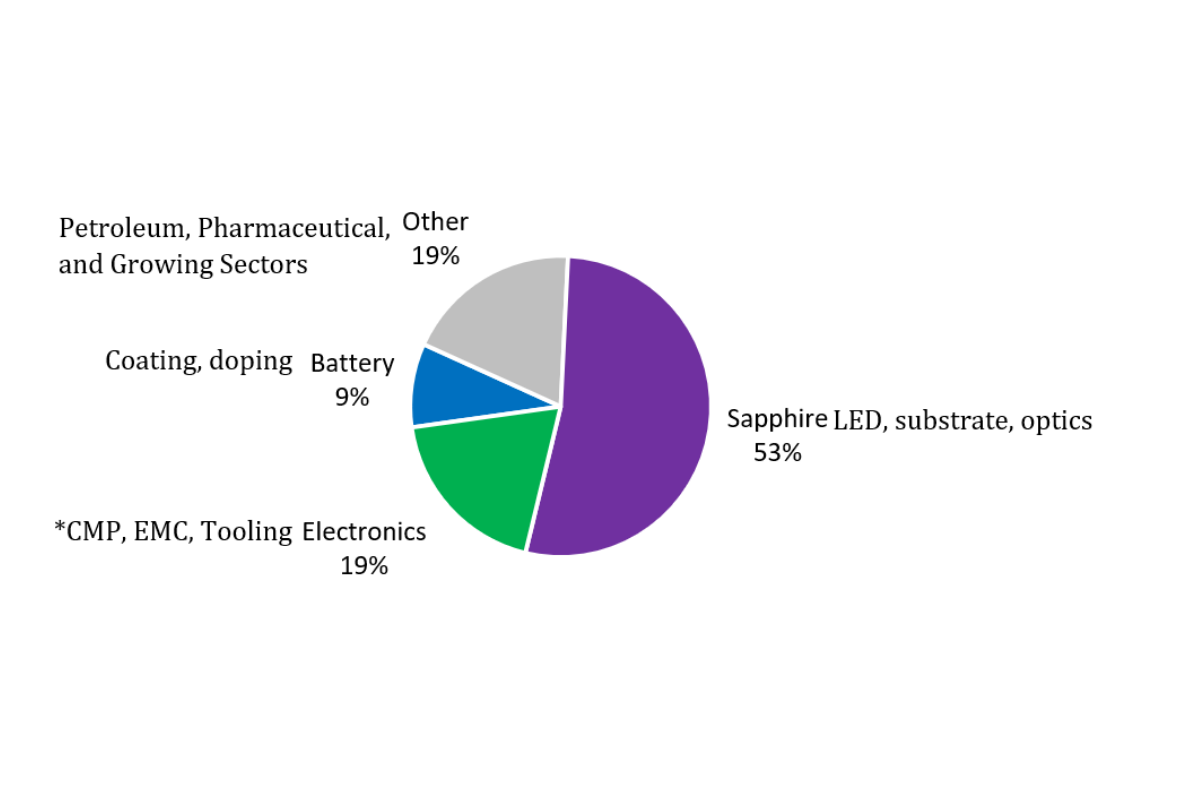
Image: HPA application in the end-use industries
Electronics and semiconductor sector: This sector represents a rapidly growing HPA application area, where it is being used in semiconductor wafers, substrates and various electronic components. Here, the growth is influenced by the increasing demand for advanced computing and smaller, more compact devices.
Lithium-ion battery industry: This is recognised as a major growth area, where HPA is deemed crucial in battery separators and coatings, boosting thermal stability, safety and overall performance. As EVs and energy storage systems continue to rise, AL Circle’s report "Global Bauxite & Alumina Market Forecast to 2036" estimates that there will be a significant surge in demand for HPA in this sector.
Other applications: HPAs are also used in ceramics, catalysts and various industrial fields, including petroleum refining and pharmaceuticals. With ongoing technological advancements, new areas for HPA applications are said to be emerging rapidly in the near future.
Must read: Key industry individuals share their thoughts on the trending topics
Companies and some key projects
Major companies that produce HPA are Alpha HPA Limited, Nabaltec AG, Altech Chemicals Ltd., Taimei Chemicals Co., Ltd., Sasol Limited, Nippon Light Metal Holdings Co., Ltd., Baikowski SAS, Almatis, Inc., Evonik Industries AG and Hindalco Industries Ltd., among many other key players.
Some of the active projects include Alpha HPA Limited, which is advancing its flagship HPA First Project in Gladstone, Queensland, which is designed to be the world's largest single-site refinery for high-purity aluminium materials. The project uses proprietary, low-carbon, solvent extraction technology to produce 4N/5N HPA for batteries and semiconductors.
On the other hand, Altech Batteries, with its Silumina Anodes™ project in Saxony, Germany, is moving towards commercialisation, where it is focused on developing high-capacity silicon-graphite battery materials. This is significantly possible by utilising its proprietary HPA coating technology to improve lithium-ion battery anodes.
Check out the historical and daily LME price of alumina platts seamlessly here
As reflected in AL Circle's report "Global Bauxite & Alumina Market Forecast to 2036", the global bauxite and alumina market is deemed to enter a phase which is a more intricate and strategically focused era. Now, the power balance is shifting from simply owning resources to controlling the supply chain. Irrespective of the geological availability, the ability to turn those resources into a steady yet cost-effective supply is increasing as it has been influenced by policy changes, infrastructure readiness and other geopolitical factors.
As a result, the usual supply-demand balance is also evolving, leading to sporadic shortages, regional disparities and increased price fluctuations, especially in alumina, where energy demands and carbon-related regulations are altering cost competitiveness.
As per the estimates in AL Circle's report "Global Bauxite & Alumina Market Forecast to 2036", by 2036, the market is expected to be characterised by new trade patterns, rising fresh refining centres and a growing divide between low-cost and high-cost producers. In this landscape, strategic positioning will be crucial.
Stakeholders who can secure upstream access, adapt to changing policies and decarbonisation efforts and respond to shifting demand centres are likely to reap greater rewards. The next decade will not just be about gradual growth, as it will hinge on how well market players can foresee disruptions and adjust to an ever-evolving, policy-driven global environment.
Check out the forecast of the global bauxite and alumina market till 2036, book the report “Global Bauxite & Alumina Market Forecast to 2036: Supply–Demand, Trade Flows & Price Outlook”
_0_0.png)
DAILY: Chinese spot alumina holds steady amid tight availability
Next articleWEEKLY: Supply disruptions keep China's alumina prices largely steady
Grow with
AL Circle