Foreign direct investment (FDI) in China has declined to its lowest level in three decades, according to official data released by the State Administration of Foreign Exchange in February 2024. The sharp decline highlights growing concerns among foreign corporations over China's increasingly stringent regulations and the impact of U.S. sanctions, as Nikkei Asia reported on February 19, 2024.
In 2023, China's net FDI totalled a mere $33 billion, a staggering 80 per cent drop from the previous year. This marks the second consecutive year of decline, a significant fall from the peak of $344 billion recorded in 2021.
Despite the dismal overall figures, the final quarter of 2023 saw a slight improvement, with inflows surpassing outflows by $17.5 billion. This modest recovery followed the first-ever recorded net outflow in the previous quarter. However, the overall trend reflects a growing reluctance among foreign investors to commit to China, as geopolitical tensions and regulatory crackdowns cast a shadow over the investment landscape.
The Voice of America (VOA) China News reported, citing data from China's Ministry of Commerce, that Foreign Direct Investment (FDI) declined in China for the 12th consecutive month in May. In a press release on June 21, the ministry reported that China attracted $56.8 billion (RMB 412.51 billion) in FDI during the first five months of this year, marking a 28.2 per cent year-on-year decrease.
Analysts and foreign investors point to political risks and China's ongoing challenges in achieving stable economic growth following the COVID-19 pandemic as key factors behind the decline.
Starting in the late 1970s, under Deng Xiaoping's 'reform and opening up' policy, China actively sought to attract foreign investment, talent, and technology. However, in recent years, foreign companies have begun scaling back their operations in China due to the government's increasing emphasis on national security, including a stringent crackdown on espionage. The Chinese authorities, particularly, have tightened controls on research firms involved in market analysis and other activities, leading to reports of foreign company employees.
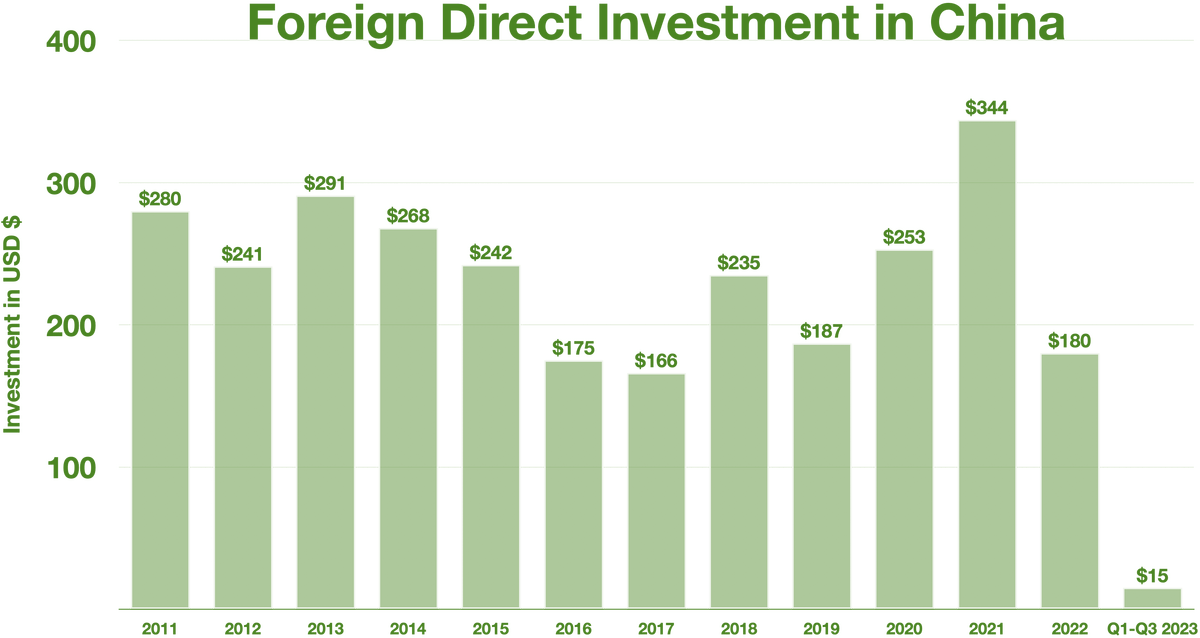 Source: File: Foreign direct investment in China.webp (WIKIMEDIA COMMONS)
For instance, the Financial Times reported that Gallup, the American research firm, decided to withdraw from China last year.
Japanese businesses are increasingly concerned about operating in China. U.S. and European companies conduct thorough research on business conditions before investing. However, many research firms have experienced delays in this work.
The impact of U.S. restrictions on China's access to advanced semiconductors is evident as chip-related businesses progressively shift away from the country. In 2018, China accounted for 48 per cent of global foreign direct investment (FDI) in the semiconductor sector. Still, by 2022, this share had plummeted to just 1 per cent, according to the Rhodium Group. Conversely, American chip-related FDI surged from 0 per cent to 37 per cent during the same period, while the combined share for India, Singapore, and Malaysia increased from 10 per cent to 38 per cent.
In response to these shifts, U.S. company Teradyne, a leading manufacturer of testing equipment for semiconductor fabrication, has moved its primary production facility from China's Jiangsu province to Malaysia, according to Chinese media reports. Similarly, Britain's Graphcore, a company specialising in chips for artificial intelligence applications, has reportedly laid off most of its employees in China.
The automotive industry is also changing as Chinese competitors become more formidable. In October, Mitsubishi Motors announced it would cease vehicle production in China, while Toyota Motor and Honda Motor are scaling back their workforce at Chinese joint ventures.
Moreover, the persistent slowdown in China's economic growth is further deterring foreign investment. Domestic demand remains weak, partly due to a slump in the real estate market, and there are growing concerns about potential deflation.
While Chinese companies have made significant strides in electric vehicles and surveillance technology, they still rely on foreign expertise in areas such as advanced semiconductor manufacturing. If foreign companies continue reducing or withdrawing their operations in China, the country's productivity gains could slow down. Coupled with a decreasing labour force, this could challenge China's economic growth in the medium to long term.
Note: All the information and data in the article has been sourced from Nikkei Asia, VOA-China News