The European Commission's Joint Research Centre (JRC) invited the Federation of Aluminium Consumers in Europe (FACE) to respond and offer clarifications prior to updating its June 2025 position paper on aluminium scrap. On December 12, FACE published a document based on a survey conducted across 7 value-chain companies. The questions addressed a vast spectrum of aluminium scrap in the European Union - starting from its availability, through circulation, to its quality. These are to be used in the preparation of the Circular Economy Act, with the primary focus remaining on aluminium in the sector of construction.
Image for representational purposes only
Explore- Most accurate data to drive business decisions with 50+ reports across the value chain
The document highlights concerns regarding the volatile situation of scrap shortage and rise in export that include an increased percentage of high-quality materials, with pre-consumer scrap on the list. Offering technical suggestions, FACE reiterates previously suggested solutions to safeguard scrap export, while acknowledging traceability and recycling capacity within the EU.
Presently, the JRC is assisting the European Commission’s Directorate-General for the Environment regarding the legislative proposal, Circular Economy Act, focusing on aluminium in the aspect of construction. 3 major questions were received by the JRC on its position paper.
Profile of Aluminium consumers in Europe
Europe has a diverse sector for aluminium recycling, constituting thousands of SMEs and some other large business units. There are around 100 large and medium-sized facilities that engage in secondary smelting of old and new scrap, and several thousand small operators.
The 7 surveyed companies have 17 production facilities spread across France, Italy, Spain, Sweden, and Germany. Their processing capacity, combining all products, add up to 570,000 tonnes annually, and that of the FACE members is approximately 800,000 tonnes.
Among these 7 companies, aluminium is mainly used in construction, packaging and automotive/transport, with a minimum 4 companies dealing with industrial and automotive sectors and 3 with the packaging division. Only 2 of them exercise a vertical integration of the smelter/remelter and the manufacturer of semi-finished products.
Secondary material is used under strict specifications from the end customers, alloy requirements and quality considerations. A smelting company reported that they collect pre-consumer scrap based on availability, adding the point of not receiving enough contracts due to the EU’s large-scale export of scrap that are clean and homogenous like 6060/6063 alloy, potential for primary aluminium substitution.
PIR scrap of semi-finished products, too, was difficult to obtain, owing to its export to the Middle East and North America.
3 companies reported an overwhelming post-consumer scrap majority in the 100 per cent scrap used in their processes. One company noted the influence of downstream buyers, mentioning the standardised 3005 Al-Mn alloy of roller shutter market transforming into 3105 alloy with many secondary smelters introducing the twin-roll continuous casting system in the past 25 years.
Don't miss out- Buyers are looking for your products on our B2B platform
Improvement of Market Framework Conditions to Increase Scrap Quality
Availability and pricing of scrap aluminium is considerably influenced by the EU regulations. Companies have reported minimum 30 EU regulations that have left a direct and indirect impact on scrap availability in Europe. Some prominent ones are the Waste Framework Directive (WFD), Waste Shipment Regulation (WSR), Registration, Evaluation, Authorisation and Restriction of Chemicals (REACH), Classification, Labelling and Packaging (CLP), and Persistent Organic Pollutants (POPs).
The main constraints come from the industrial and environmental emissions legislation such as Industrial Emissions Directive (IED), Carbon Border Adjustment Mechanism (CBAM), EU Emissions Trading System (EU ETS) etc. They demand strict filtration systems and limits on VOCs, dioxins and particulates, as well as considerable investment in the area of abatement technologies. Consequently, European operators are required to clean and shred material, discard any coating or plastic and treat emissions before melting.
An export tariff of approximately 25 to 30 per cent will add EUR 50 to 150 per tonne. For domestic scrap, an estimated EUR 20 to 40 per tonne for high-quality material. The stringent standards increase processing charges, creating a challenge for EU recyclers in the competition with non-EU nations with much less strict regulations and therefore, not bearing the brunt of an increased processing charge.
Policies suggested by the companies include traceability, harmonised and updated End-of-Waste criteria for metal scrap, traceability, and rules for recycled-content. These can help in acquiring high-quality secondary metal and standardisation of European scrap.
Current International Scrap Trade
Eurostat’s HS 7602 aluminium waste and scrap statistics record the EU aluminium scrap export, including high-quality and pre-consumer materials, to have exceeded 1 million tonnes per year, climbing faster than the intake of scrap European recyclers. Internal market survey demonstrates a wide gap of over 10 per cent in scrap price differentials versus LME primary aluminium, leading to an increase of over 250 euros per tonne, and thereby draining the European market of an incentive to opt for scrap over primary metal.
Companies unanimously agree on the implementation of some sort of restrictions on scrap export. DG TRADE had announced the plan of the European Commission to restrict EU scrap exports. Between June and July 2025, companies report a shift from supporting a fairly modest export tax of approximately 10-15 per cent to a stronger measure like export tax that exceeds 50 per cent or a complete ban on exports.
However, FACE comments that these will not solve the problem of a structural imbalance and competitiveness for the European recyclers and secondary smelters.
FACE addresses the loopholes to stabilise the volatile situation in the EU industrial landscape, and makes suggestions that have the potential to counter these drawbacks.
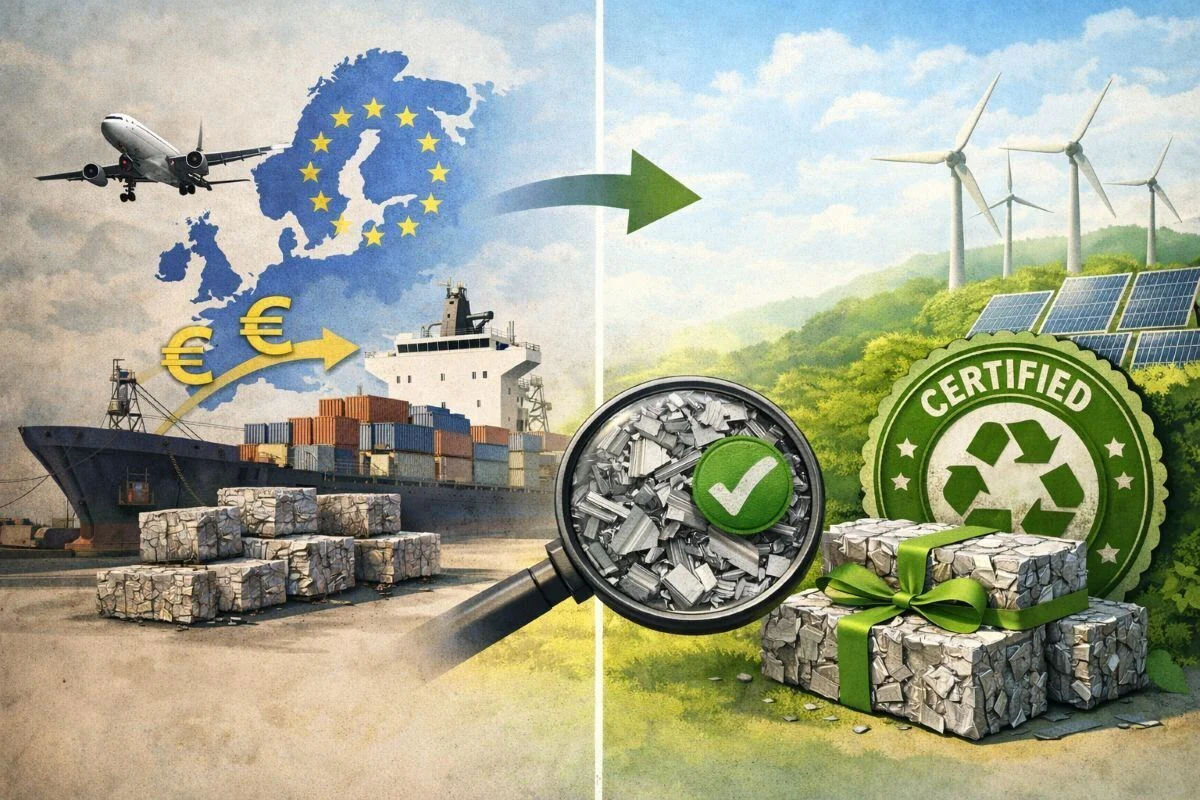
Companies strongly supported the “Green Scrap” certification system that will certify and regulate quality and contamination standards. It can verify the recycling activities carried out across the EU and also introduce processes that have a lower impact on the environment. They will build on and improve the existing regulations like the EU End‑of‑Waste and Dutch MRF Quality Mark certification process under the EU Commission Regulation. It can be well certified under the EU Waste Shipment Regulation as a non‑problematic Green List material.
The Dutch system classification
FACE advises following the example of the Netherlands, such as the Dutch Metal Recycling Federation (MRF) Quality Mark, to maintain environmental and quality levels. As it promotes aluminium recycling via compliance with occupational and environmental standards.
Implementation of End-of-Waste criteria under Commission Regulation and independent recycling assessments by accredited organisations like Kiwa Nederland B.V. to meet the desired EU-specified purity criteria are recommended.
Traceability is also encouraged as scrap handlers use European Waste Catalogue (EWC) codes to classify materials and report the corresponding transactions to the national Landelijk Meldpunt Afvalstoffen (LMA). Using computer-integrated manufacturing systems (CIMs), the quality, category and value of the scrap metal can be efficiently assessed.
The technology’s accuracy is demonstrated through the XL200 machine controller that meticulously monitors the materials passing through processing, using 99 standardised reason codes, thereby granting them a passport after verification.
Harmonized System (HS) codes are used by customs for trade purposes. Waste Shipment Regulation is also maintained through the national platform for waste documentation.
Advanced classification of the scrap
An alignment of internationally accredited commercial regulations like ISRI grades and European standards with customs can also be helpful (CN/HS) and environmental codes (EWC/List of Waste). Thus, DG TRADE and DG TAXUD of the European Commission have formed a partnership with industrial stakeholders to assess and further categorise scrap to an advanced level.
FACE has asserted that the root causes of excessive EU scrap export can be better addressed and tackled with the implementation of the Certified Green Scrap system and harmonisation of scrap categories, rather than a ban or tariff blanket on the issue.
Must read: Key industry individuals share their thoughts on the trending topics













_md.webp)
_md.webp)







