S&P Global Energy Horizons says the coming year will expose the strain within the world’s energy and sustainability systems, as governments and industries try to navigate rapid technological change, shifting geopolitical alliances and mounting climate risks.
The report points to a world moving at different speeds. The US is setting its own priorities as artificial intelligence expands at a startling pace. Europe is trying to balance competing policy goals, and China is pushing further ahead in clean technology, drawing more of the global market into its orbit.
A surge in electricity demand from AI is placing heavy pressure on grids, business models and environmental targets. Whether countries can make headway will depend heavily on how quickly they can expand and modernise network capacity, which S&P Global warns is becoming one of the key barriers to energy security and economic competitiveness.
The geopolitical backdrop is also shifting the direction of renewables, hydrogen, sustainable aviation fuel (SAF), electric vehicles and climate legislation. Supply chain politics and disputes over carbon accounting are intensifying. China’s grip on clean energy technologies continues to strengthen, while Europe and the US deal with policy uncertainty and volatile markets.
Physical and financial climate risks, meanwhile, are rising fast. What was once described as “adaptation” is now an essential requirement for business continuity. S&P Global outlines how AI-related electricity demand, grid constraints, new procurement trends, slow progress on technologies for heavy industries, fragmented carbon rules and escalating climate hazards are shaping the next phase of global energy development. The report emphasises that energy expansion and sustainability are no longer parallel ambitions but two sides of the same challenge.
AI demand puts energy systems under strain
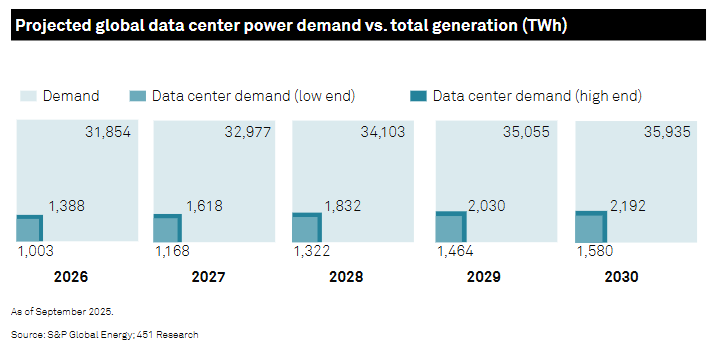
By 2026, a reliable energy supply will become a major deciding factor for countries trying to keep pace with an AI-heavy economy. S&P Global’s high-growth scenario points to data centre power use rising 17 per cent by 2026, then growing about 14 per cent each year through 2030. If this plays out, consumption could cross 2200 TWh, which is roughly the amount of electricity India uses today.
Such growth will influence investment decisions, infrastructure planning, and national energy policies, and it will also intensify environmental questions. The sector has to keep expanding quickly while proving that it can still meet its sustainability promises. Cost and speed remain the main concerns for operators, and those priorities often clash with climate goals.
Net-zero commitments are far from consistent. The 2024 S&P Global Corporate Sustainability Assessment shows that 38 per cent of companies with data centres have no net-zero plan at all. Big names like Microsoft, Alphabet and Meta have pledged net-zero pathways but are already admitting how hard these goals are. Data centre firms helped push clean-power buying in recent years, yet the pace of new PPAs is slowing. S&P Global expects some of these climate targets to be adjusted from 2026 onwards.
Solar installations hit a turning point
By the end of 2025, solar power will reach a historic milestone: more than 500 GW AC of new installations worldwide, driven mainly by China. But the momentum will shift in 2026. Chinese additions are forecast to fall from about 300 GW in 2025 to around 200 GW in 2026. A policy change in mid-2025, replacing guaranteed pricing with competitive bidding, sparked a rush of installations followed by a sharp drop, squeezing margins across the supply chain.
The decline is expected to cause the first global year-on-year reduction in solar additions, though by less than 10 per cent. It marks the end of uninterrupted expansion but not a halt in progress. Over the next five years, total photovoltaic capacity is set to double, supported by new markets, co-location with storage and improvements in operations and maintenance. Low module prices and scalability will continue to open doors, even as annual volumes stop rising every year.
S&P Global notes that solar forecasts have often been exceeded in the past. With policy shifts capable of changing the landscape quickly, the more significant signal is that the industry is nearing a potential peak in annual growth.
To know about the energy transition projection for 2026, keep an eye to our forthcoming report: Global Aluminium Industry Outlook 2026
Grid modernisation moves to the forefront
The report argues that grid investment, neglected for decades, is becoming the weakest point in global power systems. In Europe, where 40 per cent of transmission networks are more than 40 years old, the EU estimates EUR 584 billion ( USD 685 billion) of investment is needed by 2030 and EUR 1.2 trillion ( USD 1.40 trillion) by 2040. Long permitting times, often stretching 12 to 17 years, mean upgrading existing infrastructure is the most practical near-term solution.
The US faces similar problems. Rapid growth in data centres and AI-related demand is exposing the limitations of ageing and overstretched grids. Without urgent upgrades, the US risks shortages and possible instability. Calls for action are coming from across the sector, including proposals to extend tax incentives, reform permitting and boost domestic manufacturing of grid components. Modernisation has now become a measure of national competitiveness.
Must read: Key industry individuals share their thoughts on the trending topics
Flexible PPAs emerge as market volatility grows
Market volatility is pushing many buyers and sellers toward more flexible PPAs. As more renewable power flows into the system, zero and negative pricing is appearing more often, so long-term contracts are being reshaped to include storage or a mix of technologies. Utilities and energy companies are taking the lead, while corporate buyers are still adjusting. Shorter contracts and stronger downside protection are becoming more common as capture rates fall. Europe shows the biggest shifts, with PPA prices in Spain and Germany well below cost-based levels and a wider gap between what buyers want and what sellers expect.
Battery storage deals are rising at the same time. The United States is on track to add close to 15 GW of new storage capacity in 2026. Germany and Australia are expected to add about 5 GW each, and the United Kingdom roughly 3 GW.
Even though data centres continue to show strong interest, overall corporate clean-energy buying has slowed. Global PPA announcements slipped to 9.5 GW in the third quarter of 2025, down from 13.9 GW a year earlier. Data centres remain the exception, with 27 GW of PPAs announced by October 2025, accounting for 43 per cent of global activity and keeping them the largest clean-power buyers worldwide.













_md.webp)
_md.webp)







