Heard enough that Europe’s rising outflow of aluminium scrap is hitting a double blow by depleting vital feedstock for its secondary aluminium industry on one hand and on the other by eroding the material which is central to sustainability and net-zero goals. So far, the concerns were voiced mainly by recyclers but now the packaging manufacturers have joined the pack warning of a looming crunch of raw material on home soil.
The strain is being felt harder when the European Union is moving forward with its Carbon Border Adjustment Mechanism (CBAM) tool, which restricts aluminium imports yet leaves the unchecked flow of scrap exports unresolved. Let alone the supply crunch of raw material, industries fear they may also fall short on carbon-reduction targets.
For the packaging industry, the stakes are clear since aluminium scrap is the backbone of recycled can sheet production, and recycling is one of the most effective ways to cut emissions. So, without a steady domestic supply of scrap, Europe risks undermining both industrial resilience and its sustainability goals.
How much aluminium scrap is used in Europe’s packaging industry?
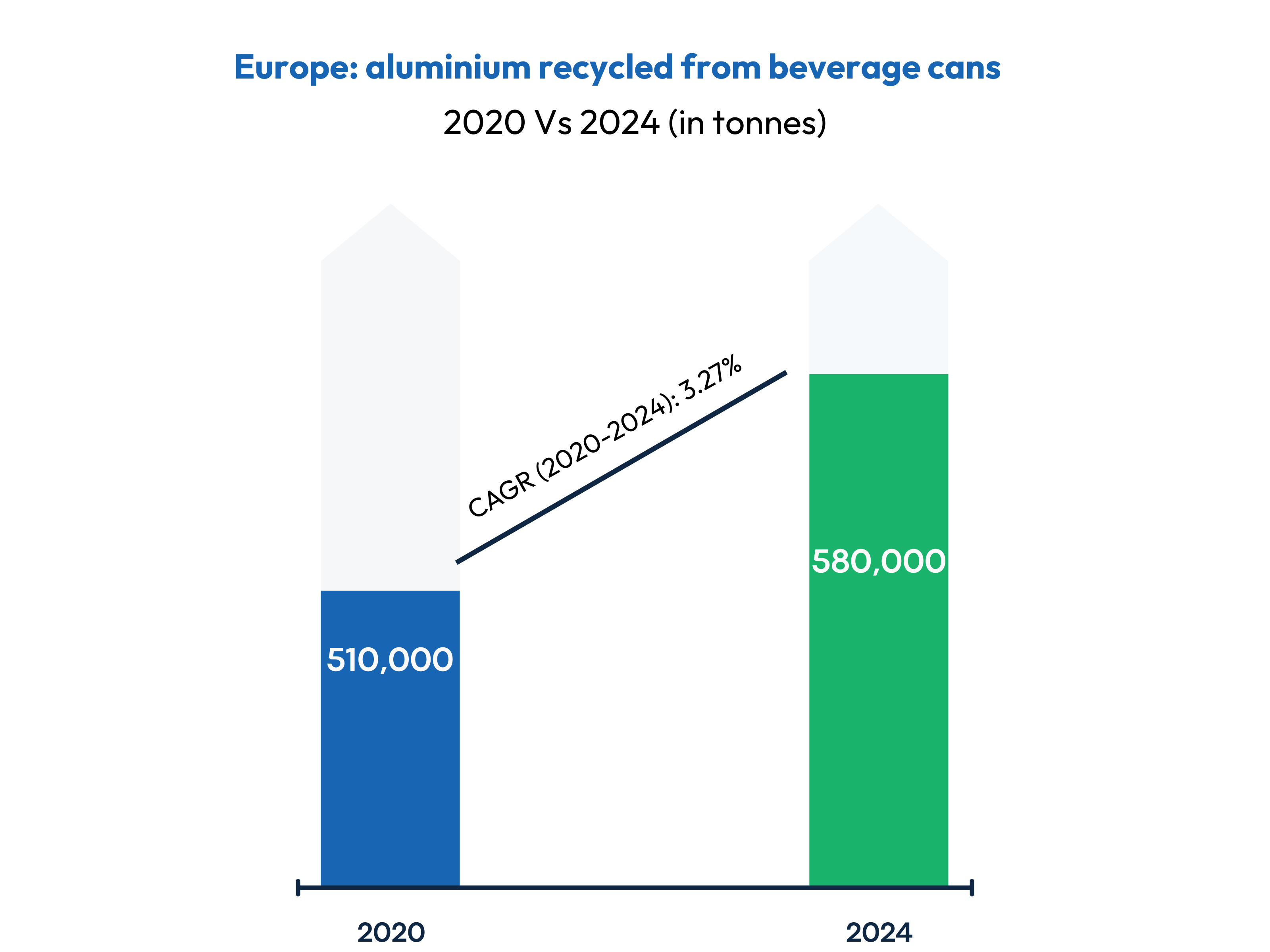
Roughly 40 per cent of aluminium consumed by EU comes from recycled metal, which in volume is about 5 million tonnes. Among all the industrial sectors known for consuming recycled aluminium in the EU, packaging is the third-largest sector. Besides, this particular sector not only consumes recycled aluminium but also boasts significant recycling rate. A report by Metal Packaging Europe and European Aluminium revealed in February 2025 that the recycling rate in aluminium beverage cans alone in the European Union, United Kingdom, Switzerland, Norway and Iceland reached 75 per cent in 2024. The amount of aluminium recycled from cans reached a record level of 580,000 tonnes, growing at a CAGR of 3.27 per cent from 510,000 tonnes in 2020.
Among all the European countries, Germany and Finland account for the highest recycling rate of 99 per cent, while Norway, Switzerland, Lithuania, Italy, and Belgium have recycling rates between 91 and 94 per cent. Cyprus, Czech Republic, Romania, Hungary, and Malta are some of the countries where recycling rates are much below 50 per cent.
Europe aims to boost aluminium beverage cans recycling rate in each country by developing better collection and sorting infrastructure and increasing the number of Deposit Return Schemes in order to reach the overall recycling rate of 90 per cent and incorporate more of recycled content into aluminium packaging. But with the consistent rise in exports with no safeguard measures yet from the government, the packaging industry is worried of its ultimate goal.
Even the recyclers have invested EUR 700 million in the past decade and developed new furnaces, plant expansions, and process upgrades to boost recycling capacity by 1 million tonnes annually. But despite these investments, 15 per cent of recycling capacities remain idle because of heavy exports. The inability of recyclers to recycle scrap due to insufficient feedstock certainly threatens the supply chain of raw materials needed in the packaging sector.
While the European Union on one hand is advocating for sustainability and implementing CBAM to check carbon-intensive aluminium, on the other, they are taking no measures to curb scrap exports. This surely indicates a policy gap. Also, when the whole wide world is running behind aluminium scrap for reducing emissions and advancing circular economy, the European Union is letting its crucial resource leave the homeland.
By 2040, aluminium demand is expected to grow by 30 per cent, and clearly import is not a solution because it has been already found that an increased volume of imports in 2023, accounting for more than half of the European consumption of primary aluminium, led to a significant impact on the environment, resulting in 60 per cent higher carbon footprint, as pointed out by European Aluminium.
Push for 30 per cent duty
The solution to curb scrap exports lies in trade duties. Thus, the European Unions’s aluminium sector is urging the commission to import duties of around 30 per cent on scrap exports to stop it flowing out of the bloc. In 2024 alone, EU exported 1.26 million tonnes of aluminium scrap, which was 50 per cent higher than five years ago. In H1 2025, the export volume stood at 636,673 tonnes, slightly lower than 66,123 tonnes of exports in H1 2024, but the drop in import volumes is way higher compared to exports - from 307,000 tonnes to 268,000 tonnes. It is good for the environment though, but the concern still remains for the availability of aluminium scrap in the market to meet the growing demand.
The situation has worsened with the United States 50 per cent tariff on aluminium and aluminium products and no duty of scrap, as it has led to scrap import boost into the US and reduced exports from the US, pushing Asian buyers to more on EU supply.
European Aluminium's director general Paul Voss has pointed out that it is difficult for the EU to compete with Asian countries who can afford to pay higher prices for scrap due to government subsidies they receive and cheaper labour costs they have to pay for production.
Paul said, "It's perfectly understandable that scrap traders prefer to sell to the highest bidder, but it's the role of public policy to correct these kinds of market failures in order to protect Europe's strategic interests."
If we see, the packaging sector is currently grappling with two complications – 1) pressure from tariffs and 2) surge in scrap exports. Already, the US tariff-led higher costs and supply disruptions of aluminium caused sleepless nights for the packaging sector. Increased scrap outflow from Europe leading to feedstock scarcity further threatens price surge, indicating potential increase in raw material costs for the packaging sector.
In the European Union, packaging sector is the third-largest end-use sector for consuming aluminium. While the transportation sector consumes 42 per cent of aluminium, building & construction sector consumes 21 per cent, packaging industry accounts for 20 per cent of aluminium consumption.













_md.webp)
_md.webp)







