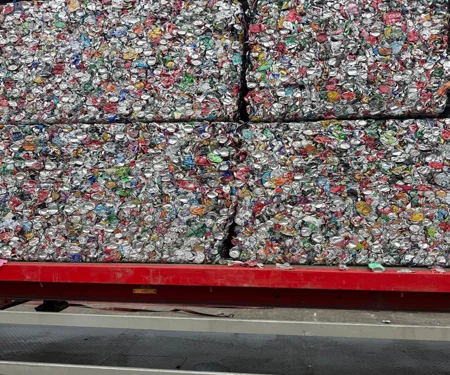
Barber & Osgerby’s vintage aluminium-glass lamp ‘Signals’ adorn London's Galerie Kreo art museum
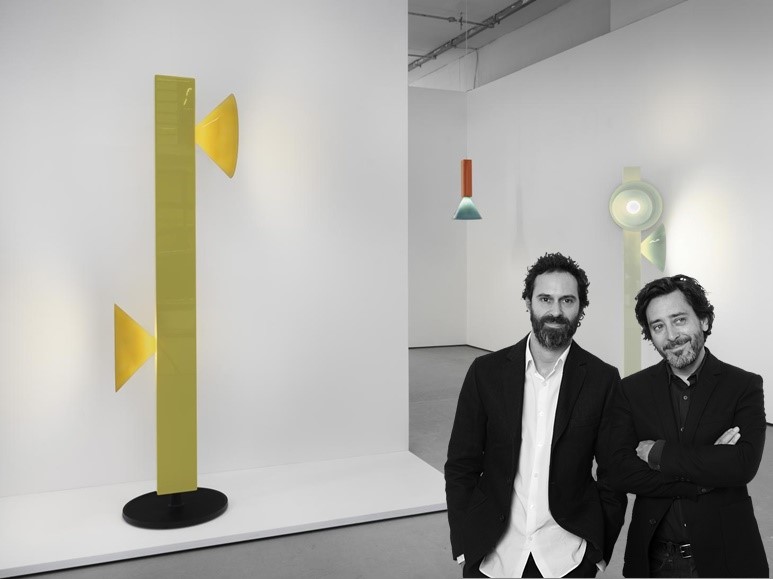
British designers Edward Barber and Jay Osgerby have taken inspiration from the orthographic projection of a cone to create a series of lamps now displayed at London’s Galerie Kreo. The lamps named ‘Signals’ for their certain shape are made of aluminium and glass and are available in floor, wall and pendant variants.
Galerie Kreo, established in 1999, Paris, is a mansion turned museum showcasing masterpieces of famous contemporary designers and architects from around the world. It also displays various creations from the past, carefully curated for the undivided attention of art lovers and enthusiasts. The gallery serves as a research centre for iconic French and Italian lightings from the 50’s till 80’s. They have recently opened their London branch that provides the UK with a similar kind of panache and class. Galerie Kreo, London, also stores remarkable creations by various famous contemporary artists.
Born in 1969, Edward Barber and Jay Osgerby studied architecture and interior design as fellow students at the Royal College of Art in London. The former hailed from Shrewsburry and the latter from Oxford. In 1996, the foundation stone to their contemporary interior design studio, Barber & Osgerby was laid. Since then, their contributions to the field of modern design and architecture have been immense. With their collaborative, thoughtful and minimalist approach, they have within 26 years achieved a high place among their peers.
‘There is something about the cone that we often return to,’ says Barber. ‘There’s energy in its form,’ adds Osgerby. ‘In technical drawing, orthographic projection makes use of the conical form to define the view of the object we are drawing. It is a code that is deeply embedded in our minds.’
An aluminium box forms the base of the lamp’s design, attached to which are conical glass cones. Each of these glass light shades is being handcrafted by master craftsmen at Venini workshops in Murano, Venice, where the artisan mouth blows into the die to form a particular shape. . ‘There’s a tension between the industrial and the artisanal elements of the lamps, which we call engineered craft,’ explains Osgerby. ‘We’re always trying to work in this space between the sketch and the machine.’
This collection can be identified by bold, tertiary colours, further brightened by the light rays coming out of conical portal. Barber Osgerby’s recent muse, colour composition is being celebrated in this collection.
The use of aluminium in the making is extraordinary and quite environment friendly since it is one of the world’s most recyclable non-ferrous metal. The lamps’ obtuse shape reminds us of the Orwell-Kubrick interpretation of dystopian dreams; the Cold-war era sci-fi designs and space yet the reminiscence is tendered by the brilliant display of light and colour.
‘These are technical objects and we haven’t tried to soften them by adding curves or further refinement,’ continues Osgerby. ‘They’re bold, monolithic objects, but those qualities then contrast against the core crafted forms that emit light.’

On showcasing some of the ongoing researches in the studio, ‘Signals’ is the most apt representation of a modern minimalized world. With box shaped aluminium platforms it holds the bridge to the past while the cone is the ideal most shape for the reception of light by the eyes as our eyes process colour information with the help of cone-shaped cells. Transmission of light is also smooth and wide angled, facing no obstruction at all. ‘They are the ideal shape to transmit and receive information,’ says Barber. ‘They invite engagement.’
ELYSIS scales up its liaison with Apple; technology giant invests $4.7 billion in green bonds
Next articleMeta accomplishes construction of Havhingsten aluminium power subsea cable system, outperforming copper
Grow with
AL Circle