Bahamas import of Aluminium structures displays positive trend during 2017-20
The Bahamas is comprised of 700 islands and over 2000 rocks and cays, sprinkled over 100,000 square miles of ocean. The Bahamas has a predominantly market economy that is heavily dependent on tourism and international financial services. The gross national product (GNP) per capita is one of the highest in the region.
The most important economic sector is financial services, which places the Bahamas among the world's leading financial centres. Major industries include tourism, banking, cement, oil refining and transhipment, salt production, aragonite, pharmaceuticals, and spiral-welded steel pipe.
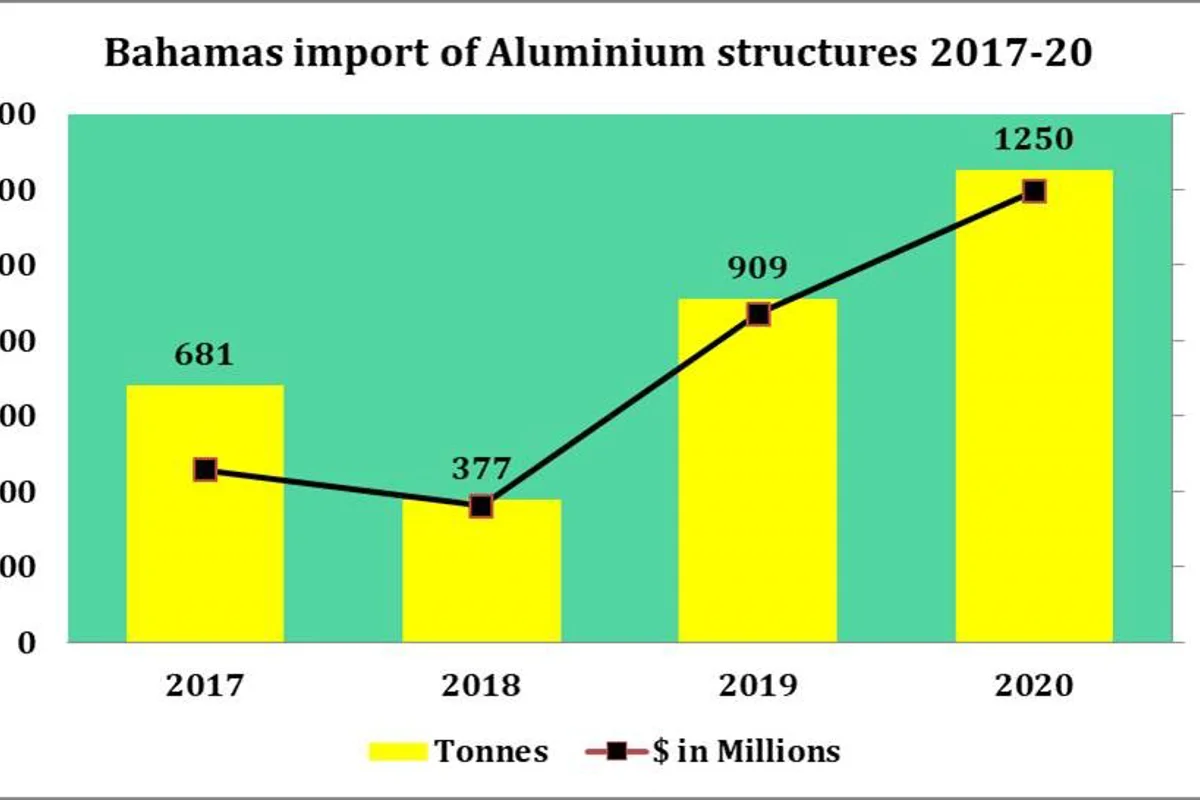
The island nation’s aluminium structures import has shown a steady move during 2017-19 as the total import volume has been recorded at 1967 tonnes and foreign revenue expended stood at $16.88 million. The projected import volume for 2020 has been analysed as the highest in a stretch of four years as the volume might rise to 1250 tonnes and the expenditure might also stretch to $11.97 million. When the estimated import volume and the expenditure gets added with the previous three years figures, the total reflects 3217 tonnes and $28.85 million respectively.
The major trading nation for Bahamas importation of aluminium structures is USA, Italy, China, Finland, Germany, Greece, Netherlands, Portugal, UK, etc.
Bahamas import of aluminium structures during 2017 was recorded at 681 tonnes and the expenditure stood at $4.56 million, while in 2018 the import volume was recorded at 377 tonnes and expenditures also dropped to $3.62 million.

In 2019 the importation of aluminium structures saw a recorded growth by 141.11% as the import volume stood at 909 tonnes, with Y-o-Y excess of 532 tonnes and the expenditure also shot up to $8.70 million.
The estimated import for 2020 has been analysed with growth by 37.51%, as the import volume might stand at 1250 tonnes.
RUSAL enters on production of aluminium anodes with enhanced performance attributes for oil and gas and shipbuilding industries
Next articleChinese aluminium billet inventories extend downfall over the week ending May 28
Grow with
AL Circle