Copper and aluminium have long competed across a wide range of industrial applications. In many sector, these two metals can be used alternatively because of their few common traits like durability, conductivity, ductility, and corrosion-resistance. But at this moment, there is one factor that is tipping the balance in favour of aluminium – price it is. And the gap is not some hundreds of dollars but thousands. Taking the instance of the current market, aluminium is trading nearly USD 8,700 per tonne below copper. This price advantage is the reason for sectors like electric vehicles, renewable energy, and AI data centres to switch from copper to aluminium wherever technical standards allow.
Price gap is increasing aluminium’s appeal
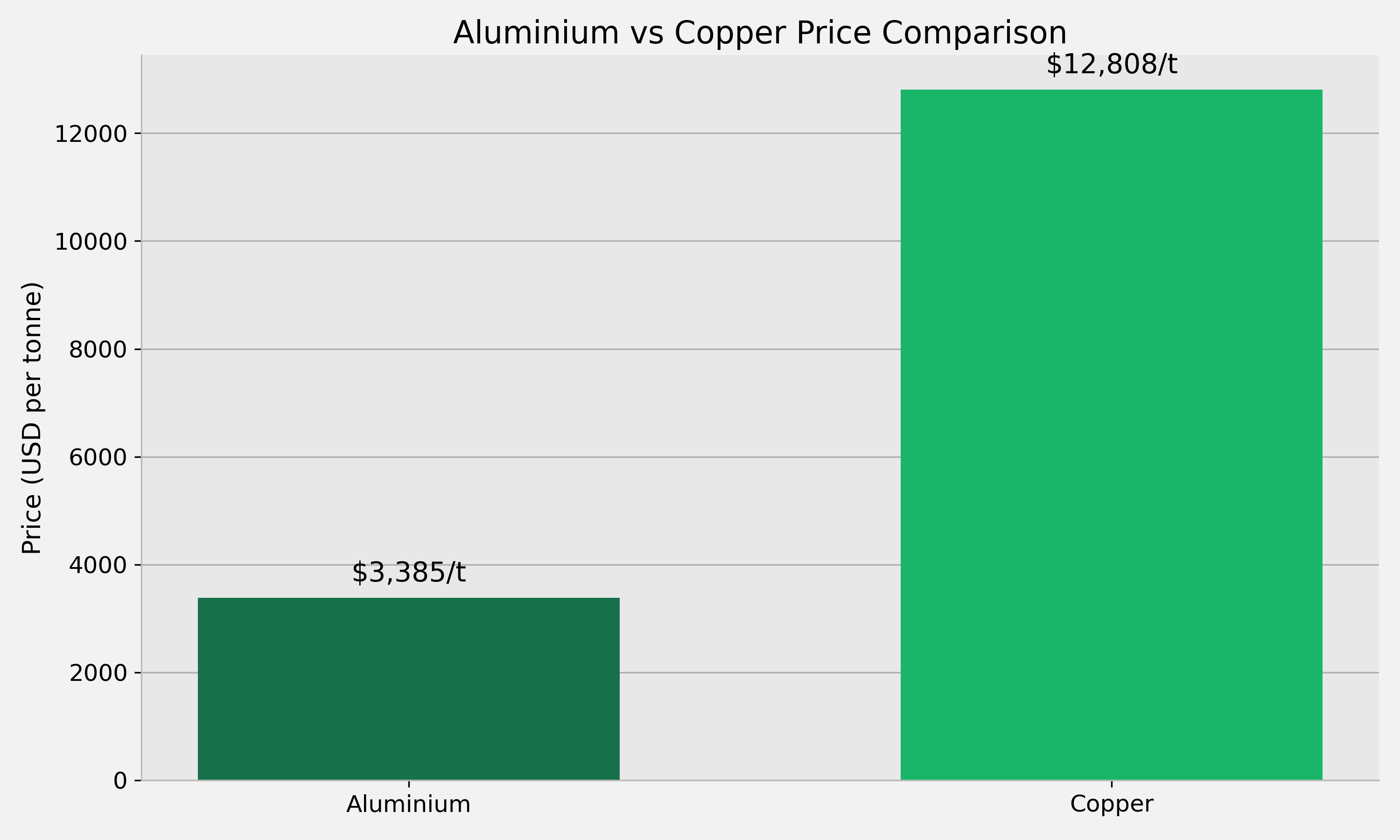
This shift is taking placing even though aluminium prices are growing rapidly and relentlessly in recent times. So far in 2026, aluminium price has gained 14 per cent, outpacing copper’s 10 per cent rise. But the absolute price difference remains vast. In 2025, copper price climbed 39 per cent over the year, from USD 8,977.57 per tonne to above USD 13,800 per tonne. In contrast, aluminium price increased by about 19 per cent from the mid-USD 2,500s per tonne to USD 2,968 per tonne. As of now, aluminium stands at USD 3,385 per tonne and copper at USD 12,808 per tonne. So, even when aluminium rallies harder in percentage terms, copper remains in an entirely different price bracket.
Due to this price difference, the International Energy Agency has also suggested that if the electricity industry has to reduce its raw material costs, then it should move to aluminium as a viable alternative. According to the IEA, annual copper demand from electricity grids are likely to grow from 5 million tonnes in 2020 to 7.5 million tonnes in 2040 under the STEPS scenario, and to nearly 10 million tonnes under the SDS. Aluminium demand is also projected to increase at a similar annual pace, from 9 million tonnes in 2020 to 12.8 million tonnes in STEPS and 16 million tonnes in SDS by 2040.
Supply crunch is reshaping metal choices
Price, however, is only half the story. The other half is copper’s supply crunch. The copper market is increasingly constrained by the difficulty of bringing news mines online, declining ore grades, and operational halts at major sites like Grasberg and mines in Chile. Until CY2024, copper production was 26.9 million tonnes, slightly above consumption of 26.5 million tonnes. But going ahead, by 2040, global copper supply is projected to face a 10 million tonnes shortfall, equal to 23.8 per cent of the projected demand of 42 million tonnes.
So, the sectors racing to scale infrastructure quickly and affordably have started seeing aluminium as the next best option. Renewable energy and electric vehicles have already emerged as two of the strongest demand drivers for aluminium, consuming around 8.7 million tonnes globally and 4.24 million tonnes, respectively, according to the AL Circle Research Team. By 2030, these consumptions are expected to grow to 8.8 million tonnes and 10.19 million tonnes, respectively. By comparion, copper consumption in electric vehicles is expected to reach 2.5 million tonnes by 2030, while that in renewables to nearly 4 million tonnes. The construction of global data centres, on the other hand, is expected to consume more than 1 million tonnes per year of aluminium and copper by 2030, according to CRU. Taken together, aluminium demand linked to the global green transition could approach 19 million tonnes annually.
Explore- Most accurate data to drive business decisions with Global ALuminium Industry Outlook 2026 across the value chain
Is aluminium free from supply pressure?
But if supply chain disruption is a factor for demand redirection from copper to aluminium, then it is necessary to assess if the latter is in a position to justify the demand growth. Until CY2024, primary aluminium production and consumption were both at 73 million tonnes. In 2025, production grew modestly to 73.9 million tonnes but consumption reached 100.8 million tonnes. In 2026, the production forecast is 75.3 million tonnes but consumption is likely to grow higher, causing a deficit in global aluminium markets, with a shortfall estimated between 180,000 and 510,000 tonnes, According to analysts at the Gerber Group, aluminium demand is expected to increase at an average of 2.1 per cent a year until 2040, outpacing supply growth.
May be aluminium is positioned better than copper in terms of scale, but it is not operating with unlimited headroom. In fact, it faces its own structural constraints: energy intensity, decarbonisation pressure, regional production concentration, and slow capacity additions outside a handful of countries. And now, the blockage of the Strait of Hormuz has added another layer of supply unrest in the global aluminium sector. So, the idea that aluminium can simply absorb displaced copper demand without friction is too simplistic.
In addition, there is another layer of complexity in the case of data centres. While on one hand, aluminium is gaining demand for data centres construction, on the other hand, idle smelters themselves are converting into data centres. Century’s Hawesville smelter in Kentucky and Alcoa’s ten facilities are the examples. Compatible analysis reveals that redeveloping idle smelters into data centres is feasible as the locations possess pre-existing electrical infrastructure and eliminate the requirement of years of utility coordination and grid upgrade investments. So, data centres are not only a new source of aluminium demand, they can also compete with aluminium production for energy-rich industrial locations.
on't miss out- Buyers are looking for your products on our B2B platform
What, then, is making aluminium a viable substitute?
If supply constraint is a challenge in the copper industry, then it is the same in case of aluminium. The difference is in their production volume. Aluminium production volumes are higher than copper, which gives it more room to accommodate industrial substitution. Like the way aluminium cannot touch the price level of copper, the latter cannot reach the level of aluminium production. Even by 2030, global copper output is anticipated to reach 33 million tonnes, which will be its peak. But it is also in projection that by 2040, the output could fall to 22 million tonnes, below current output levels, and that is due to declining ore grades, rising energy, and labour costs.
Recycling adds another important distinction between copper and aluminium. Global copper recycling rate is 38 per cent to 40 per cent, while that of aluminium is 76 per cent. In 2024, global recycled aluminium consumption was 28.4 million tonnes, while that of copper was 8.07 million tonnes. This gives aluminium a much stronger secondary supply base, which is a real strategic advantage in an era of resource insecurity.
However, it is important to note that aluminium is not substituting copper (wherever technically possible) because it is abundant in the market; rather it is gaining ground because the economics of the energy transition are harder to ignore.














_md.webp)








