Aluminium wire importation of Portugal during 2018-20 displays significant growth
Despite the well-founded economic performance and sustained reform momentum over the past few years, Portugal entered the COVID-19 crisis with undersized capital markets. As an open economy, the country is heavily reliant on exports and tourism, Portugal was been working to diversify its output by increasing activities in information technology and services. “Within Europe, Portugal will probably be among the most affected, with a double-digit recession rate in 2020,” says Paula Carvalho, Chief economist at Banco BPI.
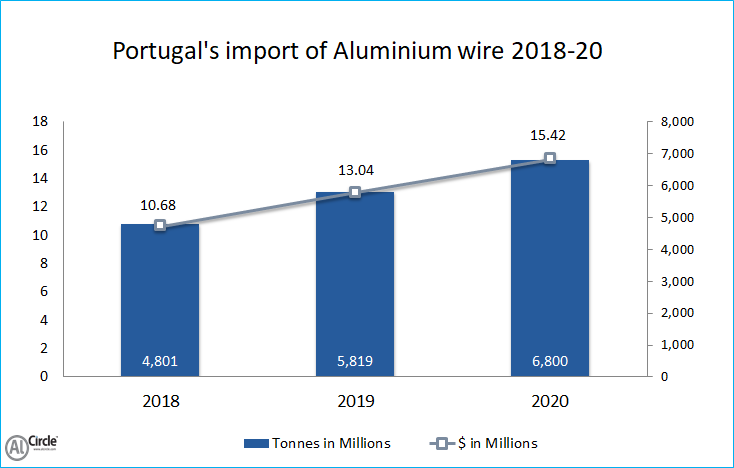
Aluminium delivers a better conductivity to weight ratio than copper; hence it is also used for wiring power grids, including overhead power transmission lines and local power distribution lines, as well as for power wiring of some aeroplanes. The Southern European nation’s import of aluminium wire during 2018-19 was recorded at 10,620 tonnes and the expenditure remained at $23.72 million. The import for 2020 is marked to reach at 6,800 tonnes with expenditure to follow at $15.42 million. When the import volume and expenditure for 2020 gets summed up with the previous two years, it resembles 17,420 tonnes and $39.14 million respectively.
Portugal’s import of aluminium wire in 2018 stood at 4801 tonnes and expenditure remained at $10.68 million, whereas in 2019, the import displayed growth by 21.20%, as the import volume rose to 5819 tonnes and expenditure turned to $13.04 million.
The import of aluminium wire in 2020 has also been highlighted with growth by 16.85%, as the import volume is expected to climb at 6,800 tonnes and expenditure to rise at $15.42 million.

Portugal’s major trading destination for the importation of aluminium wires are Czech Rep., Belgium, China, France, Germany, Italy, Oman, Netherlands, Slovakia, Spain, Turkey, USA, etc.
GEWA Balkonsysteme GmbH produces maintenance-free and innovative balcony railings made of aluminium
Next articleAl Ghurair Group in Dubai selects SirajPower for solar power project; Gulf Extrusions to manufacture the aluminium rails
Grow with
AL Circle