Africa & Asia (ex-China) ranks as the world's third-largest alumina-producing region after China, Oceania, and South America, accounting for nearly 10 per cent of the world's output annually. In 2024, the region's share of global alumina production increased slightly to exactly 10%, up from 9.65% in the previous year.
The contribution has grown in line with the increase in production volume from 13.014 million tonnes in 2023 to 13.859 million tonnes in 2024, reflecting a Y-o-Y rise of 6.49 per cent, according to the data revealed by the International Aluminium Institute. Throughout 2024, Africa & Asia's (ex-China) alumina production stood between 1.12-1.19 million tonnes. There were only three months when production exceeded 1.2 million tonnes, such as in March, June, and December.
According to IAI, Africa & Asia's (ex-China) alumina production in December 2024 saw a monthly rise of 2.62 per cent, amounting to 1.212 million tonnes versus 1.181 million tonnes in November. On a year-on-year basis, the December output edged an increase of 2.19 per cent from 1.186 million tonnes.
The daily average production in December saw a month-on-month drop of 0.8 per cent from 39,400 tonnes to 39,100 tonnes. However, one additional operational day in the said month counterbalanced the total production in December. On an annual basis, the daily output in December 2024 experienced an increase of 2.1 per cent from 38,300 tonnes.
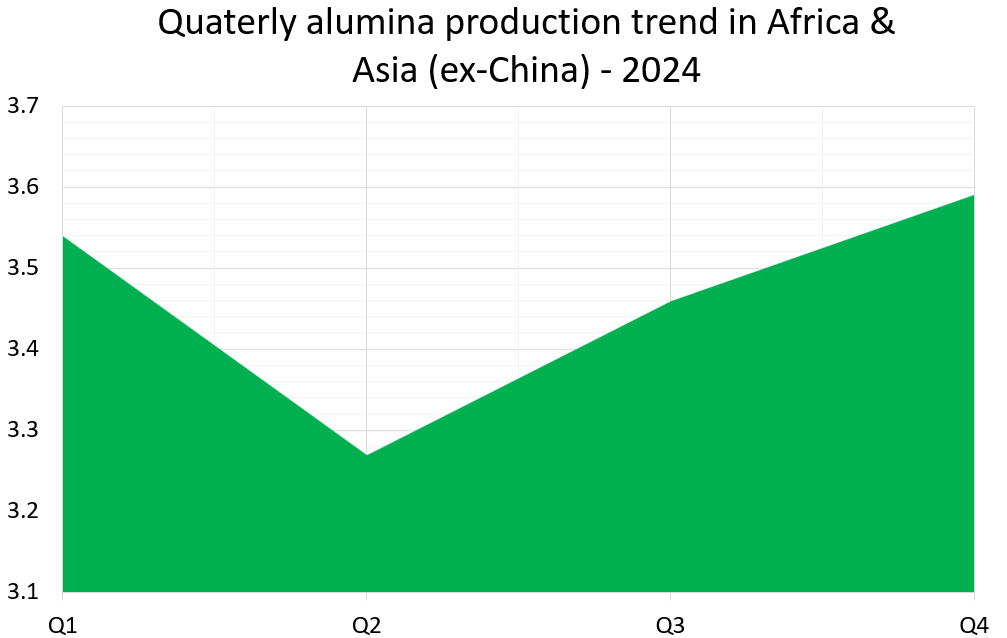
In Q4, Africa & Asia's (ex-China) total alumina production stood at 3.59 million tonnes, up by 3.76 per cent from 3.46 million tonnes in Q3 2024 and 4.66 per cent higher than 3.43 million tonnes in Q4 2023, marking the second consecutive sequential growth, following a rise of 5.8 per cent in Q3 from 3.27 million tonnes. Only the year's second quarter witnessed a Q-o-Q fall of 7.6 per cent from 3.54 million tonnes.
Top alumina-producing countries in Africa & Asia (ex-China)
Guinea in Africa and India, Indonesia, Iran, Turkey, Vietnam, and the United Arab Emirates are the alumina-producing countries in Africa & Asia (ex-China). At present, the only alumina refinery in operation in Guinea is Friguia managed by Russia, having an annual refining capacity of at least 600,000 tonnes. However, the West African country aims to become an alumina production hub with 11 million tonnes of annual capacity, with refineries developed by six global companies - Société minière de Boké or SMB, ALTEO, Guinea Alumina Corporation, Aluminium Corporation of China (Chalco), Natural Oil Field Services (NOFSL), and Guinea Evergreen Mining Intelligence Company (GEMIC).
In June 2024, Emirates Global Aluminium's GAC signed a term agreement with the Government of Guinea to develop a 2 million tonnes capacity refinery by September 2026. Initial production is expected to commence with 1.2 million tonnes of capacity annually. At the beginning of 2025, Chinese enterprise State Power Investment Corp. (SPIC) also announced a heavy-duty alumina refinery to be established in Guinea. The construction is expected to commence in March and be completed by the end of 2027 with a production capacity of 1.2 million tonnes.
In Asia, India is the largest alumina-producing country, with around 7.5 million tonnes of annual capacity, led by National Aluminium Company (NALCO), Bharat Aluminium Co. Ltd, Hindalco Industries Ltd, Utkal Alumina (a 100 per cent subsidiary of Hindalco), and Vedanta Aluminium Ltd. Indonesia and the United Arab Emirates (UAE) are the next leading alumina producers in Asia after India, followed by Vietnam, Turkey, and Iran. While Indonesia and UAE have an annual capacity of 2 to 2.5 million tonnes each, Vietnam has a capacity of 1.4 million tonnes, and Turkey and Iran have 550,000 tonnes and 510,000 tonnes, respectively.
As the world's fourth largest alumina producer after China, Australia, and Brazil, India is always under focus, and recently a bit more ever since Vedanta's chairman Anil Agarwal announced its dream project plan for 6 million tonnes of alumina production capacity and 30 lakh tonnes of aluminium smelting capacity, involving a budget of INR 1 lakh crore (US$11.55 billion). The project's first phase is expected to be commissioned in the next three years, with further expansion plans in the pipeline.
So far, Vedanta group has invested more than INR 1 lakh crore in Odisha, bringing its smelter capacity to 1.8 million tonnes per year and refinery to 3.5 million tonnes per annum in Lanjigarh. Vedanta has also established mines in Odisha's Jaipur and Dhenkanal districts for chrome ore mining.
Hindalco is India's largest alumina-producing company, with a capacity of 3.6 million tonnes, including 0.36 million tonnes of speciality grade, followed by NALCO's capacity of 2.1 million tonnes, which is expected to grow to 3 million tonnes by the end of 2025. Overall, India’s alumina production is likely to reach 9.7 million tonnes in 2025, with 1 million tonnes Anrak alumina refinery in projection.
At present, India is the largest alumina producer in Africa & Asia region (ex-China). In 2023, the country produced 4.1 million tonnes of aluminium ore, contributing 31.5 per cent to Africa & Asia's (ex-China) total output. Indonesia produced 3.9 million tonnes, accounting for 29 per cent. The total production in South-Southeast Asia amounted to 10.7 million tonnes in 2023, with annual capacity of 13.57 million tonnes. Once all the projects in pipeline come into operation in two to three years down the line, Africa & Asia’s alumina production will grow.












_md.webp)
_md.webp)
_md.webp)