Metro Mining Ltd (ASX: MMI), an Australian bauxite producer, is trading at AUD 0.056 per share (as of May 26, 2025). With a substantial discount against the consensus analyst target of AUD 0.17, the pricing hints towards a potential upside of 209 per cent, according to AInvest data. Shaw & Partners, which has been covering the company since 2023, maintains a ‘Moderate Buy’ recommendation, with its latest reaffirmation in February 2025.
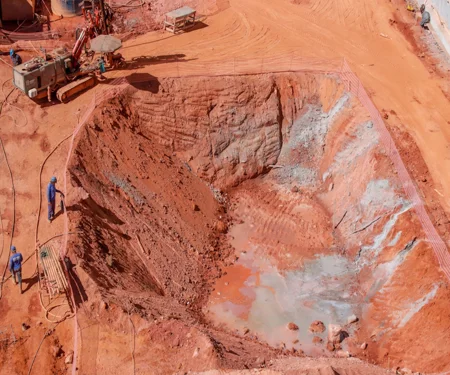
Image for representational purposes only (source: https://metromining.com.au/)
Operational growth and output scale
Metro’s production at its flagship Bauxite Hills mine in Queensland has expanded from approximately 3.5 million tonnes per annum (Mtpa) in 2020 to 6 Mtpa in 2024. The company has outlined its goal of reaching a run-rate between 6.5 and 7 Mtpa by late 2025, subject to logistics and weather stability.
Analysts expect a sharp earnings rebound for Metro Mining following its AUD 22 million net loss in FY2024. The company is projected to return to profitability in FY2025 with an estimated net profit of AUD 103 million, boosted by a 26 per cent year-on-year revenue increase. This turnaround is driven by operational and market tailwinds, including record bauxite shipments of 589,000 wet metric tonnes in June 2025 (a 16 per cent rise compared to the previous year) and an average 20 per cent increase in realised bauxite prices during Q2 2025. These gains reflect stronger demand fundamentals, higher CIF pricing, and Metro’s expanded production capabilities.
This operational scaling is reflected in projected revenue growth. The company is expected to report AUD 484 million in revenue in FY2025, rising to AUD 536 million in FY2026 and AUD 537 million in FY2027, up from AUD 307 million in FY2024.
Metro Mining reported EBITDA of AUD 39 million in FY2024, representing a 108 per cent year-on-year increase. Forecasts project a significant jump to AUD 182 million in FY2025 and AUD 205 million in FY2026. The numerics translate to a margin expansion from 14.1 per cent in FY2024 to over 38 per cent in FY2025.
Key contributors to this EBITDA growth include:
- Low strip ratios (0.5m)
- Elimination of blasting requirements
- Competitive transhipping logistics
- Marine freight cost savings (up to AUD 3 per WMT)
A full plant flowsheet upgrade completed in late 2024 is expected to deliver further operational efficiencies across FY2025.
Pricing trends and market positioning
Metro’s cost base remains highly competitive, with average delivery costs to China below USD 30 per dry tonne. Meanwhile, the landed bauxite price from Australia has risen to approximately USD 80 per tonne CIF China, still below Guinea’s price of USD 94 per tonne. The bauxite price has increased roughly 89 per cent since early 2023.
Analyst models suggest that every USD 5per tonne increase in bauxite prices could shift Metro’s FY2025 EBITDA by AUD 25 million, equivalent to a 3.5 cents per share valuation impact.
China remains the largest buyer of bauxite globally and currently sources approximately 70 per cent of its bauxite imports from Guinea. With Indonesian export restrictions and recurring political disruptions in Guinea, Australia’s role as a stable supplier has gained importance.
Shipping performance and logistics
Metro reported shipments of 589,000 wet metric tonnes (WMT) in June 2025, the highest recorded for that month, and a 16 per cent increase compared to the previous year. The total Q2 2025 shipments stood at 1.7 million WMT, bringing year-to-date shipments to around 1.9 million tonnes.
The company’s Ikamba floating terminal remained fully operational throughout the period. While some disruptions were noted due to river draft limitations, these were managed within scheduled maintenance windows. Open contract pricing for Q3 2025 remained stable, in line with late-2024 benchmarks.
Financial position and liquidity
The company’s elevated debt profile remains a critical consideration. Metro Mining reported a debt-to-equity ratio of approximately 185 per cent in late 2024, significantly above the industry average of around 40 per cent. However, meaningful deleveraging efforts are underway. The company reduced its net debt to AUD 44 million by year-end 2024 following the full repayment of AUD 39 million in junior debt facilities. It also restructured its senior debt on more favourable terms. With a cash balance of roughly AUD 31 million, Metro maintains a liquidity buffer sufficient to sustain operations for up to three years, even under conservative cash flow scenarios. Although the company had previously received “going concern” warnings from auditors, the current trajectory, characterised by improved EBITDA, higher margins, and reduced leverage, indicates growing financial stability.
Metro has also restructured its senior debt under improved commercial terms and repaid its junior debt facilities. At present, the company holds AUD 18.7 million in cash against total liabilities of approximately AUD 123 million.
Insider activity and governance signals
Board members have increased their equity holdings in 2025. Non-Executive Director Andrew Lloyd converted over 35,000 shares in May 2025, while Paul Lucas made share purchases through March 2025. Importantly, there have been no recorded director sales in 2025, contrasting with prior years and suggesting confidence in the company’s medium-term performance.
Valuation and Financial Ratios
Metro’s current valuation metrics indicate a deep discount relative to its earnings potential:
Metro Mining’s key financial metrics reflect a notable improvement trajectory from FY2024 through FY2026. The company’s EBITDA margin is expected to grow from 14.1 per cent in FY2024 to over 38 per cent in FY2025 and 39 per cent in FY2026, indicating strong operational leverage.
Underlying earnings per share (EPS), which stood at -0.4 cents per share in FY2024, are projected to turn positive at 1.7 cents per share in FY2025 and 2.1 cents per share in FY2026. In terms of valuation, Metro’s EV/EBITDA multiple is forecast to drop from 8.8× in FY2024 to just 2.0× in FY2025 and 1.8× in FY2026, while its price-to-earnings ratio is expected to move from a negative 14.2× to 3.0× and then 2.5× over the same period. Free cash flow yield is also projected to surge from negative 0.2 per cent in FY2024 to 52.6 per cent in FY2025 and a prospective 65.4 per cent in FY2026, highlighting substantial anticipated cash generation.
Despite positive developments, several risk factors remain. A 2024 audit flagged concerns about Metro’s status as a going concern, driven by past debt levels and capital constraints. These have been partially mitigated through improved cash flow and asset utilisation.
Alongside, any softening of global bauxite prices or reversal of current export policies in Guinea or Indonesia could pressure margins.
Metro’s medium-term strategy hinges on increasing output to 7 Mtpa, further debt reduction, and sustained shipping performance. With strong fundamentals and tightening global supply dynamics, the company is positioned to benefit from ongoing price recovery and demand growth in China.














_md.webp)
_md.webp)