36Mt of global alumina capacity remains unutilised, with China and Asian region showing the widest gap
Stock image for referential purposes only
Global metallurgical alumina production has been expanding in a measured and consistent manner. Output rose from 130.4 million tonnes in 2021 to 133.1 million tonnes in 2022, followed by gradual increases to 134.8 million tonnes in 2023 and 137.8 million tonnes in 2024.
The trajectory strengthened in 2025, with production reaching 144.9 million tonnes, reflecting a sharper 5.2 per cent rise.
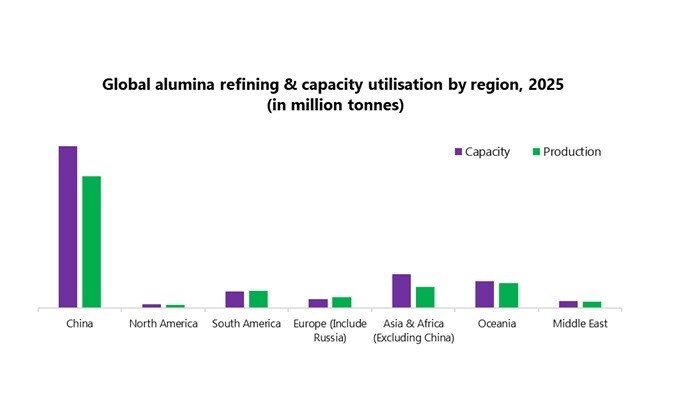
However, the underlying dynamics point to a market that is not constrained by supply capacity. With global installed refining capacity at around 181 million tonnes in 2025 and utilisation levels between 85 per cent and 87 per cent, nearly 36 million tonnes of capacity remains unutilised. This indicates that output is being actively managed rather than maximised, with producers responding to demand signals, cost structures, and regional operating conditions.
China remains central to this balance. Installed capacity in 2025 stands at 114.1 million tonnes, while operating capacity is 95.3 million tonnes and actual production is 94.5 million tonnes. The gap of 19.6 million tonnes between installed and actual capacity highlights the extent of built-in flexibility within the system.
Despite this, utilisation remains strong at around 83 per cent, supported by concentrated production in key provinces such as Shandong, Shanxi, and Guangxi, which together account for more than 70 per cent of total capacity.
Across the rest of Asia, excluding China, refining capacity stands at 22.1 million tonnes in 2025, led by India with 12.5 million tonnes, followed by Indonesia at 8.3 million tonnes and Vietnam at 1.3 million tonnes. This distribution suggests that while China dominates current supply, the broader Asian region is gradually building its capacity base.
It also highlights that China and the broader Asian region account for a significant gap between installed capacity and actual utilisation. For a deeper perspective on how this imbalance is expected to evolve, the Global Bauxite & Alumina Market Forecast to 2036: Supply–Demand, Trade Flows & Price Outlook provides a detailed long-term view of supply, demand, and pricing trends.
China’s under-construction alumina projects
China’s near-term alumina pipeline is centred on coastal, import-dependent refining hubs, with multiple operators scaling capacity through integrated greenfield builds and brownfield expansions.
East Hope Group – Beihai, Guangxi is developing a large integrated refining complex targeting 4.8 million tonnes per year. The project combines greenfield development with phased expansions, including a current incremental addition of 2.0 million tonnes and subsequent capacity ramp-ups from 2.0 million tonnes and 3.4 million tonnes toward the full 4.8 million tonnes.
Guangxi Long’an Hetai New Material Co., Ltd - Long’an, Guangxi is building a 1.2 million tonne greenfield refinery. The project is scheduled for Q1 2026, will use imported bauxite, and remains under construction.
TBEA Co., Ltd - Fangchenggang, Guangxi is executing a combined greenfield and expansion strategy, scaling capacity to 2.4 million tonnes. This includes a greenfield build and a brownfield expansion from 1.2 million tonnes, together adding 1.2 million tonnes incrementally. The project is targeted for H1 2026, will depend on imported bauxite, and is under construction.
Chongqing Bosai Mineral Group – Jiulong Wanbo, Chongqing is expanding capacity from 4.6 million tonnes to 5.6 million tonnes through a brownfield project, adding 1.0 million tonnes. The project is expected in 2026, will utilise imported bauxite, and is under construction.
Lubei Marine Biology Co., Ltd – Lubei, Shandong is increasing capacity from 2.0 million tonnes to 2.5 million tonnes, adding 0.5 million tonnes through a brownfield expansion. The project is scheduled for 2026, relies on imported bauxite, and remains under construction.
Guangxi Guangtou Lingang Industry Co., Ltd – Beihai, Guangxi is developing a combined greenfield and expansion platform, targeting 2.0 million tonnes. This includes a new refinery alongside an expansion from 1.0 million tonnes, adding 1.0 million tonnes. The project is expected in 2026.
Hebei Huasheng New Material Co., Ltd – Tangshan, Hebei is constructing a 3.06 million tonne greenfield refinery, fully incremental. The project is expected by 2028, and will include integration with 2.15 million tonnes of aluminium hydroxide capacity.
Also read: Alumina production in Africa and Asia (ex-China) up 5% in 2025-exploring what drove the rise
Planned alumina projects in China
China’s longer-term alumina pipeline is characterised by larger-scale projects, with several mega-refineries planned across northern and coastal regions, often developed in phased stages.
Jinzhou Port Co., Ltd – Qihui, Chifeng is planning a large-scale integrated refinery development targeting 6.5 million tonnes. The project combines a greenfield build with phased expansion from an initial 1.3 million tonnes toward full capacity. Timeline remains to be determined.
Hangzhou Jinjiang Group – Longzhou Xinxing, Guangxi is planning a brownfield expansion from 1.0 million tonnes to 1.7 million tonnes, adding 0.7 million tonnes. Timeline is yet to be defined.
Inner Mongolia Zhuxuan New Material Co., Ltd - Dalat, Ordos is expanding capacity from 1.0 million tonnes to 3.6 million tonnes, adding 2.6 million tonnes through a brownfield project.
Hebei Wenfeng Steel & Aluminium Industry Co., Ltd – Caofeidian, Hebei is developing a 4.8 million tonne greenfield refinery, fully incremental.
Hebei Xinya United Metallurgical Holding Group – Cangzhou, Hebei, through Hebei Xinye Materials Co., Ltd, is planning a 7.4 million tonne greenfield refinery, entirely incremental.
Tangshan Guotang Iron & Steel Co., Ltd – Tangshan, Hebei, via Tangshan Yujialian New Material Co., Ltd, is also developing a 7.4 million tonne greenfield refinery, fully incremental.
Aluminum Corporation of China Limited – Dalian, Liaoning is planning a 3.0 million tonne greenfield refinery under its Northern Coastal Aluminium Industrial Base, entirely incremental.
East Hope Group – Fengdu, Chongqing is developing a 3.2 million tonne greenfield refinery, fully incremental.
Geely Baikuang Group – Fangchenggang, Guangxi is planning an integrated refinery complex targeting 4.8 million tonnes, combining a greenfield build with expansion from an initial 2.4 million tonnes, adding 2.4 million tonnes incrementally.
Asia’s alumina push driven by India
Asia’s alumina sector is gradually gaining momentum, with a mix of capacity expansions, greenfield developments, and large integrated projects shaping the region’s refining landscape.
National Aluminium Company Limited (NALCO) – Damanjodi, Odisha is expanding its alumina refinery with the addition of a 1.0 MTPA fifth stream. The expansion is closely linked to the development of the Pottangi bauxite mine, with both projects expected to come online around June 2026, strengthening upstream integration and feedstock security.
Hindalco Industries Limited – Rayagada, Odisha is developing a greenfield alumina refinery with a capacity of 850 KTPA as part of its broader downstream and upstream expansion strategy. The first phase is targeted for commissioning in FY27, with timelines pointing to completion by March 2027.
At the same time, Hindalco’s Utkal Alumina refinery – Odisha is slated for a major expansion from 1.5 MTPA to 3.0 MTPA. While the project has secured long-standing environmental clearance, it remains delayed, with no updated commissioning timeline currently confirmed.
Vedanta Limited – Rayagada, Odisha is planning a large integrated complex comprising a 6 MTPA alumina refinery alongside a 3 MTPA aluminium smelter. The first phase is expected to be commissioned within three years of its 2024 announcement, indicating a likely timeline in the 2027–2028 period. How these additions translate into actual production, trade flows, and pricing cycles is examined in detail in the Global Bauxite & Alumina Market Forecast to 2036: Supply–Demand, Trade Flows & Price Outlook.
Also, Pioneer Aluminium Industries is developing a 1.5 million tonnes per annum alumina refinery in Andhra Pradesh, but for now producing only 0.5 million tonnes.
Vietnam: gradual but structured expansion
Vietnam’s pipeline is more measured but clearly defined. In Lam Dong Province, a USD 2.3 billion investment will expand two Vinacomin-operated plants, adding 1.2 million tonnes each at Nhân Cơ and Bao Lam.
The Bao Lam expansion is scheduled for completion by the third quarter of 2030, with commercial operations starting in the fourth quarter of 2030.
Duc Giang Chemicals is also planning a 2.0 million tonne alumina refinery as part of a larger integrated complex in Tuy Duc. The project, backed by an MoU signed in October 2025, is designed as a five-year build-out targeting completion by 2030, although the commissioning timeline remains unspecified.
Indonesia’s alumina expansion and oversupply concerns
Indonesia presents a different growth pattern, with development clustered around resource-rich regions. In the Riau Islands, PT Bintan Alumina Indonesia operates a 4 mtpa refinery, while PT Tianshan Alumina Indonesia – Lingga is planning a 2 mtpa project. In Banten, PT Banten Anugerah Industri Kemajuan is advancing a project with undisclosed capacity, and in Belitung, PT Green Indonesia Alumina is planning a 2.4 mtpa refinery.
West Kalimantan remains the core hub. PT Kalimantan Alumina Refinery – North Kayong is planning a 2 mtpa refinery, while Ketapang hosts multiple operations, including PT Well Harvest Winning Alumina Refinery at 2 mtpa and PT Borneo Alumindo Prima, which operates 1 mtpa and is planning a 5 mtpa expansion. Additional projects include PT Supreme Alumina Indonesia at 2 mtpa and PT Phoenix Alumina Industri, still at the planning stage.
In Sanggau, PT Kalimantan Alumina Nusantara is planning 1–1.2 mtpa, while PT Westrefield Alumina Indonesia is considering a phased 1–6 mtpa project. The region also hosts PT Indonesia Chemical Alumina, which operates a 300 ktpa chemical-grade facility.
In Mempawah, PT Borneo Alumina Indonesia is doubling capacity from 1 mtpa with an additional 1 mtpa expansion. Beyond this cluster, PT Progressive Indonesia Alumina – East Kotawaringin is planning a 1 mtpa refinery, marking gradual geographic diversification.
However, concerns over potential oversupply are beginning to surface. Indonesia’s state-owned aluminium company, PT Inalum, has urged the government to consider a moratorium on new alumina and aluminium projects, citing pressure on bauxite reserves and the risk of excess capacity.
According to the company’s estimates, if all pipeline projects come online, Indonesia’s alumina production capacity could rise sharply to around 29.8 million tonnes, compared with roughly 9 million tonnes at present.
What happens if all this capacity comes online
If all under-construction and planned projects in China are completed, alumina capacity could rise by around 43.2 million tonnes, taking total capacity to roughly 157 million tonnes. This would create additional room for higher operating rates and production growth.
Across Asia, planned projects could add between 28 million tonnes and 32 million tonnes of refining capacity, reinforcing the region’s role as the next major centre of alumina supply expansion.
These long-term dynamics-and how the capacity-utilisation gap may eventually rebalance-are explored in the Global Bauxite & Alumina Market Forecast to 2036: Supply–Demand, Trade Flows & Price Outlook.
Don’t miss out- Buyers are looking for your products on our B2B platform

Unlock full access – sign up for FREE.
Key benefits
South32 valuation under the lens after Q3 update, Australia manganese guidance cut
Next articleAlcoa Australia posts USD 592 million loss on USD 1.25 billion Kwinana rehab costs
Grow with
AL Circle












_md.webp)
_md.webp)
_md.webp)







