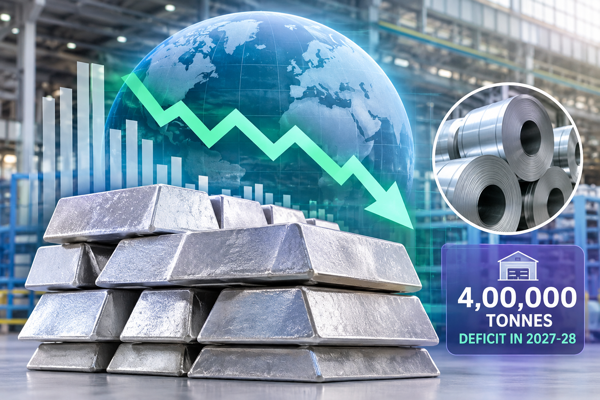
The global aluminium market is likely to experience a supply crunch through 2028, even as producers prepare to bring additional capacity online. According to Emkay Global Financial Services, an annual deficit of around 400,000 tonnes has been estimated in both 2027 and 2028. Although capacity additions and the smelter restarts by Emirates Global Aluminium (EGA) and Aluminium Bahrain (Alba) in the Middle East, low inventories, rising production costs and supply disruptions are expected to keep aluminium availability constrained. As expectations of improving supply have risen, global aluminium prices have fallen. This quarter has seen an 8.4 per cent decline so far. However, the correction may not be a testament to an improvement in metal availability. London Metal Exchange (LME) aluminium...
Novelis has commissioned a new waste heat recovery system at its Nachterstedt aluminium recycling plant in Germany, with the EUR 2.6 million (USD 2.86 million) investment expected to generate approximately 8.2 million kilowatt-hours (kWh) of electricity annually. The system will convert heat generated during aluminium scrap processing into electricity, potentially meeting around 15 per cent of the facility's annual power demand while avoiding an estimated 3,000 metric tonnes of CO2e emissions each year. The new system captures waste heat produced during decoating, a stage of aluminium recycling in which coatings and other organic materials are removed from scrap before the metal is remelted. Instead of allowing this heat to go unused, the technology converts it into electricity for...
Grow with
AL Circle

India is exactly in the middle of energy transition, with its non-fossil fuel capacity exceeding 50 per cent of the national power mix. By 2032, the aim is to achieve 68 per cent of renewable and nuclear power capacity of the total energy mix. With this, the wake-up call for energy-intensive industries becomes explicit that the adoption of renewable energy is no longer optional. Particularly for the aluminium industry, which is one of the most electricity-hungry industrial sectors, the implications are sharp, but the path is far from straightforward. India’s reliance on coal and why so Not judging, but Indian aluminium industry is still heavily reliant on coal-fired electricity for its operations. Reasons are many, such as the need for round –the-clock power supply. An aluminium smelter...

ABx Group’s subsidiary ALCORE has secured full funding to go ahead with its hydrogen fluoride pilot plant in Tasmania. The plant, planned for the ALCORE Technology Centre beside Rio Tinto’s aluminium smelter in Bell Bay, will demonstrate a process to extract hydrogen fluoride from the by-products of aluminium smelting. This is indeed the next major step in ALCORE’s effort to commercialise a technology that has been under development for several years. ALCORE secured the lease for the Bell Bay facility in early 2025, giving it a 500 square meter industrial site directly adjacent to the smelter that will provide the by-product feedstock. The project’s financial base was further strengthened by a conditional loan from the Tasmanian Government and federal support through the Modern...

Premier Energies’ joint venture, Premier-Green Aluminium, is on the road to invest INR 600 million (USD 6.7 million). This investment will be rolled out in rounds of funding to push the use of aluminium frame projects, aiming to enhance the country’s solar module manufacturing. To achieve this vision, the firm has issued 25 thousand equity shares with each valued at INR 10 (USD 11), which marks the total value of the shares to be INR 250 thousand (USD 2,793.61) for Nuevosol Energy, its joint venture partner. After allotting the equity shares, Premier Energies will hold a total of 80 per cent ownership, and Nuevosol Energy will hold the remaining 20 per cent. To produce solar module frames which are purely made of aluminium and its alloys, Premier-Green Aluminium was formed. At present,...

The United States should be living through a renaissance in aluminium. Data centers, electric vehicles and the wider clean-energy buildout are pulling unprecedented volumes of the metal into server racks, cooling systems, power grids and vehicle frames. Prices have strengthened, and shares of Alcoa and Century Aluminum have rebounded after last spring’s tariff shock. Yet the companies behind the country’s remaining smelters say the boom is slipping away from them just as demand surges. The problem is electricity. Turning alumina into metal requires vast, steady power — roughly 14 megawatt-hours for every tonne of aluminium. A single modern smelter draws as much energy as a mid-sized American city. For decades, the economics worked only when smelters locked in long-term power at around USD...

Alspec, Alspex, and Rio Tinto have recently come together to enhance a closed-loop aluminium recycling programme, aimed at supporting local industry with raw materials, help them reduce emissions, and strengthen low-carbon supply chain in Queensland. The initiative is called 20-13 as the aluminium content in the final product is supposed to be a minimum of 20 per cent. As part of the initiative, all the aluminium scrap generated from Alspec and Alspex would be collected and sent to Rio Tinto’s Boyne Smelters Limited (BSL) in Gladstone for the manufacture of aluminium billets with 20 per cent recycled content. These converted billets would then be destined to Alspex for being extruded into new aluminium profiles, and finally transported to local manufacturers for making windows, doors, and...

The Indian Union Cabinet is providing a total of INR 7,280 crore (USD 815.0 million) scheme, which is designed to promote the country’s manufacturing prowess of rare-earth permanent magnets. The country’s Prime Minister, Narendra Modi, has given his approval for the initiative, popularly known as “Scheme to Promote Manufacturing of Sintered Rare Earth Permanent Magnets.” The main agenda of the scheme is to boost domestic production, reduce dependency on imports and uphold sectors like electronics, automotive and renewable energy. Information and Broadcasting Minister Ashwini Vaishnaw told reporters, “The scheme will promote the manufacturing of rare-earth permanent magnets. The aim is to create a capacity of 6,000 MTPA (metric tonne per annum)." Within industries like electric vehicles,...

Norsk Hydro has revealed its plans for a major restructuring of its European Extrusions business, putting forward a proposal to close five manufacturing sites across the region. The company says the move is intended to consolidate its footprint and reinforce competitiveness in what it describes as a challenging market environment. Image for representational purposes only Explore- Most accurate data to drive business decisions with 50+ reports across the value chain As per the official disclosure by the brand, operations would cease at Hydro Extrusions’ plants in Cheltenham and Bedwas in the UK, Lüdenscheid in Germany, Feltre in Italy, and Drunen in the Netherlands. Consultations with employee representatives are set to begin immediately, and if the plans are confirmed, the facilities will...

JPMorgan expects aluminium price may get close to USD 3,000 per tonne in early 2026, helped by stronger copper prices and a market that, for now, looks reasonably tight. But several analysts say the outlook becomes much less straightforward once Indonesia’s new supply starts landing, and that may happen faster than the market is prepared for. For years, Indonesia has talked about becoming a major aluminium producer. What’s different now is that many of the long-promised projects are actually close to starting up. Smelters, refineries and upstream investments are advancing at the same time, creating a level of momentum that could reshape the regional market. Two of the projects — backed by Bintan Alumina Indonesia and Borneo Alumina Indonesia — are pushing the country’s alumina output...

Norsk Hydro entered its 2025 Investor Day with a clear message: the company is prepared to navigate tougher markets while staying on course with its long-term plan for a greener aluminium value chain. Over the past year, Hydro has continued executing its 2030 strategy despite unpredictable demand patterns, relying on a mix of cost cuts, capacity reshaping and renewable investments to secure future growth. The centrepiece of this year’s update is a major tightening of the Extrusions footprint in Europe. Hydro plans to close five plants across the region as part of a consolidation effort designed to improve capacity utilisation and trim operating costs. The move carries an estimated restructuring charge of NOK 1.9 billion ( USD 190 million) but is expected to deliver NOK 0.5 billion ( USD...

An Asian automotive giant has leveraged aluminium-wound motor technology designed by Newcastle-based Advanced Electric Machines (AEM) for potential use in high-volume passenger vehicles, following the vulnerable copper supply chain affecting the global EV industry. Where performance and price once dominated decision-making in the EV industry, procurement considerations have now taken centre stage. The volatility in the mineral geopolitics has made the situation even more vulnerable. Copper, which has so far been a default choice for motor windings, has now become a point of vulnerability, with almost 50% of copper’s global refining capacity being concentrated in one region. This has exposed automakers to strategic blockage and price concerns. Explore- Most accurate data to drive business...

Recent UK research conducted by Every Can Count (ECC), a recycling not-for-profit organisation, has revealed a shocking generational divide in recycling awareness and support for the Deposit Return Scheme (DRS). Despite Gen Z’s (from the age group of 16 to 28) reputation for having a strong voice for environmental well-being, they are found to be less responsive to the DRS system. The survey, ahead of the launch of the UK’s own DRS system in 2027, shows only 59 per cent of Gen Z are supportive of Deposit Return Schemes (DRS), compared to 77 per cent of boomers, falling in the age group of 55 to 74. This finding is astonishing, especially at a time when Gen Z are considered to be the flag bearer of climate protection and sustainability. Moreover, they are the ones more willing to pay a...

This week, the aluminium downstream sector has presented a mix of progress and challenges across global markets. In Europe, a rise in foil demand and some exciting new production technologies have surfaced. Meanwhile, the US is grappling with operational hurdles, Asia is experiencing a rollercoaster of market sentiment and South Africa is pushing forward with strategic modernisation efforts. Each region is at a pivotal moment. On top of that, global extrusion forecasts and India’s import-duty issues are adding more layers of complexity to the sector’s short-term outlook. All these developments paint a picture of a week filled with strategic changes, competitive pressures and shifting market signals, setting the stage for what could be a crucial time for aluminium’s value-added segments...

The aluminium sector across Africa and Asia (excluding China) has been gathering strength for three years now, and the momentum has carried cleanly into 2025. Over the first nine months of the year, the two regions produced 4.84 million tonnes of primary aluminium, supported by steady monthly output in the 504–544 thousand-tonne range and daily averages holding between 17.3 and 17.5 thousand tonnes. That consistency pushed cumulative production 1.55 per cent higher than in 2024 and 3.70 per cent above 2023, signalling a supply base that has become both more resilient and more predictable. According to International Aluminium Association, the quarterly numbers show the same quiet climb. The 2025, began with 1.59 million tonnes in Q1, edged up to 1.61 million tonnes in Q2, and reached 1.63...

Pahal Solar, a Surat-based solar panel module manufacturing firm, is eyeing to push backward integration to expand its solar panel module components portfolio. The company aims to augment its product range as well as manufacturing capabilities to strengthen the domestic supply chain for solar module components in line with the demand growth. This shift is also aligned with the wider industry trend of reducing import dependence and improving production stability. Ayush Sharma, Head – North India at Pahal Solar, explained the firm is preparing to scale up by deploying more efficient technologies and introducing new groundbreaking solar products. Pahal Solar currently operates with 2 GW of module capacity, and is working on adding an additional 2 GW capacity in the near term . Explore- Most...

Indian aluminium market witnesses a 0.64 per cent price drop to INR 270.45 per kilogram, owing to the declining demand from China, which is otherwise the world’s largest aluminium producer cum consumer. Along with deflating pricing in the Chinese market, the SHFE inventory rise of 7.67 per cent has also pressurised the market sentiment. To cushion the aluminium price’s free-fall, the US federal rate cut has weighed in, supporting broader commodity sentiment. Image for representational purposes only Explore- Most accurate data to drive business decisions with 50+ reports across the value chain China is experiencing a structural and cyclical economic slowdown. This is not a typical, short-term dip but a complex deceleration from its previous high-growth phase. Both the country’s overall...

Maan Aluminium, an India-based manufacturer and trader of aluminium profiles, has reportedly advanced to a year-high in intraday trading, standing above INR 160 (USD 1.79). This peak follows back-to-back gains in the past three days from INR 132.41 (USD 1.48) on November 24 to INR 149.12 (USD 1.67) on November 27. Hence, until the moment, Maan Aluminium has recorded a hike of 21.5 per cent since November 24, delivering an 18 per cent return to shareholders. The report says the company opened the trading session this morning with a gap of 4.36 per cent, signalling robust buying sentiment in the market. Also, the company’s performance compared to its peers from other metal sectors by leading with a stock price above 4.81 per cent also indicates strength within the non-ferrous metals...

In a major push towards sustainable operations, Vedanta Limited Aluminium has expanded its lithium-ion electric forklift fleet to 142 units across Odisha and Chhattisgarh facilities. Doubling its previous totals, this move is one of the remarkable sustainability pushes of the country’s biggest aluminium producer, further strengthening its position with India’s largest electric forklift fleet. The announcement coincides with World Sustainable Transport Day on November 26, an annual UN observance that highlights the importance of safe, accessible and environmentally responsible transport networks to support socio-economic development in the coming years.. This year’s theme resonated well at Vedanta Limited, where sustainable mobility is increasingly viewed as an essential pillar of wider...

The London Metal Exchange (LME) aluminium prices on November 27 showed a slight uptick. On the other hand, the LME inventory showed a mixed trend. The LME cash bid and offer moved up by USD 18.5 per tonne or 0.65 per cent, where each reached USD 2,803.5 per tonne and USD 2,804 per tonne. The 3-month contract also strengthened, where both the bid and offer inched up by USD 20.5 per tonne or 0.7 per cent to finally settle at USD 2,827.5 per tonne and USD 2,828 per tonne, respectively. Explore- Most accurate data to drive business decisions with 50+ reports across the value chain. A similar trend is seen in the December 26 contract, where both on November 27 increased by USD 16 per tonne or 0.55 per cent, with a bid at USD 2,862 per tonne and an offer at USD 2,867 per tonne. The LME...