











As global industries accelerate decarbonisation, embrace circular economy practices and seek lower-carbon raw materials, demand for recycled base metals, especially aluminium, is expected to increase significantly. This growth presents considerable opportunities for base metal recyclers. However, it also brings a critical business challenge into sharper focus: Managing price uncertainty without compromising profitability.
Market price fluctuations, currency movements and changes in scrap premiums can directly influence inventory valuations, profit margins and contract pricing. Even when operational performance remains strong, these market movements can affect the financial outcome of a transaction. Consequently, hedging is increasingly becoming a practical risk management tool rather than a concept reserved for just the financial markets.
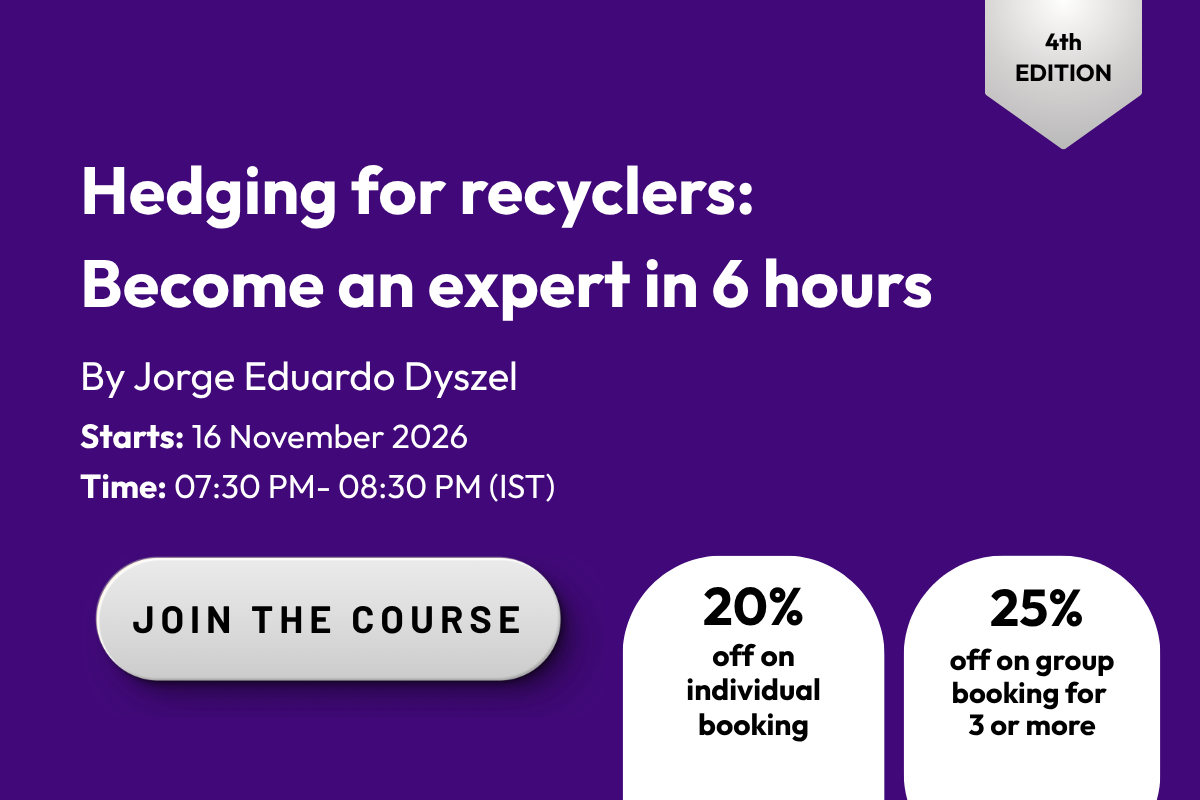
To help industry professionals understand this changing landscape, AL Circle, in collaboration with Jorge Eduardo Dyszel, an LME-certified Risk Management Consultant, is coming back with the fourth edition of “Hedging for recyclers: Become an expert in 6 hours” course.
Designed for base metal recyclers, scrap traders, procurement professionals, commercial managers and finance teams, the course will focus on understanding price exposure, building effective hedging strategies, managing currency risks and making better-informed commercial decisions in volatile markets.
Hedging is about managing uncertainty, not speculation
For base metal recyclers, adapting hedging strategies has now become more about managing exposure to unfavourable market movements. It can help businesses reduce uncertainty, protect inventory values, stabilise margins and make purchasing and selling decisions with greater confidence.
Rather than reacting to every market movement, companies can establish a structured approach to identifying and managing price risks. This enables them to evaluate potential exposure before committing to transactions and make commercial decisions with a clearer understanding of the risks involved.
A six-session learning course tailored to all recyclers
Understanding hedging requires more than theoretical knowledge. Businesses need to recognise where their exposure originates, evaluate suitable risk mitigation instruments and understand how these tools can be applied in real commercial situations. The six-session course is structured to take participants from the fundamentals of price volatility to the development of an integrated risk management framework.
Session 1: Understanding prices, risk and volatility
Objective: To understand how commodity prices are determined and why market volatility matters to recycling businesses.
Key takeaways:
- The fundamentals of commodity price formation.
- The factors contributing to volatility in metal markets.
- How price fluctuations influence recycler margins.
- The effects of market movements on inventory values and commercial decisions.
Session 2: Recycler business dynamics and price fixation
Objective: To identify potential risk exposure within the recycling business model and understand the implications of price fixation.
Key takeaways:
- Analysing the recycler business model and identifying exposure points.
- Understanding different pricing mechanisms.
- Evaluating the timing of price fixation.
- Recognising operational reasons for implementing risk mitigation measures.
Session 3: Managing price risk through futures
Objective: To learn how futures contracts can be used to manage metal price exposure in recycling operations.
Key takeaways:
- Understanding futures-based hedging strategies.
- Applying hedging techniques in volatile market conditions.
- Examining practical examples of risk management.
- Understanding mismatches between physical transactions and hedging positions, as well as non-performance scenarios.
Session 4: Applying hedging through practical exercises
Objective: To put hedging principles into practice through market-based scenarios and commercial simulations.
Key takeaways:
- Exercises focused on reducing price exposure.
- Practical aluminium hedging scenarios.
- Examples involving copper and lead.
- Commercial simulations reflecting the risks faced by recyclers.
Session 5: Understanding options for recyclers
Objective: To explore how options can offer flexibility when managing price risk.
Key takeaways:
- Introduction to options markets.
- The application of call and put options.
- Using options to help protect profit margins.
- Understanding how options can preserve opportunities to benefit from favourable price movements.
Session 6: Developing an integrated risk management policy
Objective: To understand how to establish a practical internal framework for managing commercial risks.
Key takeaways:
- Developing a structured risk management policy.
- Establishing appropriate internal controls.
- Integrating risk assessment into commercial decision-making.
- Implementing practical risk governance processes.
A course to mitigate risk & yield long-term business value
As base metal markets become increasingly interconnected, price movements can have implications across sourcing, inventory management, sales contracts and profitability. Operational efficiency remains essential, but it must be supported by informed commercial decisions.
Businesses that understand their price exposure and implement suitable risk management practices can be better positioned to protect margins, negotiate contracts with greater confidence and respond to changing market conditions.
Whether a recycling company is beginning to explore hedging or looking to strengthen its existing risk management framework, practical knowledge of commodity markets can help build a more disciplined approach to commercial risk.
Register for the course, “Hedging for recyclers: Become an expert in 6 hours” and bridge the gap between theoretical understanding and real-world application.